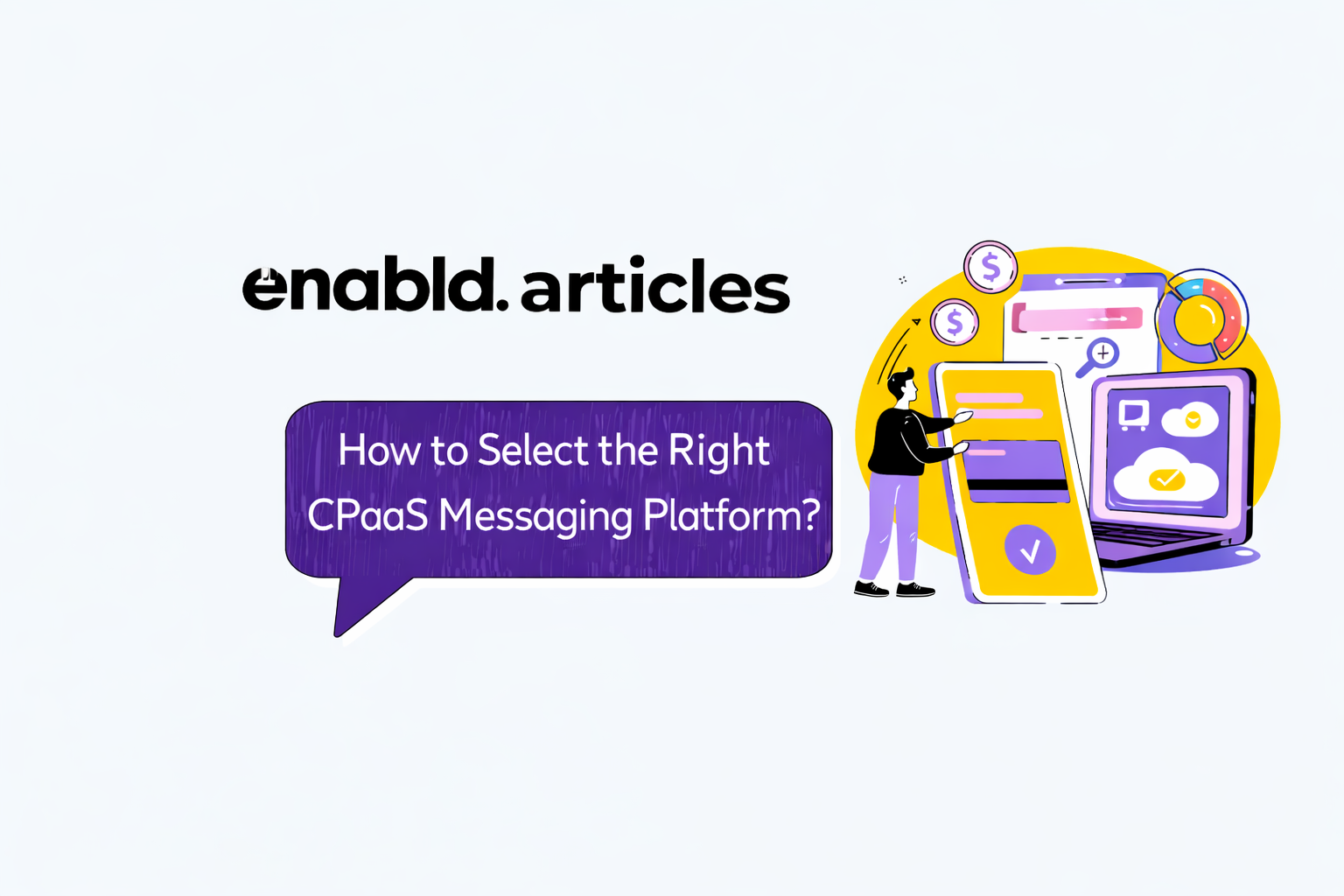
Choosing a CPaaS messaging platform isn’t just about ticking off a long list of features. It’s about finding a trusted partner that grows with your business, keeps your data safe, and blends smoothly into your existing cloud communication setup.
According to a report, the global CPaaS market was valued at USD 12.50 billion in 2022 and is projected to reach USD 45.30 billion by 2027, growing at a 29.4% CAGR driven by demand for improved customer service and client engagement.
A well-chosen CPaaS platform becomes the backbone of your customer communication, powering everything from OTPs and alerts to WhatsApp conversations and large-scale campaigns without constant firefighting.
In this blog, we will explore key factors to consider, from scalability and security to seamless integrations and real-world reliability, helping companies make a smart choice that drives customer engagement without the headaches.
Table of Contents
- What Is a CPaaS Messaging Platform?
- Key Steps to select the Right CPaaS Messaging Platform
- Where the Cloud Communication Platform Fits in Your Stack
What Is a CPaaS Messaging Platform?
A CPaaS (Communications Platform as a Service) is a cloud-based communication model that lets businesses implement real-time messaging and calling into their products and workflows using Communication APIs for enterprises. |
With CPaaS, businesses can directly plug into a ready-made cloud platform to prioritize customer journeys and business logic, instead of focusing on building telecom infrastructure from scratch.
A strong CPaaS provider generally provides bundle channels like SMS, WhatsApp, voice, email, RCS, and push notifications with automation, templates, analytics, and integrations, enabling teams to launch use cases fast and scale confidently.
Key Steps to select the Right CPaaS Messaging Platform
Dimension | What to Consider |
Use Case | Current communication landscape and future goals. |
Channels & Features | SMS, WhatsApp, email, voice, two-way messaging, automation, analytics, and campaign tools. |
Scalability & Reliability | Cloud-native design, redundancy, routing quality, and performance at peak volumes. |
Security & Compliance | Certifications, encryption, data residency, consent tools, and anti-fraud/spam protections. |
Integrations & Developer Experience (DX) | API quality, SDKs, docs, connectors, and ease of embedding Communication APIs for enterprises. |
Pricing & Transparency | Clear rates, minimal hidden fees, volume discounts, and predictable growth paths. |
Support & Roadmap, Enablement & White-Label | Robust support SLAs, expert access, customer success managers, and ongoing product roadmap. Multi-tenancy, custom branding, and tools tailored for CPaaS providers and service resellers. |
Picking the right CPaaS messaging platform sets the foundation for scalable customer engagement. Here’s a straightforward guide to the essential steps and considerations.
Start with Your Use Cases, Not Features
Before considering any CPaaS platform, you must map your current communication landscape and future goals. This prevents overbuying features or choosing a platform that looks great in a demo but falls short in production.
Start with these main categories:
- Transactional messaging: OTPs, order confirmations, delivery updates, password resets, account alerts, and policy notifications.
- Marketing and lifecycle campaigns: Promotional SMS, festive campaigns, cart recovery flows, event reminders, and loyalty updates powered by an Enterprise SMS platform.
- Customer service and support: Two-way messaging for support tickets, appointment reminders, feedback surveys, and field service updates.
- Internal operations: Workforce alerts, incident notifications, logistics coordination, and system health alerts across your cloud communication ecosystem.
For each use case, note which channels you rely on currently (like SMS + WhatsApp), who’s in charge (marketing, product, support), and key goals (fast delivery, replies, conversions, happy customers, etc.). This checklist helps you find out if a CPaaS really matches your needs.
Channels and Features
Once you know your use cases, you can compare different CPaaS solutions providers directly. Many vendors claim multiple channels, yet quality and features aren’t equal.
Here, you must look for:
- Multichannel messaging: Native support for SMS, WhatsApp Business, voice, email, and push notifications, all managed from a single platform.
- Two-way capabilities: Inbound and outbound messaging, long and short codes, virtual numbers, and the ability to build conversational experiences using chatbots, or escalation to agents.
- Campaign and automation tools: Scheduling, segmentation, triggers, workflows, and templates that allow users to build journeys without writing code every time.
- Analytics and reporting: Track deliveries, engagement, funnels, and export data straight to your data warehouse or reporting systems.
- Specialized products: A Wholesale SMS platform for aggregators and operators, or an Enterprise SMS platform for brands that need deeper campaign controls and reporting.
Scalability, Reliability, and Telecom-Grade Performance
Even the most elegant API will fail if the platform crashes under peak traffic or international loads. This is where a telecom CPaaS solution should stand apart from generic messaging tools.
Questions to ask:
- How does the platform scale when you double or triple traffic, such as during holiday campaigns or peak onboarding seasons?
- Does the CPaaS provider use direct operator connections, smart routing, and redundancy to maintain high delivery rates and low latency at volume?
- Can they serve both wholesale and enterprise scenarios, i.e., acting as a Wholesale SMS platform for partners while still supporting rich enterprise messaging solutions under the same umbrella?
Security, Compliance, and Trust
Messages often contain sensitive data, so security should be the major consideration. When you evaluate a CPaaS platform company, Pick the same way would choose any core infrastructure provider.
Key aspects to evaluate:
- Security standards: Certifications, secure development practices, and rigorous incident management.
- Data protection: Encryption for data in transit and at rest, strong authentication, role-based access controls, and audit logs.
- Compliance: Tools and features that help you manage consent, opt-in/opt-out flows, and regional messaging rules, which is important when using a CPaaS solution for communication service providers operating across multiple countries.
Integration, Developer Experience, and Day-to-Day Operations
A CPaaS platform shines when your team can integrate and use it effortlessly. Great developer tools and ops features speed up results and keep everyone happy long-term.
Focus on:
- Developer experience: Clean REST APIs, clear error messages, SDKs in popular languages, sample code, and well-maintained documentation.
- Integration ecosystem: Connectors or guidelines for CRMs, helpdesk tools, e-commerce platforms, marketing automation, and internal systems, including standard Communication APIs for enterprises.
- Operational tools: A web console where non-technical users can manage templates, campaigns, numbers, routing rules, and reporting without raising tickets every time.
For operators and aggregators, an advanced telecom CPaaS solution should also support multi-tenant management, partner portals, margin control, and full visibility into traffic across your cloud communication ecosystem.
Pricing, Transparency, and Total Cost of Ownership
CPaaS pricing looks simple—per message, minute, or chat—but it’s more complex. Therefore, when comparing one CPaaS provider with another, look beyond just the base rate.
Points to clarify:
- Rate structure: Per-channel pricing for SMS, voice, email, and other channels, along with surcharges, country-specific pricing, and special routes.
- Platform and support fees: Any minimum commitments, monthly platform fees, or paid support tiers that might significantly affect your total bill.
- Volume and growth: How pricing scales as you send more traffic, launch new regions, or add resellers and sub-accounts, especially when using a CPaaS solution for communication service providers and their downstream customers.
- Also consider the cost of doing nothing: A cheaper provider with weak routing, poor analytics, or limited automation might end up costing more in lost revenue, operational effort, and customer dissatisfaction.
Partnership, Roadmap, and Long-Term Fit
Picking CPaaS is an ongoing process, not a one-off call. As your messaging strategy matures and new channels or regulations appear, you need a partner that helps you move ahead.
When you compare CPaaS solutions provider options, pay attention to:
- Support quality: Response times, escalation paths, dedicated account managers, and the availability of solution architects for complex setups.
- References and track record: Case studies, testimonials, or customer logos in your industry or region, especially if you need the best CPaaS platform for telecom operators or large-scale enterprises.
- Product roadmap: How quickly they add channels, support new regulations, improve analytics, or expand enablement features like white-labeling and multi-tenancy.
If you are a service provider, prioritize a CPaaS enablement platform that lets you launch your own branded CPaaS platform company, offering Communication APIs for enterprises under your logo while the vendor handles the heavy lifting behind the scenes.
Where the Cloud Communication Platform Fits in Your Stack
Think about where CPaaS fits in your overall tech and business architecture. The right platform should:
- Act as a central layer that connects your apps, CRM, billing tools, and customer-facing systems through APIs and webhooks.
- Support both enterprise messaging solutions and wholesale messaging business models in a single, coherent environment.
- Let operators and aggregators evolve into full CPaaS providers, or empower digital businesses to supercharge their apps with seamless communication.
Enabld is one such platform that can help you build an ecosystem view for modular, open, scalable growth. This mindset shifts you from isolated tools to interconnected platforms that evolve with your business. It ensures seamless integration across channels, while supporting multi-tenancy and white-label customization for CSPs and aggregators.
Ready to transform? Visit https://www.enabld.tech/contact-us/ today.
To Sum Up
An SMS solution for enterprises that includes a telecom-grade SMS Gateway platform, SMS routing platform, and wholesale SMS gateway capabilities becomes the central hub for all A2P messaging, including multichannel use cases.
When connected with WhatsApp Business API and supported by ss7 solutions from a reliable ss7 service provider, it enables carrier-level delivery quality, intelligent routing, and rich conversational experiences in one unified stack.
This combination allows marketers to design sophisticated multichannel messaging strategies that boost reach, engagement, and ROI, while operations teams benefit from reliability, observability, and cost control at scale.
Ready to build your own messaging stack? Visit https://www.enabld.tech/ for more insights or schedule a demo today.
Frequently Asked Questions
1. Is a CPaaS platform only for large enterprises?
No. While large enterprises use CPaaS heavily, small and mid-sized businesses also rely on Communication APIs for enterprises to send OTPs, alerts, reminders, and marketing messages without building their own infrastructure.
2. How is a CPaaS provider different from a traditional bulk SMS vendor?
A traditional SMS vendor focuses mainly on outbound messaging, whereas a CPaaS provider offers a broader cloud communication platform with multiple channels, APIs, automation, and deeper integration options.
3. Why would a telecom operator use a CPaaS enablement platform?
A CPaaS enablement platform allows operators to launch their own branded CPaaS platform company, monetizing their network assets while offering enterprise messaging solutions and APIs to downstream customers and partners.
4. What is the role of a Wholesale SMS platform in CPaaS?
A Wholesale SMS platform is typically used by operators, aggregators, or communication service providers to manage high-volume SMS traffic across multiple routes, partners, and regions as part of a wider telecom CPaaS solution.
5. Do I need both an Enterprise SMS platform and other channels like WhatsApp or email?
If you care about engagement and customer experience, yes. An Enterprise SMS platform is great for reach and reliability, but combining it with WhatsApp, email, or voice in one omnichannel communication platform gives you much more flexibility.
6. How does a CPaaS solution for communication service providers help resellers and partners?
It offers multi-tenancy, branding, routing, billing, and analytics so CSPs can give their customers access to Communication APIs for enterprises and self-service tools while maintaining control over margins and infrastructure.
7. What should I check before calling a platform the best CPaaS platform for telecom operators?
Look for strong routing, direct carrier connections, high availability, white-label capabilities, Wholesale SMS platform features, and deep support for regulatory and compliance requirements in your key markets.
8. How does a cloud communication ecosystem improve long-term flexibility?
By treating CPaaS as part of a broader cloud communication ecosystem, you can plug in new channels, apps, and partners over time without ripping out your core platform, keeping your messaging strategy adaptable and future-proof.