In today’s digital economy, SMS messaging remains one of the most trusted communication channels in the world. Businesses use it for OTP verification, alerts, notifications, and marketing campaigns.
The global SMS and messaging services market estimated at approximately $70 billion in 2023, fueled by widespread mobile penetration and rapid enterprise adoption of transactional messaging. It’s projected to reach $150 billion by 2033, reflecting a CAGR of around 8.2% from 2026 to 2033, with transactional messages leading the segment due to their critical role in banking, e-commerce, and alerts. Telcos can’t afford to ignore this opportunity.
For telecom operators, building a carrier-grade SMS gateway platform is a major strategic opportunity. It allows telcos to take control of their messaging infrastructure, reduce dependency on aggregators, and increase revenue from the fast-growing A2P messaging market.
Instead of treating SMS as a basic service, telcos can turn it into a high-value business through a wholesale SMS gateway, serving enterprises, resellers, and global traffic.
This guide explains how to design, build, and scale a modern SMS routing platform with enterprise-grade reliability, security, and performance.
Understanding Carrier-Grade SMS Gateways
A carrier-grade SMS gateway platform handles massive volumes with 99.99% uptime, low latency, and full protocol support like SMPP and SS7. Unlike basic bulk tools, it acts as a wholesale SMS gateway and SMS routing platform, connecting enterprises to mobile networks while optimizing costs and quality. This telecom-grade SMS delivery gateway ensures messages flow seamlessly for OTPs, alerts, and campaigns.
Here’s what sets it apart in practical terms:
- Unmatched Reliability: Designed for telcos, it guarantees five-nines availability (99.999%) through redundant systems, ensuring zero downtime even during peak traffic surges like New Year promotions or election results.
- High-Volume Throughput: Supports high transactions per second (TPS) sustained performance, far beyond consumer gateways, powering massive A2P message volumes annually.
- Protocol Mastery: Full SMPP v3.4/v5 compatibility for enterprise binds, plus SS7/SIGTRAN for direct carrier interconnects, bypassing aggregators for faster delivery and better margins.
- Intelligent Features: Includes real-time routing based on network efficiency ratio (NER), automatic failover to backup routes, and delivery receipt (DLR) normalization across vendors.
- Global Reach with Compliance: Handles international numbering (E.164), mobile number portability (MNP) lookups, and region-specific rules like sender ID masking or content filtering to stay regulatory-compliant worldwide.
- Enterprise-Ready: Offers HTTP/REST APIs, self-service portals, and analytics dashboards, making it a versatile SMS solution for enterprises needing scalable, secure messaging.
In essence, this platform turns your telco network into a revenue-generating powerhouse, reliably delivering massive A2P messages while adapting to future shifts like RCS.
Why Telcos Need Their Own Platform
Telcos build their own platforms to earn more from their networks, reduce reliance on third-party aggregators, and provide SMS services directly to businesses. Direct access to an SS7 SMS gateway gives better delivery quality and reliability, often achieving 99.9%+ success rates compared to indirect routes.
The global A2P messaging market is expected to grow from $74.27 billion in 2025 to $125.79 billion by 2033, with steady annual growth of 7.2%. This growth is mainly driven by businesses increasingly using A2P messaging for customer communication. This data indicates that having scalable messaging infrastructure helps turn network connectivity into a strong revenue source.
SMS Gateway Architecture Overview
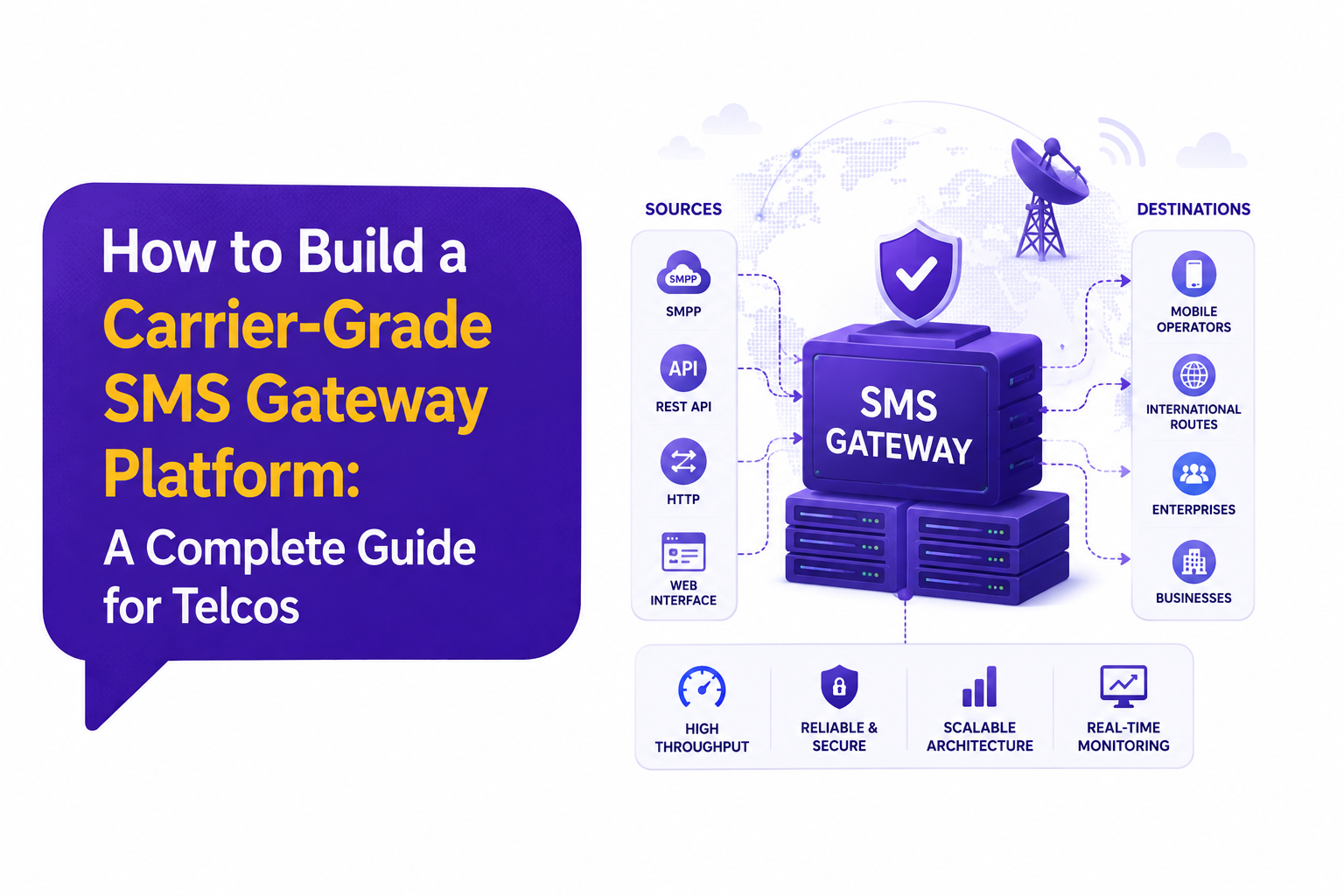
A robust SMS gateway platform starts with layered components for high-volume handling. Key building blocks include:
- Traffic Ingress Gateways: Accept SMPP v3.4, HTTP/REST APIs from clients and upstream providers.
- Routing Engine: Applies real-time rules based on country, operator, cost, or quality for least-cost routing (LCR).
- Load Balancer: Distributes traffic across SMSCs to prevent overloads, supporting failover.
- SMPP Session Controller: Manages binds, retries, and window sizes for stable sessions.
- DLR Processor: Normalizes delivery reports from vendors into unified status.
- Compliance Engine: Filters spam, enforces sender IDs, and handles MNP lookups.
Use message queues like Kafka for buffering and NoSQL databases for analytics. This setup scales to tens of thousands of TPS.
Integrating SS7 for Direct Carrier Connectivity
SS7 (Signaling System 7) is a core telecom protocol used for global communication between operators. In a carrier-grade SMS gateway, SS7 enables direct operator connectivity without relying on intermediaries.
Advantages of SS7 Integration
- Direct routing between telecom operators
- Improved delivery speed and reliability
- Reduced dependency on external aggregators
- Better control over international SMS traffic
- Higher efficiency in wholesale SMS routing
Modern systems often use SIGTRAN-based transport, which allows SS7 signaling over IP networks, making it more scalable and flexible.
Intelligent Routing in SMS Platforms
An intelligent SMS routing system is the brain of a modern messaging platform. It dynamically selects the best route for every message. Instead of fixed routing, it uses real-time data to optimize delivery.
Routing Decision Factors
- Network performance and stability
- Vendor quality and historical success rates
- Latency and delivery speed
- Cost efficiency
- Operator availability
Advanced Routing Capabilities
- Automatic failover routing
- Vendor scoring systems
- Real-time MNP lookup for correct operator detection
- Priority routing for enterprise traffic
- Least-cost routing for promotional traffic
This ensures high-quality delivery while optimizing costs across the network.
Scalability and High Throughput Design
Carrier-grade SMS platforms must operate continuously and handle large volumes of traffic without interruptions. A strong platform should support high message capacity, fast delivery, and reliable uptime.
Key strategies include:
- Geo-redundant active-active infrastructure
- Auto-scaling message queues
- Traffic throttling and rate control
- Distributed processing architecture
- Real-time performance monitoring
These systems ensure that the SMS gateway platform remains stable even during peak traffic conditions.
Security, Compliance, and Monitoring
Security is a core requirement for any enterprise SMS solution. Telecom platforms must protect against fraud, spam, and unauthorized traffic.
Security Measures
- Content filtering and blacklisting
- Fraud detection systems
- Consent and opt-in enforcement
- Country-specific compliance rules
- Multi-tenant isolation for enterprise clients
Monitoring Systems
- Real-time traffic dashboards
- Delivery performance tracking
- Cost and revenue analytics
- Automated anomaly alerts
These tools ensure that the platform remains secure, compliant, and reliable at all times.
Deployment Strategy for Telcos
Building a carrier-grade SMS gateway platform requires a structured deployment approach.
Step-by-Step Deployment
- Define traffic requirements and business goals
- Select technology stack (open-source or white-label solution)
- Deploy core SMS routing infrastructure
- Integrate SS7 and SMPP connectivity
- Enable enterprise APIs and portals
- Conduct load and stress testing
- Launch in controlled environments
- Scale infrastructure with redundancy
This phased approach minimizes risk while ensuring system stability.
Enterprise SMS Solutions
A modern SMS gateway platform is not just infrastructure. It is also a full enterprise communication solution.
Enterprise Features
- Self-service SMS dashboards
- Bulk SMS campaign management
- Two-factor authentication (2FA) systems
- CRM and API integrations
- Pre-built messaging templates
Industry Use Cases
- Banking: OTP and transaction alerts
- E-commerce: order updates and delivery notifications
- Healthcare: appointment reminders
- Logistics: shipment tracking updates
- Retail: promotional campaigns
Because SMS works across all mobile devices, it remains one of the most universal communication channels.
Monetization and Future-Proofing
A wholesale SMS gateway platform creates multiple revenue streams for telcos.
Monetization Models
- Pay-per-message pricing
- Subscription-based API access
- Volume-based enterprise pricing
- White-label reseller programs
Expanding Revenue Opportunities
Beyond traditional SMS, telcos can expand into:
- RCS (Rich Communication Services)
- 5G messaging ecosystems
- Advanced analytics services
- Global enterprise messaging networks
- Premium routing services
As the A2P messaging market continues to grow, scalable infrastructure becomes a long-term revenue engine for telecom operators.
Conclusion
Building a carrier-grade SMS gateway platform allows telcos to transform messaging into a high-value digital service. By combining SS7 connectivity, SMPP infrastructure, and intelligent routing systems, operators can achieve: better delivery performance, stronger enterprise relationships, higher revenue from A2P messaging, and future readiness for RCS and 5G messaging
With the right architecture and strategy, telcos can evolve from connectivity providers into full-scale global messaging service platforms.
Ready to build your telecom-grade SMS delivery gateway? Partner with proven SS7 solutions providers or deploy a white-label SMS routing platform today.
Contact experts at Enabld to launch your wholesale SMS gateway and unlock enterprise messaging profits now!