CPaaS works in different ways in conjunction with telcos or communication service providers. One model follows the path in which CPaaS providers offer services directly to clients while accessing a telco’s backend infrastructure. Obviously, telcos cannot hope to gain brand recognition. The other model is CPaaS-enabled services in which the CPaaS providers offer the cloud platform and a white-label CPaaS stack to telcos, interfacing seamlessly with the telco’s hardware stack. Telcos can then push rich communication, video, voice, 2-way interactive SMS, WhatsApp & messaging, document transmission, and other features under an omnichannel platform to their enterprise clients based on the CPaaS platform. There are dozens of CPaaS providers, and the question arises: How do telcos and communication service providers vet a CPaaS provider offering enabled services? This guide should be of help in deciding on the best CPaaS provider for your telecom operations.
The essentials
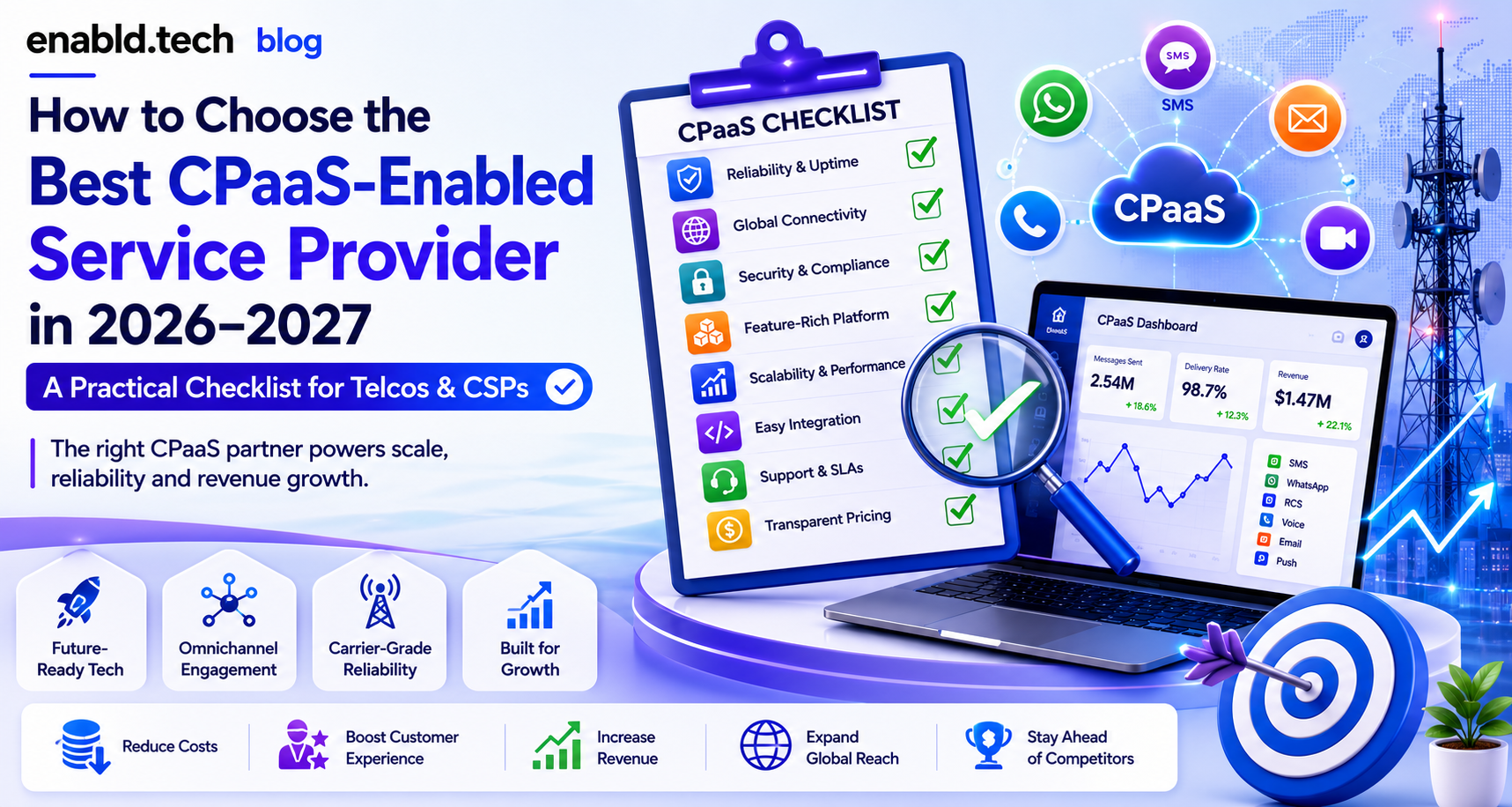
Telecom operators operate on a large scale and handle a massive amount of traffic. As such, the prime essentials to look for are the following:
- Failover and redundancy in routing paths to ensure transmission takes place.
- Low latency: Communication spans video, voice, real-time messaging, and more these days. Lags and delays are simply intolerable, especially when networks must handle sudden surges in traffic.
- Uptime: Any CPaaS that cannot guarantee 99.99% uptime is not worth considering.
- Deep integration: CPaaS providers must have the capability to deeply integrate their software, APIs, SDKs, and platform into that of the carrier’s infrastructure and must also offer tier-1 connectivity with mobile network operators around the world.
- Seamless omnichannel programmable interfacing: Users these days use email, SMS, WhatsApp, Telegram, Viber, WeChat, and other channels, all of which should be available and seamlessly integrated into the dashboard with the facility to track conversations and store data.
- Artificial intelligence integration: This works across layers such as fraud detection, SIM changes, number verification, chatbots, voice AI, transcription, insight generation, and analysis as well as predictive capabilities.
- Security: The importance of absolute security and protection cannot be overemphasized considering that communication channels transmit vital financial and personal data. For instance, SMS is used to transmit OTPs and passwords that should be proof against theft or hacking.
- A proven, time-tested, white-label software package built with an accent on modularity in order to be able to handle the communication side and another facet that handles the customer side. The CPaaS software must also have a self-serve dashboard that the telecom operator and their clients can use to customize usage, manage campaigns, and provision numbers. For instance, a telco may wish to set up virtual DID numbers, or an enterprise may wish to set up an SMS campaign for specific target groups and regions. Telcos also need software that incorporates call data records that can be used for automatic billing in various currencies and languages. There is plenty to check for, but if you choose Enabld, you get the whole package with all the bells and whistles and more.
With this checklist you have covered the essentials. However, there is more to look for.
The CPaaS provider as a company
The CPaaS platform is only as good as the company and its team. Your checklist here should cover aspects like the following:
- How long has this company been in the CPaaS field? A decade is a good indicator of expertise and trustworthiness.
- What about its team? Tech experts drawn from the telecom industry and software developers with exceptional skills in using tools specific to communications, infrastructure, and location need to be evaluated before you settle on one particular CPaaS provider.
- What do their existing clients have to say? Take a look at reviews and testimonials by clients. A CPaaS provider will give references and encourage you to find out about their service from their clients.
- Do their strengths and areas of expertise match your service needs? Some CPaaS providers are experts in some areas like SMS and voice but may lack data integration or AI integration capabilities, for example.
Going beyond the package
CPaaS is sufficiently mature, and existing CPaaS providers can be said to be quite technically capable of meeting telco/communication service providers’ requirements in all parameters. However, one must also go beyond the standard scenario and consider issues that may arise unexpectedly. A telco may need specific functionalities that require developers to use various platforms to come up with a solution. Enabld, for instance, offers telecom managed services covering consulting and engineering assistance to build or improve telecom products. They use platforms like Kubernetes with Helm, Argo, Java Spring Boot, Azure, Terraform and Node JS with experts capable of using these to deliver required solutions. Enabld’s capability in protocol and standards management translates to seamless experiences and higher security. Expertise in these areas leads to assurance of customized front and back-end development, especially in core APIs. It does not end when a CPaaS delivers white-label software but goes beyond in helping telcos tailor experiences the way their enterprise users need it.
Service with a smile
It is par for the course for CPaaS enablers to set up the software and interface at the telco’s end and integrate SDKs and APIs as may be required. However, given that telcos use a mix of old and new hardware and software and that they may encounter issues once CPaaS is operationalized, service becomes important. Can you get prompt services from the CPaaS enabler that resolve your issues immediately every time and any time?
AI integration
CPaaS-enabled service providers must, by now, be in a position to integrate AI into their packages covering areas such as
- Voice-to-text transcription, text-to-speec, analysis of interactions, sentiment analysis, and predictions of a customer’s reaction.
- AI for security and fraud detection, spam filtering, number identification, identity verification
- AI for smart routing and network optimization, which goes beyond instance-by-instance least-cost routing to acquiring predictive routing capabilities based on analysis of past behaviors.
Pricing model
Most CPaaS providers offer either a subscription model or a pay-as-you-go model or a combination of both. Importantly for telcos, the white-label software that CPaaS enablers provide must have extreme flexibility in selection and allocation of communication modules to clients, rates for each, rate slabs, currency, and language options.
Conclusion
What is current today may become obsolete tomorrow. Telcos may have a set of requirements today, but these could change in the face of evolving end-user requirements, and CPaaS must be agile and nimble to adapt and change. Does your CPaaS provider have agility like Enabld does? Wish to more about how to select your CPaaS? Reach out to us for help.