Every CPaaS vendor’s sales deck claims carrier-grade reliability, global reach, and best in class support. The differences that actually matter, route quality, fraud protection depth, real pricing behavior at scale, only become visible once traffic is live, and by then switching vendors is expensive and disruptive. That is exactly why telecom operators and CSPs need a structured way to evaluate options before signing anything, rather than comparing feature lists alone.
This guide walks through how to choose a CPaaS vendor using a practical 10-point checklist, followed by the RFP criteria and procurement steps that turn evaluation into an actual decision.
| Quick Answer: Choosing the right CPaaS vendor comes down to verifying network coverage and interconnect quality, multi-protocol support, built-in fraud protection, omnichannel capability, white-label flexibility, uptime guarantees, compliance support, transparent pricing, developer experience, and onboarding support, rather than relying on marketing claims alone. |
Why CPaaS Vendor Evaluation Needs a Structured Process
A CPaaS vendor becomes core infrastructure the moment traffic goes live, which means a bad choice does not just cost money, it costs time, engineering effort, and customer trust to unwind. A structured cpaas vendor evaluation process forces every vendor to answer the same set of questions, which makes proposals genuinely comparable instead of each vendor framing the conversation around whatever they happen to do best.
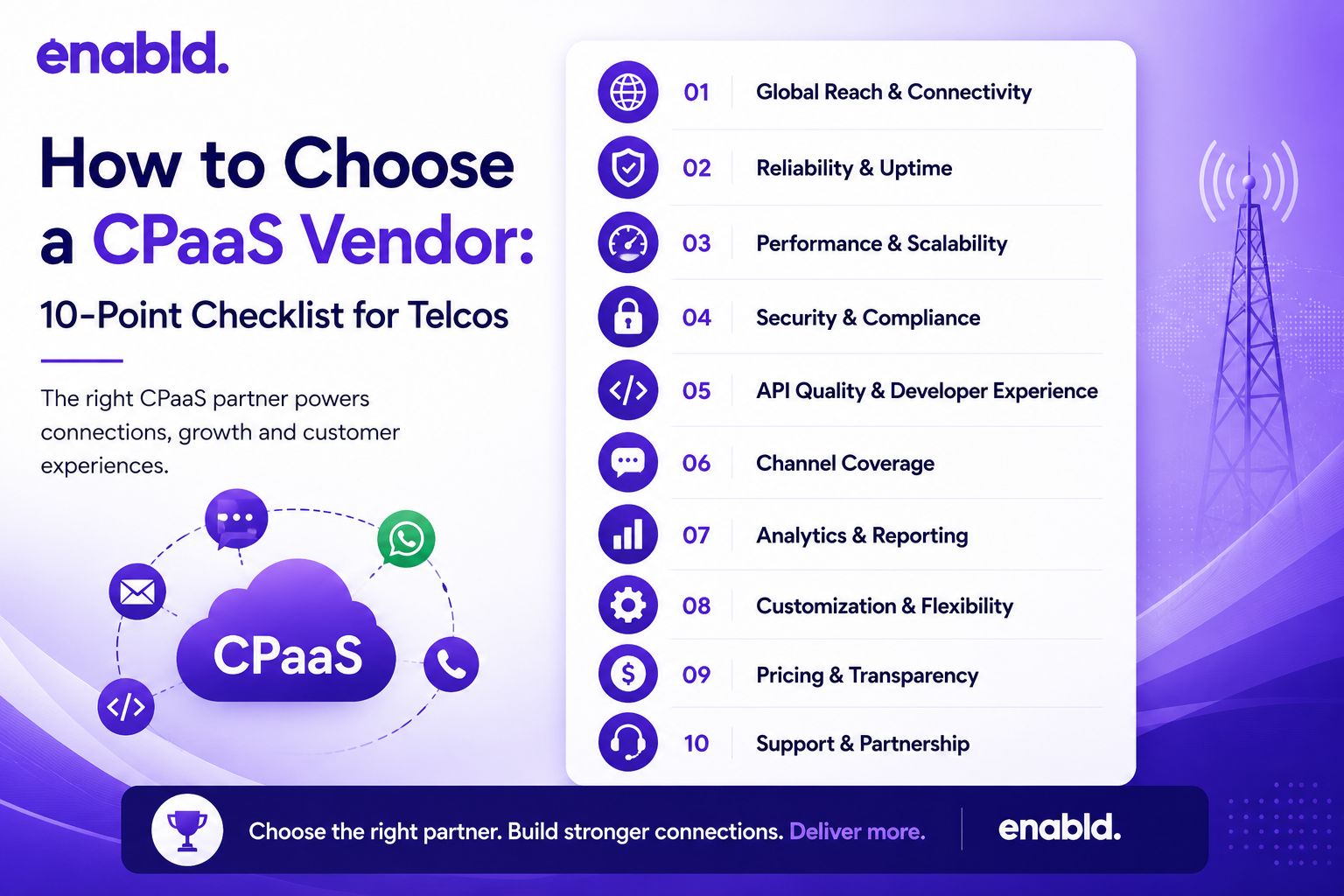
The 10-Point CPaaS Vendor Selection Checklist
These ten criteria cover the areas that consistently separate a vendor that performs well in a demo from one that performs well at carrier scale.
1. Carrier-Grade Network Coverage and Interconnects
Ask specifically about direct interconnect relationships versus resold capacity, the mix of tier-1 versus tier-2 and tier-3 routes, and actual country and operator coverage rather than a marketing map. Route quality determines real world deliverability far more than headline coverage numbers do.
2. Multi-Protocol Support: SS7, SMPP, and HTTP
A capable vendor should support SS7, SMPP, and HTTP simultaneously, so you can accept traffic in whichever protocol a given partner already uses. Our breakdown of SMPP vs HTTP SMS APIs covers why this flexibility matters at the infrastructure level rather than just the integration layer.
3. Built-In Fraud and Grey Route Protection
Fraud protection should be native to the platform, not an expensive add-on negotiated after the fact. Look for real-time traffic analysis, sender ID verification, and HLR lookup based validation, the same capabilities covered in our guide on what an SMS firewall actually does and how it blocks grey route traffic.
4. Omnichannel Capability Beyond SMS
SMS alone is no longer enough for most enterprise customers. Evaluate whether the vendor supports WhatsApp, RCS, and voice under the same API with automatic fallback between channels, which is exactly the comparison covered in our guide on WhatsApp Business API vs RCS vs SMS for enterprise messaging.
5. White-Label and Branding Flexibility
If the goal is launching your own branded messaging business rather than reselling someone else’s product, branding flexibility is not optional. Confirm the vendor supports full white-labeling, custom domains, and UI customization rather than a thin branding layer bolted onto a shared platform.
6. Uptime, Redundancy, and SLA Guarantees
Ask for specific SLA terms in writing, not just an uptime percentage on a slide. Geo-redundant infrastructure and documented failover behavior matter far more during an actual outage than a number in a sales deck.
7. Compliance and Regulatory Support
Requirements vary heavily by industry and region, from GSMA recommendations around routing and spam filtering to data residency rules and industry-specific needs like the HIPAA considerations covered in our guide on CPaaS for healthcare messaging. Confirm the vendor can support your specific regulatory environment before signing, not after.
8. Transparent Pricing and Billing Model
Pricing structures that look simple at low volume can behave very differently at scale. Push for clarity on per-message or per-conversation pricing, interconnect cost pass-through, and any minimum commitments before comparing quotes across vendors.
9. API Documentation and Developer Experience
Strong documentation, sandbox access, and SDK support directly affect how quickly your team can integrate and how much ongoing engineering time the platform demands. A vendor whose architecture is well documented, the kind of detail covered in our explainer on how an SMS gateway actually works, is usually a signal of overall platform maturity.
10. Onboarding, Support, and Account Management
Ask how onboarding is actually structured, who owns the relationship after the contract is signed, and what response times look like for critical issues. A vendor that treats onboarding as a real, staffed process rather than a self-serve afterthought tends to be far less painful to work with long term.
CPaaS Checklist at a Glance
| Criterion | What to Evaluate | Why It Matters |
| 1. Network coverage | Direct interconnects, tier-1 route mix, country and operator reach | Determines actual deliverability, not just claimed reach |
| 2. Protocol support | SS7, SMPP, and HTTP support in one platform | Lets you accept traffic in whichever protocol partners use |
| 3. Fraud protection | Built-in SMS firewall, grey route detection, HLR lookup | Protects revenue and subscriber trust from day one |
| 4. Omnichannel capability | SMS, WhatsApp, RCS, and voice under one API | Avoids bolting on separate vendors channel by channel |
| 5. White-label flexibility | Full branding control, custom domains, UI customization | Preserves your brand and customer relationship |
| 6. Uptime and redundancy | SLA terms, geo-redundant infrastructure, failover behavior | Determines reliability during peak traffic or outages |
| 7. Compliance support | GSMA alignment, data residency, industry-specific needs | Reduces regulatory and legal risk |
| 8. Pricing transparency | Clear per-message or per-conversation pricing, no hidden fees | Protects margins as volume scales |
| 9. Developer experience | API documentation quality, sandbox access, SDK support | Speeds up integration and reduces engineering cost |
| 10. Onboarding and support | Dedicated account management, response times, migration help | Determines how smoothly you actually go live |
CPaaS RFP Criteria: Questions to Include in Your Request for Proposal
A well built RFP should force every vendor to answer the same specific questions rather than respond with general capability statements. Useful cpaas rfp criteria to include:
• What percentage of your routes are direct interconnects versus resold capacity, by country?
• What protocols do you support natively, and can we run SS7, SMPP, and HTTP simultaneously?
• What fraud and grey route detection capabilities are included by default, not as a paid add-on?
• What channels beyond SMS are supported under the same API, and how does fallback work between them?
• What level of white-labeling and branding customization is actually possible?
• What are your documented SLA terms for uptime and support response times?
• What compliance certifications or frameworks do you support, and can you provide documentation?
• How is pricing structured at our expected volume, and what triggers additional fees?
• What does the onboarding process look like, and who is our point of contact after signing?
A Simple CPaaS Procurement Process
Once the checklist and RFP responses are in hand, a straightforward process keeps the decision moving without dragging on indefinitely.
1. Define internal requirements, including expected volume, target markets, and required channels, before contacting any vendor.
2. Shortlist three to five vendors and score each one against the 10-point checklist above.
3. Request a proof of concept or pilot with real traffic rather than relying on a demo environment alone.
4. Negotiate SLA terms and pricing in writing, not as informal verbal assurances.
5. Plan onboarding and migration timelines with the vendor before signing, including a rollback plan if issues arise.
How Enabld Fits This Checklist
Enabld’s CPaaS enablement model is built specifically around the criteria that matter most to telecom operators: direct carrier-grade routing through the SMS gateway platform, native fraud protection, full white-label branding, and omnichannel support across SMS, WhatsApp, RCS, and voice under one CPaaS platform. If you are building an RFP or shortlist right now, this checklist doubles as a practical way to compare Enabld against any other vendor on your list.
Final Thoughts
Choosing a CPaaS vendor is not a decision to make from a features page alone. Working through network coverage, protocol support, fraud protection, compliance, pricing, and support against a consistent checklist is what actually separates a platform that performs well at scale from one that only performs well in a sales demo.
If you are evaluating vendors against this checklist, talk to the Enabld team about how the platform holds up point by point.
Frequently Asked Questions
What is the most important factor when choosing a CPaaS vendor?
Network coverage and interconnect quality tend to matter most, since they directly determine actual message deliverability, but fraud protection and pricing transparency are close behind for most telecom buyers.
How long should a CPaaS vendor evaluation process take?
Most structured evaluations, from initial RFP to signed contract, take between six and twelve weeks, depending on how many vendors are shortlisted and whether a proof of concept is required.
What should be included in a CPaaS RFP?
A strong CPaaS RFP should ask about interconnect structure, protocol support, fraud protection, channel coverage, SLA terms, compliance certifications, pricing structure, and onboarding process.
Is it worth requesting a proof of concept before signing with a CPaaS vendor?
Yes. A proof of concept with real traffic reveals route quality and support responsiveness far more reliably than a sales demo or reference call alone.
Do all CPaaS vendors support white-labeling?
No. Support varies significantly, from full white-label platforms to a thin branding layer over a shared product, so this should always be confirmed directly rather than assumed.
How important is fraud protection in CPaaS vendor selection?
It is critical for telecom operators specifically, since unprotected networks are frequent targets for grey route traffic and SIM box fraud, which directly costs interconnect revenue.
Should pricing or reliability weigh more heavily in the decision?
Reliability should generally weigh more heavily, since unreliable delivery undermines the entire business case for messaging revenue regardless of how competitive the pricing looks on paper.
What is a common mistake telcos make when choosing a CPaaS vendor?
Comparing vendors primarily on price or headline coverage claims, without verifying route quality, fraud protection depth, or SLA terms in writing, is one of the most common and costly mistakes.