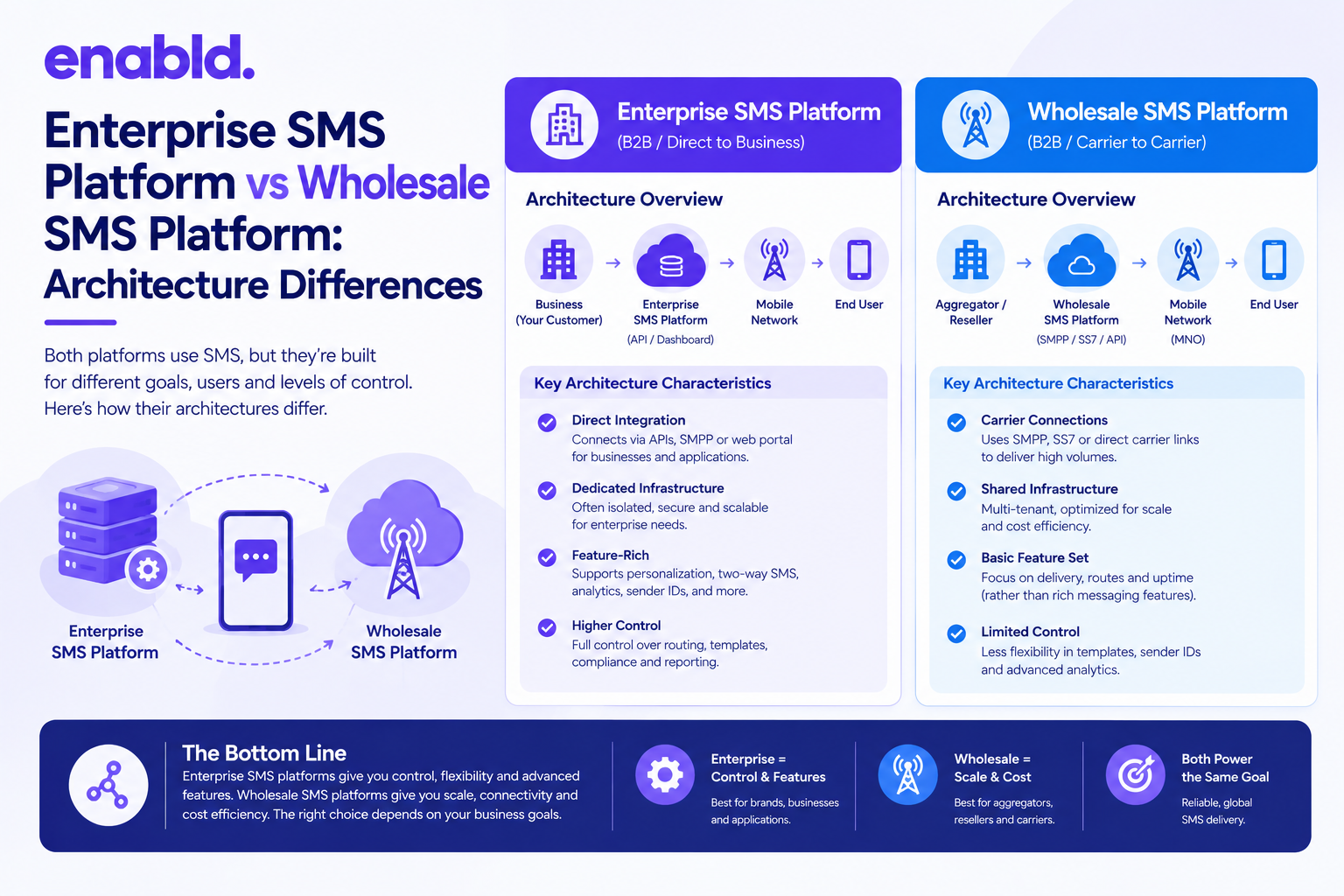
Aggregators often ask for an “SMS platform” as if it were one product. It is not. An enterprise SMS platform and a wholesale SMS platform both move messages, but they are built around different customers, different billing logic, and different definitions of success. Pick the wrong one and you end up bolting features onto a system that was never designed for your business model.
This guide explains the architecture differences between the two, where they overlap, and how aggregators and operators should decide which one they need.
Quick Answer: An enterprise SMS platform is built for brands sending their own messages to customers, with campaign tools, APIs, templates, and reporting. A wholesale SMS platform is built for carrier and aggregator traffic, with high throughput connections, route management, least cost routing, and interconnect billing. The core difference is who the customer is: a business sending messages versus another operator buying and selling capacity.
What Is an Enterprise SMS Platform?
An enterprise SMS platform serves businesses that need to message their own customers. Think banks sending OTPs, retailers sending order updates, or clinics sending appointment reminders. The platform’s job is to make sending easy, trackable, and compliant for the end brand.
Core Architecture of an Enterprise SMS Platform
The architecture centers on the sender experience. That usually means a REST or HTTP API, a web portal, campaign scheduling, contact and list management, message templates, two way messaging, and opt out handling. Sender ID registration and delivery reporting sit close to the surface because the enterprise customer wants to see exactly what happened to each message. Enabld’s enterprise messaging platform follows this pattern, with the focus on making business messaging simple to run and easy to measure.
How Enterprise Billing Works
Billing is straightforward. The enterprise pays per message or per bundle, often with a prepaid balance or monthly invoice. There are fewer rate cards and fewer counterparties, so the billing engine stays relatively simple.
What Is a Wholesale SMS Platform?
A wholesale SMS platform serves operators, aggregators, and carriers trading SMS capacity with each other. The customer is not a brand sending a campaign. It is another network or reseller buying routes and terminating traffic.
Core Architecture of a Wholesale SMS Platform
The architecture centers on traffic engineering. High throughput SMPP binds carry millions of messages between partners, while a routing engine selects the best path per destination based on cost, quality, and capacity. Least cost routing, route failover, and per destination rate management are core functions rather than extras. Underneath, the signaling and interconnect layer, covered in our guide on how an SMS gateway works, has to be carrier grade because a single weak route affects a large volume of traffic.
How Wholesale Billing Works
Billing is far more complex. Every vendor has a rate card per destination, every customer has a different sell rate, and margin is the gap between the two. The platform has to track call detail records, reconcile traffic with partners, and manage disputes. Our overview of SMS wholesale management covers why this layer often decides whether a wholesale business is profitable at all.
Enterprise vs Wholesale SMS Platform: Side by Side
| Aspect | Enterprise SMS Platform | Wholesale SMS Platform |
|---|---|---|
| Primary customer | Brands messaging their own customers | Operators and aggregators trading capacity |
| Main interface | API and web portal, campaign tools | SMPP binds, routing and rate management console |
| Throughput focus | Moderate to high, tied to campaigns | Very high, sustained carrier scale volume |
| Routing logic | Simple, often a few preferred routes | Least cost routing, quality based, failover per destination |
| Billing model | Per message or bundle | Vendor and customer rate cards, margin tracking, reconciliation |
| Key features | Templates, contact lists, two way messaging, reporting | CDRs, interconnect management, route testing, dispute handling |
| Fraud and compliance | Sender ID, opt out, content rules | Grey route detection, traffic validation, firewall integration |
| Success metric | Delivery and engagement for the brand | Margin, route quality, and uptime across partners |
Where the Two Architectures Overlap
Both rely on the same foundation: a gateway that speaks SMPP, HTTP, and SS7 where needed, a reliable SMSC connection, and delivery receipts flowing back to the sender. Both also need fraud protection. A wholesale network without an SMS firewall is exposed to grey route traffic, while an enterprise platform without content and sender controls risks spam complaints.
Because the foundation is shared, some vendors run both models on one core. The difference lives in the layers above it, the interfaces, routing depth, and billing engine.
Why Aggregators Sit Between Both Worlds
Aggregators are the interesting case. They buy capacity wholesale from operators and sell it to enterprises, which means they need wholesale grade routing and billing on the supply side and enterprise grade tools on the customer side. Running only a wholesale platform leaves enterprise customers without portals and reporting. Running only an enterprise platform leaves the aggregator without the routing control and rate management that protect margin.
Signs You Need a Wholesale Platform
You manage multiple upstream vendors, sell to other resellers, negotiate rate cards by destination, or need route level quality control. If margin per destination matters to your business, wholesale architecture is not optional.
Signs You Need an Enterprise Platform
You sell mainly to brands, your customers expect dashboards, templates, and APIs they can use on their own, and your support load comes from campaign questions rather than route issues.
Signs You Need Both
You buy wholesale and sell retail. This is the most common aggregator profile, and it is where a single platform with dual capability saves the cost of stitching two systems together.
How Enabld Maps to Both Models
Enabld’s SMS gateway platform provides the shared carrier grade foundation, with the enterprise messaging layer for brand facing use and wholesale management capability for operators and aggregators trading traffic. Running both on one foundation means routing intelligence, fraud protection, and delivery data stay consistent across supply and customer sides rather than living in separate tools. For operators that want to package this under their own name, the same stack supports a branded CPaaS platform.
How to Choose Between the Two
Start with your customer, not the feature list. If your buyers are brands, begin with enterprise architecture. If your buyers are other operators, begin with wholesale. If you serve both, prioritize a platform that handles both natively, and ask vendors to show routing rules, rate management, and reporting in a live environment before you commit.
Final Thoughts
Enterprise and wholesale SMS platforms solve different problems with similar plumbing. One optimizes the sender experience, the other optimizes traffic and margin. Aggregators who understand that distinction avoid buying a system that fits only half of their business. If you are mapping out which model fits your traffic, talk to the Enabld team about running enterprise and wholesale messaging on one platform.
Frequently Asked Questions
What is the difference between an enterprise SMS platform and a wholesale SMS platform?
An enterprise platform serves brands sending their own messages, with APIs, templates, and campaign reporting. A wholesale platform serves operators and aggregators trading capacity, with high throughput SMPP, route management, and rate card billing.
Which SMS platform should an aggregator use?
Most aggregators need both capabilities. Wholesale features manage supply routes and margin, while enterprise features serve brand customers who expect portals, APIs, and reporting.
What is least cost routing in a wholesale SMS platform?
Least cost routing selects the cheapest available route per destination while meeting quality thresholds, so margin improves without sacrificing delivery rates.
Does a wholesale SMS platform use SMPP?
Yes. SMPP is the standard protocol for high volume carrier and aggregator connections because persistent binds sustain throughput far better than repeated HTTP requests.
Can one platform support both enterprise and wholesale SMS?
Yes. Many carrier grade platforms share a common gateway and fraud layer, then add enterprise tooling and wholesale routing and billing modules on top.
How does billing differ between the two models?
Enterprise billing is usually per message or bundle for a single customer. Wholesale billing tracks vendor and customer rate cards by destination, calculates margin, and reconciles traffic with partners.
Why does fraud protection matter on a wholesale platform?
Wholesale networks handle traffic from many partners, which makes them targets for grey routes and spoofed traffic. A firewall and HLR validation protect both revenue and route reputation.
Is an enterprise SMS platform enough for a small aggregator?
It can be at the start, if you resell to brands from a single upstream route. Once you manage several vendors or sell to other resellers, wholesale routing and billing tools become necessary.