For mobile network operators, lost SMS revenue rarely shows up as a single dramatic event. It shows up quietly, as traffic that enters the network through channels the operator never authorized, sender IDs that get reused across campaigns they never approved, and interconnect fees that simply never get collected. This is exactly the gap an SMS firewall is built to close, and it is why network and fraud teams research this topic long before they ever look at vendor pricing sheets.
This guide covers the SMS firewall definition in plain terms, explains what grey route SMS actually means, breaks down how an A2P SMS firewall works alongside HLR lookups, and looks at the core techniques behind modern SMS fraud protection for telcos.
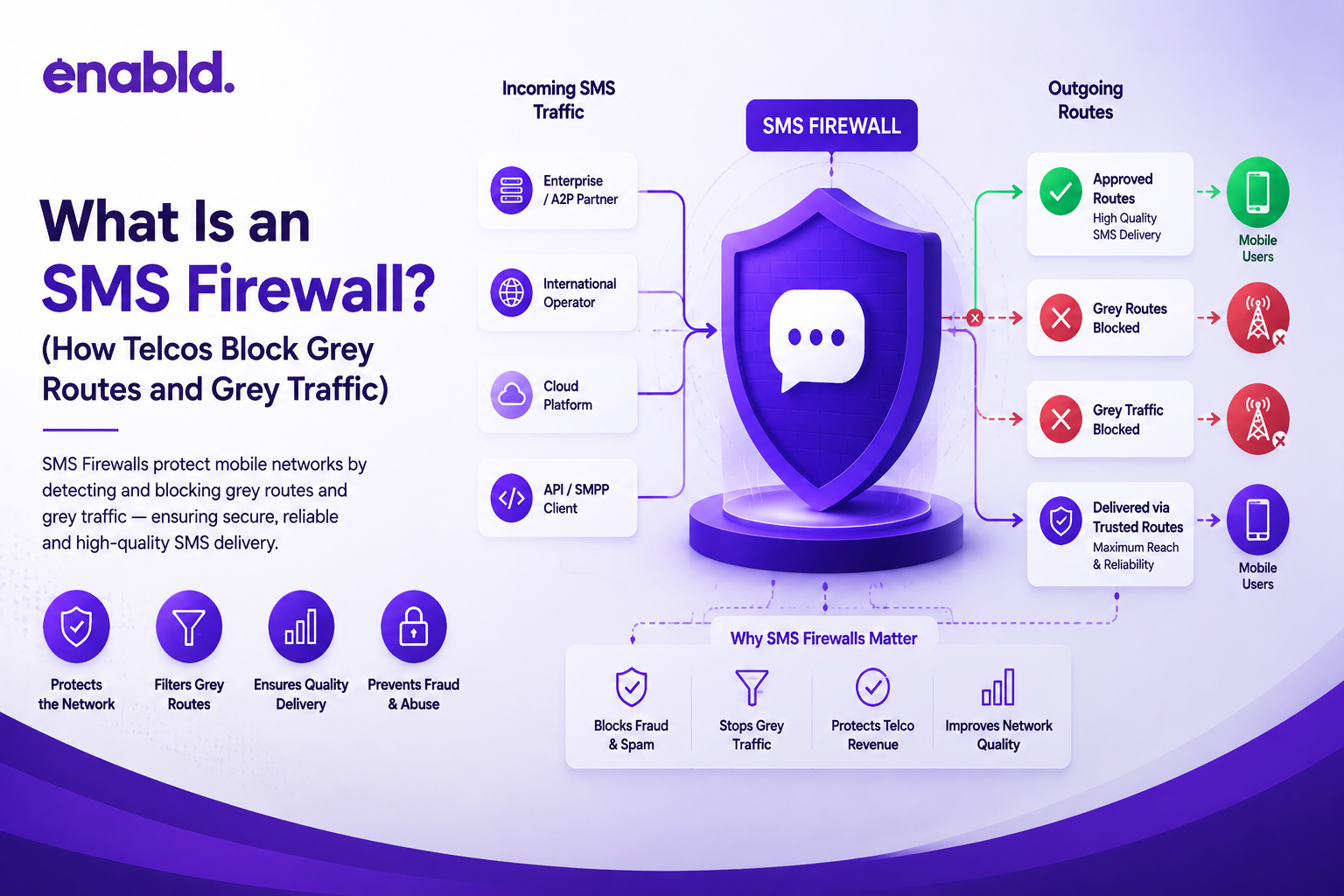
Quick Answer: An SMS firewall is a network security system that inspects SMS traffic in real time, identifies unauthorized or fraudulent messages such as grey route traffic, spoofed sender IDs, and SIM box activity, and blocks or redirects that traffic so operators keep control of their network and recover lost interconnect revenue.
SMS Firewall Definition: What It Actually Does
At its core, an SMS firewall sits at the edge of an operator’s network and inspects every message that enters, checking signaling behavior, sender identity, message content, and traffic patterns against a set of rules. Legitimate business traffic is allowed through, while anything that looks like fraud, spam, or unauthorized bypass gets blocked, filtered, or quarantined before it ever reaches a subscriber.
The reason this matters so much for telecom operators specifically is billing. When A2P messages enter a network through a properly monetized route, the terminating operator collects an interconnect fee. When that same traffic enters through a grey route instead, the message still gets delivered, the subscriber still receives it, but the operator collects nothing. A well configured SMS firewall closes that gap.
What Is Grey Route SMS and Why Does It Exist?
Grey route SMS refers to commercial, business generated traffic that gets disguised as ordinary person to person messaging to avoid the fees that legitimate A2P traffic would normally incur. It is not always outright illegal in every jurisdiction, but it bypasses the commercial agreements operators rely on to monetize their network.
Grey routes exist because messaging networks are globally interconnected, and that interconnection creates gaps that are easy to exploit. An aggregator might route bulk marketing messages through SIM farms disguised as regular handsets, or push traffic through an international gateway specifically chosen because it avoids the fees a direct route would trigger. The message still arrives, so from a subscriber’s perspective nothing looks wrong, but the operator has effectively been cut out of a transaction that should have generated revenue.
How Grey Route Fraud Actually Works
A few patterns show up repeatedly across telecom networks dealing with this problem.
SIM box fraud uses banks of SIM cards, often housed in a physical device called a SIM box, to convert what should be A2P traffic into what looks like ordinary P2P traffic from a regular mobile number. International bypass fraud routes messages through low cost international gateways specifically to dodge termination fees in the destination country. Sender ID spoofing manipulates the displayed sender name or number so a message appears to come from a trusted brand, a bank, or a government agency, which is as much a fraud and security issue as it is a revenue one. None of these patterns break the network outright. Messages keep moving and subscribers keep receiving them, which is exactly why they can persist for a long time before anyone notices the pattern.
A2P SMS Firewall vs P2P Traffic
Not all SMS traffic should be treated the same way, and this is where an A2P SMS firewall specifically earns its place in the network. Person to person messages between two individual subscribers are P2P traffic, typically low volume and not commercially billed the same way. Application to person messages, OTPs, delivery alerts, marketing campaigns, appointment reminders, are commercial traffic that should be billed as A2P and routed through approved commercial channels.
An A2P SMS firewall is specifically tuned to tell these two categories apart, using signals like message volume from a single source, timing patterns, content structure, and sender behavior. Traffic that looks commercial but arrives dressed as P2P is exactly the kind of hidden revenue leak operators are trying to catch.
HLR Lookup and SMS Firewalls: How Number Validation Works
HLR lookup plays a critical role inside most modern SMS firewall deployments. The Home Location Register holds real time data about a subscriber, including their current network status, roaming information, and porting history. By querying the HLR before or during message delivery, a firewall can confirm whether a destination number is active, legitimate, and actually on the network it claims to be on.
This matters directly for fraud detection. Number farms used in grey route schemes often show patterns an HLR lookup can expose quickly, numbers with unusual porting histories, inconsistent roaming data, or activity inconsistent with a genuine subscriber. Enabld’s own SMS firewall and HLR lookup platform is built around pairing real time HLR data with policy enforcement precisely so operators are not relying on message content alone to catch fraud.
Core Capabilities Behind Modern SMS Fraud Protection
A capable SMS fraud protection system for telcos generally combines several layers of defense rather than relying on any single check.
| Capability | What It Does |
|---|---|
| Real time traffic analysis | Inspects signaling behavior and message flow as traffic enters the network |
| Sender ID verification | Confirms a sender identity matches an approved, registered source |
| Rate limiting | Flags or throttles unusual volume spikes from a single origin |
| Content filtering | Scans message structure and content for spam or fraud indicators |
| Dynamic blacklisting | Automatically blocks known bad actors, numbers, or gateways as patterns emerge |
| HLR based validation | Confirms subscriber and network status before or during delivery |
These capabilities work together in real time, since fraud patterns shift constantly and a static rule set becomes outdated within weeks. That is also why SMS policy management, the ability for operators to configure and adjust whitelisting, rate limits, and content rules on the fly, has become just as important as the detection engine itself.
How an SMS Firewall Fits Into Carrier-Grade Architecture
An SMS firewall does not operate in isolation. It sits alongside the same signaling and routing infrastructure covered in our guide on how an SMS gateway works, inspecting traffic as it moves through the network rather than as a separate bolt on system. For operators already running a carrier-grade SMS gateway platform, adding firewall capability at the same layer means fraud detection benefits from the same routing visibility rather than working from a narrower, isolated view of traffic.
This is also part of a broader shift where SMS security is no longer treated as optional infrastructure. As covered in our outlook on the future of SMS firewall solutions, operators without modern firewall protection are increasingly the ones absorbing the cost of grey route traffic that better protected competitors are already capturing as revenue.
Why This Matters for Telecom Revenue Right Now
A2P messaging volume keeps growing as more industries, healthcare, banking, logistics, retail, shift routine communication to SMS. Every message that slips through as unbilled grey traffic is revenue an operator has already paid signaling and network costs to carry, without collecting anything in return. Closing that gap is not just a security exercise, it directly affects the bottom line of a telecom operator’s messaging business, which is part of why SMS firewalls are increasingly bundled into broader CPaaS strategies rather than treated as a standalone purchase.
Final Thoughts
An SMS firewall gives mobile network operators the visibility and enforcement they need to stop grey route traffic, block A2P fraud, and protect subscribers from spoofed or fraudulent messages, all while recovering revenue that would otherwise quietly disappear. If you are a telecom operator, CSP, or MVNO looking to close these gaps in your own network, a real time SMS firewall paired with HLR based validation is the foundation to start from. Talk to the Enabld team to see how SMS firewall and HLR lookup capability could fit into your network.
Frequently Asked Questions
What is an SMS firewall in simple terms?
An SMS firewall is a system that inspects incoming SMS traffic in real time and blocks or redirects anything that looks like grey route traffic, fraud, or spam before it reaches subscribers.
What is grey route SMS?
Grey route SMS is commercial business traffic disguised as ordinary person to person messaging to avoid the fees and approvals that legitimate A2P traffic normally requires.
How is an A2P SMS firewall different from a general SMS firewall?
An A2P SMS firewall is specifically tuned to distinguish application to person traffic from person to person traffic, since commercial messages are billed and regulated differently.
Why is HLR lookup important for SMS firewalls?
HLR lookup confirms a subscriber’s real time network status and history, helping the firewall detect number farms and irregular patterns that message content alone would not reveal.
What kinds of fraud does an SMS firewall block?
Common targets include grey route bypass, SIM box fraud, international bypass fraud, and sender ID spoofing, all of which cost operators revenue or expose subscribers to risk.
Does an SMS firewall slow down message delivery?
A well built firewall analyzes traffic in real time and adds negligible delay, since the checks run alongside normal routing rather than as a separate, sequential step.
Is SMS firewall protection only relevant for large mobile operators?
No. MVNOs, CSPs, and smaller operators are frequent targets for grey route traffic precisely because fraudulent actors assume smaller networks have weaker monitoring in place.
How does an SMS firewall help recover lost revenue?
By correctly identifying and blocking traffic disguised to avoid billing, operators can force that same traffic back through properly monetized, commercially agreed routes.