This post demystifies how the CPaaS enablement ecosystem works. Learn more about the CPaaS structure, the interface of the CPaaS with telcos, layers, partners, and revenue flows. As a matter of fact, there are two business or operational models in which CPaaS interfaces with telcos and clients. One is the direct model, or the “pure play model,” in which CPaaS vendors handle customers directly while paying a lump sum amount to telcos. Enabld uses the enablement ecosystem (the white-label model) that works in a different way with a different layering structure and that is what we are going to elaborate on here.
Table of Contents
- The CPaaS enablement ecosystem and layers
- CPaaS provider and telecom/communication services provider partnership
- Telco and end-user partnership
- Telco-reseller partnership
- Revenues
- Conclusion
The CPaaS enablement ecosystem and layers
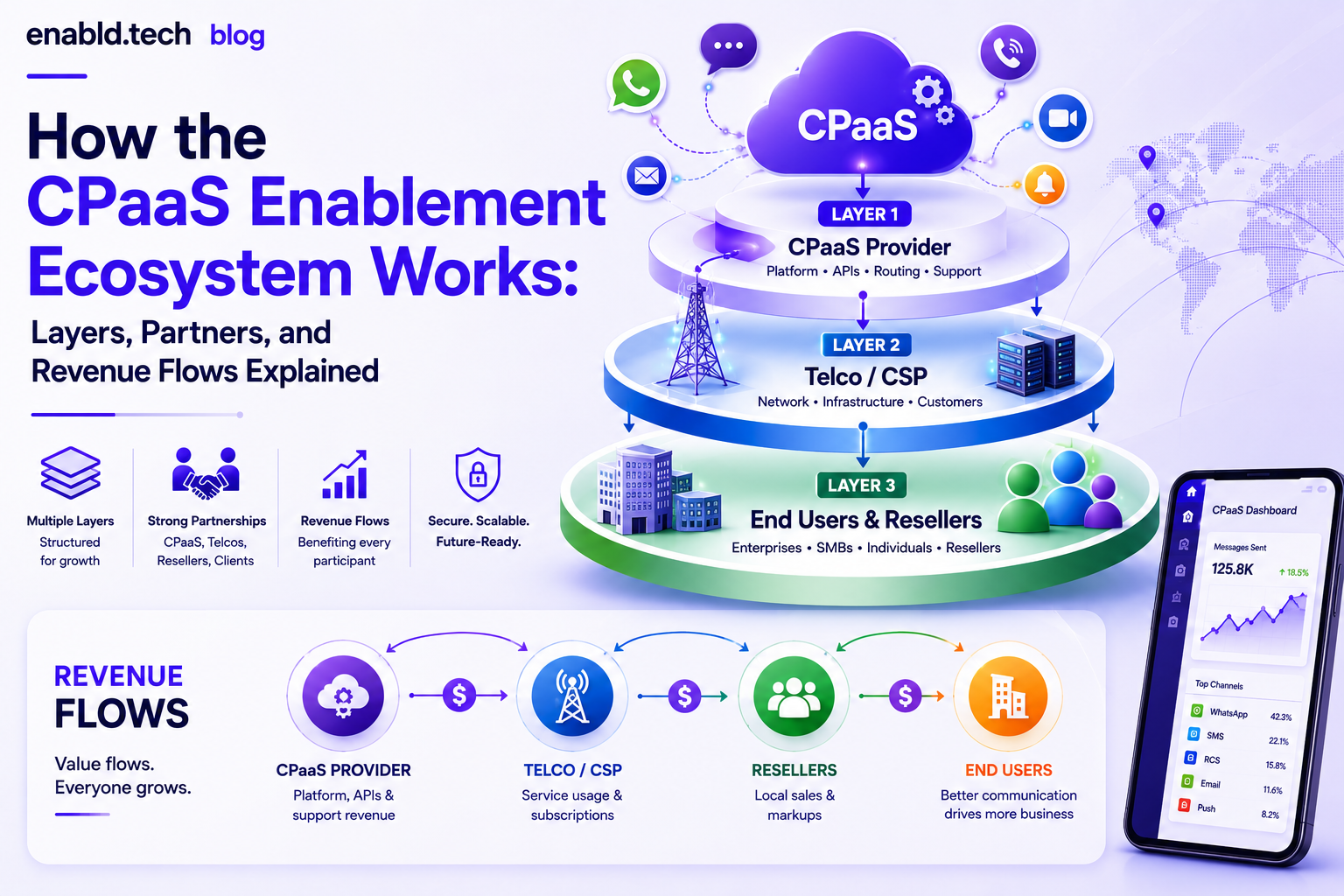
The enablement model of CPaaS follows a layered hierarchical structure in how it is implemented and deployed. The table below gives you an at-a-glance-view of the structure and layers.
| Layer 1 CPaaS🡪 | Layer 2 Telco🡪 | Layer 3 Telco Customer | Layer 3 Telco Resellers |
| CPaaS enablement stack comprises of the following services: The API platform comprising rich communications, voice, video, messaging, and SMS. The requisite routing infrastructure to handle various protocols like SMS, SIP, SS7. The white label CSaaP software, APIs, Dashboards, and SDK that plugs into the telco’s infrastructure and bridges telecom network and modern cloud software. Service and support, maintenance, upgrades to the software. | Telco/Communication service provider’s infrastructure sits below layer 1. Telcos offer routers, hardware switches, transmission towers, fiber optic lines, data centres. Telcos handle routing, call switching and protocol management SS7->SIP->HTTPs. Telcos implement CSaaP software APIs and SDK into client’s existing software setup, mobile apps, or websites. Telcos set up dashboard, module accessibility for various services, language, currency, and billing for clients. | Layer 3 comprises end user clients of the telcos under layer 2. These may be: Enterprise clientsIndividual clientsSmall enterprisesResellers Service providersEnd users use any or all of the services and pay on a pay-as-you-go model. Individual clients not in possession of custom software may use the telco’s portal to create an account and use services | In parallel with business clients, telcos also serve resellers in various regions who may sell all services or specific modules like SMS, for instance to local customers. Such resellers get the same white-label CPaaS telco branded solution further customized to suit their business brand. Software solution providers may incorporate communications into their packages. |
CPaaS provider and telco/communication service partnership
The telecom company has an established hardware network and mobile towers and an established clientele using their voice, MMS, and SMS services. The CPaaS provider offers white-label software and APIs with cloud connectivity to the telecom operator and interfaces the software with the existing hardware setup of the telecom company. This is a kind of partnership that proves beneficial to both in terms of business and revenues. The CPaaS provider gets a client for life, and a revenue flow is established. The telecom operator transforms its business from vanilla voice/SMS to rich communications through the web interface, allowing end users to use omnichannel features like voice, video, audio files, document transmission, WhatsApp and messaging platforms, two-way SMS, chat, and even AI bots. CPaaS providers like Enabld usually offer white label software, which is then rebranded at the front end to reflect the telco’s brand and design theme while backend operations remain intact. This software is offered on a pay-as-you-go model, with no upfront costs, and since it is a tried and proven platform, telcos are able to transform their business overnight, virtually morphing to SaaS providers and boosting revenues.
Telco and end user partnership
In the same way that the CPaaS provider plugs in its software into the telco’s setup, telcos in turn plug in the software into the enterprise or small business’s existing software setup. Here again, the partnership is a pay-as-you-go model. Drilling down into details, end users may subscribe to one or a few or all of the available communication channels and modules and pay accordingly. Telcos set up accounts for their enterprise clients, set up rates and available services, permissions, limits, and billing currency as well as language options.
Telcos may also have thousands of individual professionals who do not use a specific software setup but who may wish to make use of all the software-based communication facilities through a single dashboard. The white-label CPaaS platform on the telco’s end may offer a portal for such single users who can set up accounts, log in, and use various services through a single dashboard. This maintains continuity and linkages across channels like SMS, voice, video, and WhatsApp.
Telco-reseller partnership
Telcos may not operate globally due to various restrictions, but the CPaaS software permits them to offer their services on a global scale. They can rope in resellers who may sell any or all of their services to local clients. In such a partnership arrangement the telco usually offers the white-label CPaaS platform further modified to suit the reseller’s brand, rates, currency, and other specifics.
Revenues
Revenue generation is important for everyone in the chain. With this model, everyone earns and grows through revenue-based strategic partnerships.
CPaaS provider revenue: CPaaS providers may not charge for providing and provisioning the CPaaS enablement white-label software. However, they may charge a monthly or annual subscription charge. They generate further ongoing revenues by charging a miniscule amount for each transaction. For example, an end user using the software to send an SMS or make a call pays charges to the telco, and a fraction of that cost goes to the CPaaS solution provider. There are millions of ongoing transactions going on in various channels, and this means even though the charges are almost negligible, the CPaaS provider gets a decent amount.
Telcos-end user revenues: Telcos are charging for mobile voice, SMS, MMS, and data. With this CPaaS platform in place, they can offer enhanced communication services on a chargeable basis to end users. The software platform allows setting up various accounts, assigning services, setting limits, rates, currency, billing cycles, and invoice generation. In addition, telcos can now offer virtual numbers and direct inward dialing facilities, AI chatbot integration, and more to users, exponentially increasing their revenue streams across channels and users.
Telcos-reseller revenues: With global reach now possible, telcos can rope in resellers to sell value-added services in various geographic locations. Such resellers get access to the white-label software, further rebranded to reflect their brand as well as that of the telco. Resellers may get a preferential rate, and then they can add a markup on services and generate revenue streams.
End-user revenues: By having an omnichannel communication platform in place, enterprises enhance their customer services and satisfaction levels, as well as reach out to more customers across various geographic locations. Naturally, their revenues increase over time.
Conclusion
As can be seen, CPaaS intervention transforms a carrier from a simple voice-SMS provider to a total communications services provider. The telco’s brand reputation grows, revenues grow, and customer loyalty increases when they offer rich value-added services. The future holds more promise by way of inclusion of more AI into communication channels, phasing out of SMS in favor of QR code/eye detection/mobile number verification or other changes, but web software communications are here to stay and grow. Telcos can, if they have not already done so, get on to this gravy train and become global players.