Every telecom operator that decides to launch a CPaaS business eventually runs into the same decision point. Build the platform internally, with full control and a long runway, or license a white label CPaaS platform and go to market in a fraction of the time. Both paths can work, but they lead to very different cost structures, timelines, and levels of risk, and getting this decision wrong is expensive to reverse once engineering resources are already committed.
This guide breaks down white label CPaaS vs build from scratch across cost, time to market, technical risk, and long term control, so telecom leadership can make the decision with a clear picture rather than a vendor pitch on one side.
Quick Answer: Most telecom operators should choose white label CPaaS over building from scratch, because it delivers a working, carrier-grade platform in months instead of years, avoids the ongoing cost of maintaining SS7, SMPP, and routing infrastructure internally, and still allows full branding and customer ownership. Building from scratch only makes sense when an operator has significant in-house telecom engineering capacity and a strategic reason to own every layer of the stack.
The Core Question: Build or Buy?
Should a telco build its own CPaaS platform or use a white label solution? The honest answer depends less on preference and more on resources. Building a CPaaS platform from scratch means standing up SMSC infrastructure, SS7 and SMPP connectivity, a routing engine, number management, fraud and firewall capability, developer facing APIs, and a billing layer, then maintaining all of it indefinitely. A white label CPaaS platform gives an operator that same stack already built, tested, and running at carrier scale, ready to be branded and launched under the operator’s own name.
What Building From Scratch Actually Involves
Building in-house is not simply a development project, it is an ongoing operational commitment. An operator needs telecom protocol expertise for SS7 and SMPP integration, security and compliance expertise to build fraud detection and meet GSMA recommendations, and a dedicated team to maintain uptime, monitor routing quality, and handle interconnect relationships with carriers around the world. None of this is a one time build. Signaling standards evolve, fraud patterns shift constantly, and carrier relationships require continuous negotiation and management. A platform that works well at launch can degrade quickly without a team dedicated to keeping it current.
What White Label CPaaS Actually Involves
A white label CPaaS platform flips that equation. The vendor has already built and hardened the SMSC, signaling, routing, and fraud infrastructure, and the operator’s job becomes branding, commercial packaging, and go to market execution. Enabld’s CPaaS enablement model is built specifically around this, giving operators a fully branded platform on top of infrastructure that is already carrier-grade, rather than asking them to prove out signaling reliability and routing quality from zero.
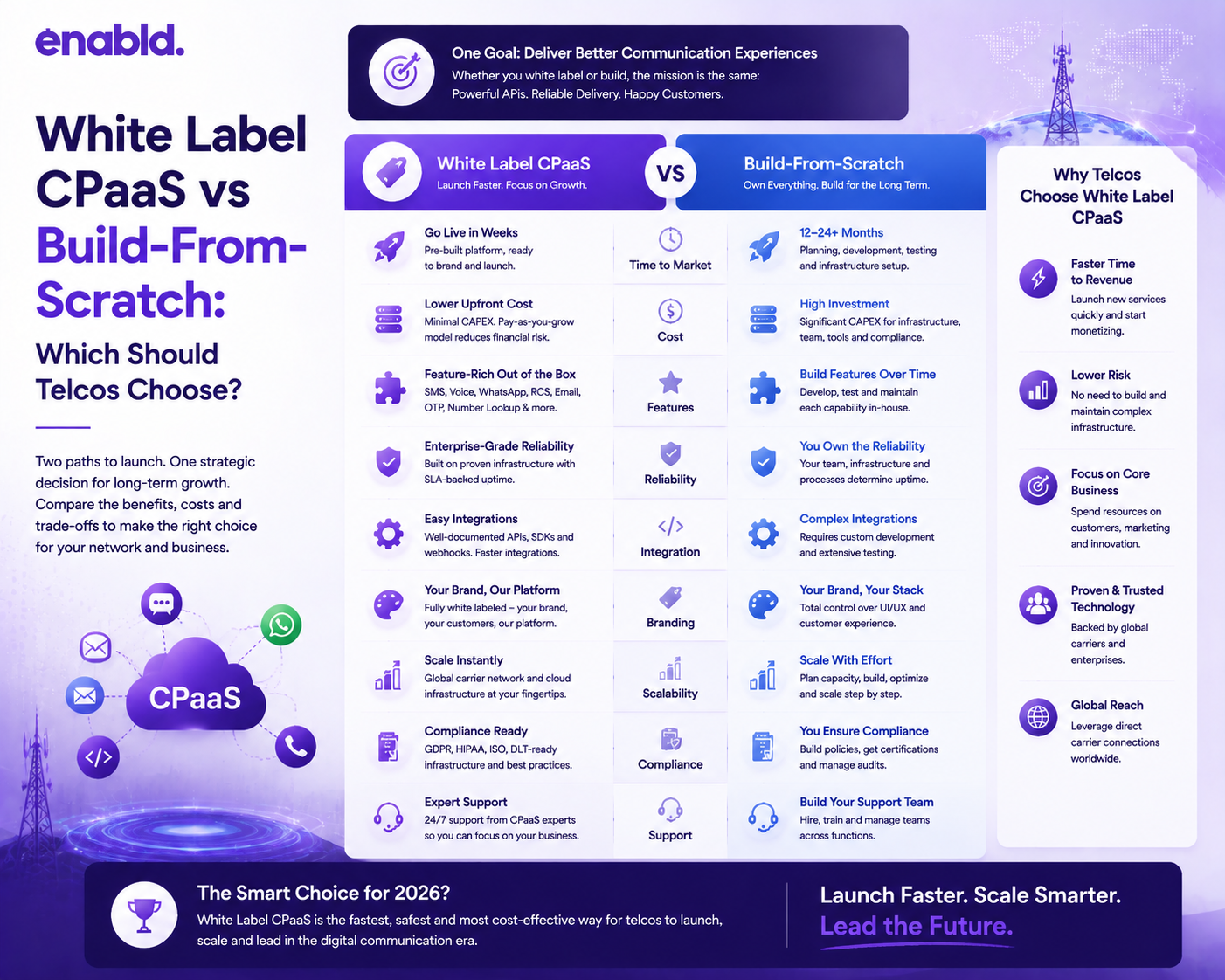
White Label CPaaS vs Build From Scratch: Side by Side
| Factor | Build From Scratch | White Label CPaaS |
|---|---|---|
| Time to market | 12 to 24 months or longer | Typically weeks to a few months |
| Upfront cost | High, covering infrastructure, licensing, and specialized hires | Lower, usually structured around licensing or revenue share |
| Ongoing maintenance | Fully owned by the operator’s internal team | Handled by the platform vendor |
| Telecom expertise required | Deep in-house SS7, SMPP, and signaling knowledge needed | Minimal, the vendor already has this expertise |
| Brand and customer ownership | Full control by design | Full control, delivered under the operator’s own brand |
| Risk of delay or failure | Higher, since telecom infrastructure is unforgiving of mistakes | Lower, since the underlying platform is already proven |
| Flexibility to customize deeply | Maximum, since every layer is owned | Good, though bound by what the vendor’s platform supports |
Why Time to Market Usually Decides This
For most operators, the deciding factor is not cost alone, it is speed. A competitor that launches branded messaging and CPaaS services in three months captures market share and enterprise relationships while a build-from-scratch effort is still in signaling integration testing. Revenue that could have started flowing in month four instead waits until month eighteen or later, and in a competitive telecom market that gap rarely closes. This is why white label CPaaS has become the default path for operators focused on revenue diversification rather than telecom infrastructure as a core competency in itself.
When Building From Scratch Actually Makes Sense
There are legitimate cases where building in-house is the right call. A very large operator with an existing, mature telecom engineering organization, deep signaling expertise already in place, and a strategic reason to own every layer of the stack, perhaps to integrate tightly with proprietary network infrastructure, may find that ownership outweighs speed. Building also makes more sense when an operator’s roadmap depends on capabilities so specific that no vendor platform would reasonably support them. These situations exist, but they are the exception rather than the norm across the market.
When White Label CPaaS Is the Right Call
For the large majority of operators, CSPs, MVNOs, and wholesale carriers, white label CPaaS is the more rational choice. It removes the multi year infrastructure build, avoids the ongoing burden of maintaining SS7 and SMPP connectivity internally, and still delivers full branding and customer ownership, which is usually the part operators actually care about protecting. Retaining the customer relationship and the margin, without also owning the operational burden of telecom signaling infrastructure, is exactly the balance a white label model is designed to strike.
What to Evaluate in a White Label CPaaS Vendor
Not every white label offering delivers the same value, so the evaluation still matters. Look closely at the depth of the underlying SMS gateway platform, including whether it supports SS7, SMPP, and HTTP simultaneously, whether fraud and grey route protection is built in rather than bolted on, and how much branding and commercial flexibility the platform actually allows. A checklist like our guide on choosing the best CPaaS enabled service provider covers the specific criteria worth pressure testing during vendor evaluation.
A Hybrid Path Is Also Common
Some operators do not treat this as a permanent, one time decision. It is common to launch on a white label CPaaS platform first, generate revenue and prove out demand quickly, then evaluate deeper in-house investment later once the business case is proven with real customers and real traffic. This staged approach reduces risk on both sides, since it avoids the sunk cost of a multi year internal build before knowing whether the market opportunity justifies it.
Final Thoughts
The build versus white label CPaaS decision comes down to what an operator actually wants to own. Building from scratch delivers maximum control at the cost of time, capital, and ongoing operational burden. White label CPaaS delivers a fast, branded path to market while still preserving customer ownership and margin, which is why most telecom operators land on this side of the decision. If you are weighing this choice for your own network, talk to the Enabld team about what a white label launch timeline would actually look like for your business.
Frequently Asked Questions
Should a telco build its own CPaaS platform or use a white label solution?
Most telecom operators should choose a white label CPaaS platform, since it launches in a fraction of the time and avoids the ongoing burden of maintaining SS7 and SMPP infrastructure internally, while still preserving full branding.
How much faster is white label CPaaS than building from scratch?
White label CPaaS platforms typically launch in weeks to a few months, while building carrier-grade infrastructure from scratch often takes twelve to twenty four months or longer.
Does white label CPaaS mean giving up customer ownership?
No. A properly structured white label CPaaS platform runs entirely under the operator’s own brand, meaning the operator retains the customer relationship and billing control.
Is building a CPaaS platform from scratch ever the right choice?
It can be, typically for very large operators with existing deep telecom engineering expertise and a specific strategic reason to own every layer of the infrastructure themselves.
What is the biggest hidden cost of building CPaaS infrastructure in-house?
Ongoing maintenance is usually the biggest hidden cost, since signaling standards, fraud patterns, and carrier relationships all require continuous attention long after the initial build is complete.
Can an operator switch from white label to a self-built platform later?
Yes. Many operators launch on a white label CPaaS platform first to prove demand and generate revenue, then evaluate a deeper in-house build once the business case is validated.
What should telcos look for when evaluating a white label CPaaS vendor?
Key factors include the depth of the underlying SMS gateway architecture, built-in fraud and grey route protection, and how much branding and commercial flexibility the platform allows.
Is white label CPaaS only suitable for smaller operators?
No. Operators, CSPs, and carriers of many sizes use white label CPaaS, since the time to market and reduced operational burden benefit large and small operators alike.