By 2026, most enterprises are not deciding whether to use CPaaS, they are deciding how much of their customer communication should run through it. What started as a way to bolt SMS notifications onto an app has grown into the infrastructure behind login security, fraud alerts, order updates, and entire customer engagement programs. For a lot of enterprise buyers researching this space, the real question is not what CPaaS is anymore, it is how other businesses are actually using it day to day.
This guide walks through how enterprises use CPaaS in practice, covering 2FA, customer engagement, and the broader role an enterprise messaging API plays inside a modern communication stack.
What Enterprise CPaaS Actually Looks Like Day to Day
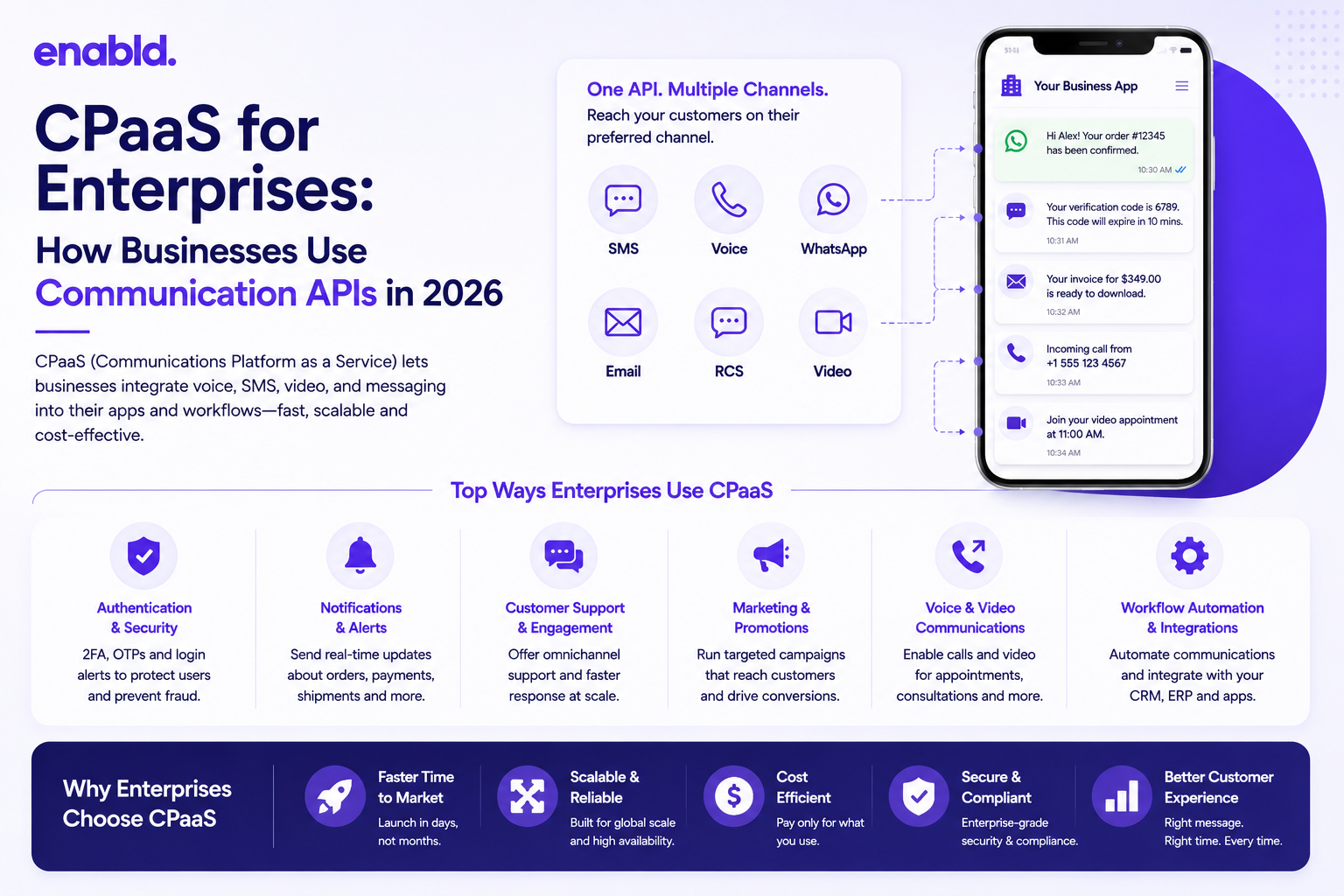
An enterprise communication platform built on CPaaS is not one feature, it is a layer that sits behind dozens of small, constant interactions a business has with its customers. A login triggers an OTP. A suspicious transaction triggers a fraud alert. An order ships and triggers a tracking update. None of these look like a big communication strategy from the outside, but together they make up the majority of the messages a large enterprise sends every day, and CPaaS is what makes running all of them through one system possible instead of stitching together separate tools per channel.
2FA and CPaaS: Why It Remains the Default
Two factor authentication is still the single most common enterprise CPaaS use case, and for good reason. Sending a one time passcode by SMS or voice call adds a layer of security that does not depend on the user having a separate authenticator app installed, which keeps friction low during signup and login. Banks in particular lean on 2FA CPaaS integrations heavily, using OTPs for account access, high value transactions, and password resets, since the cost of a compromised account far outweighs the cost of sending a text. This use case has stayed remarkably stable even as messaging channels have diversified, because reliability matters more here than rich formatting ever will.
Customer Engagement Through CPaaS
Beyond security, customer engagement CPaaS use cases have expanded significantly. Retailers send cart abandonment reminders and flash sale alerts. Airlines and logistics companies send delivery and gate change updates through channels customers already trust. Subscription businesses send renewal reminders and usage alerts timed to reduce churn. What ties these together is that the message itself is only useful if it is timely and reaches the right channel, which is why more enterprises are routing engagement campaigns through RCS and WhatsApp where adoption supports it, with SMS as the dependable fallback when it does not.
What an Enterprise Messaging API Actually Replaces
Before adopting an enterprise messaging API, most large organizations were relying on some combination of manual outreach, disconnected point tools for each channel, and internal teams stitching together fragile integrations with individual carriers. An enterprise messaging API consolidates all of that into a single integration point, letting one system trigger a message across SMS, voice, WhatsApp, or RCS depending on the use case, with delivery tracking and reporting handled consistently regardless of channel. That consolidation is often the real return on investment, not any single message type, but the elimination of maintaining five different systems to do what one API layer can now do.
Enterprise CPaaS Use Cases at a Glance
| Use Case | Typical Channel | Business Outcome |
|---|---|---|
| Two-factor authentication | SMS, voice | Reduced account takeover risk |
| Fraud and transaction alerts | SMS, voice | Faster fraud detection and response |
| Order and delivery updates | SMS, WhatsApp, RCS | Fewer support inquiries, higher satisfaction |
| Appointment and service reminders | SMS, voice | Reduced no-shows and missed services |
| Cart abandonment and promotions | SMS, WhatsApp, RCS | Recovered revenue and higher conversion |
| Customer support conversations | WhatsApp, SMS | Faster resolution, lower call center load |
Industries Leaning Hardest Into Enterprise CPaaS in 2026
Banking and financial services remain among the heaviest users, combining 2FA, fraud alerts, and omnichannel support inside a single compliance conscious workflow. Ecommerce and retail rely on CPaaS for the full order lifecycle, from confirmation to shipping to delivery, alongside marketing campaigns that need to reach customers on whichever channel converts best. Healthcare organizations use it for appointment reminders and patient notifications, an area covered in more depth in our guide on CPaaS for healthcare and HIPAA compliant messaging. SaaS companies increasingly use CPaaS for onboarding flows, usage alerts, and account security, treating communication as a core part of the product experience rather than a separate marketing function.
Build In-House or License an Enterprise CPaaS Platform?
Most enterprises do not build this infrastructure themselves, and for good reason. Maintaining reliable delivery across SMS, WhatsApp, RCS, and voice, along with fraud filtering and compliance requirements, is a specialized problem that a dedicated CPaaS platform is built to solve at scale. This mirrors the same buy versus build calculation telecom operators face when deciding whether to license a white label CPaaS platform rather than building infrastructure from scratch, the math tends to favor licensing unless communication infrastructure is genuinely core to the business.
How to Get Started With Enterprise CPaaS
Enterprises evaluating CPaaS for the first time generally get the best results by starting narrow rather than migrating every communication workflow at once. Begin with a single high value use case, most often 2FA or order notifications, prove out reliability and delivery rates, then expand into engagement and marketing use cases once the foundational infrastructure is trusted. Choosing a platform that already supports enterprise messaging across multiple channels from day one avoids having to re-platform later as needs expand beyond simple notifications.
Final Thoughts
Enterprise CPaaS use cases in 2026 span far beyond the OTP that started most companies down this path. Security, fraud protection, order communication, and customer engagement now all run through the same infrastructure, which is exactly why CPaaS has become foundational rather than optional for businesses that depend on reliable, timely communication with their customers. If you are evaluating an enterprise messaging API for your own organization, talk to the Enabld team about which use case makes the most sense to start with.
Frequently Asked Questions
How do enterprises use CPaaS?
Enterprises use CPaaS primarily for two-factor authentication, fraud alerts, order and delivery notifications, appointment reminders, and customer engagement campaigns, all delivered through a single API across SMS, WhatsApp, RCS, and voice.
Why is CPaaS still commonly used for 2FA instead of authenticator apps?
SMS and voice based OTPs do not require the user to install a separate app, which keeps signup and login friction low, making CPaaS based 2FA a practical default for most enterprises.
What industries use enterprise CPaaS the most?
Banking, ecommerce, healthcare, and SaaS are among the heaviest users, relying on CPaaS for security, order communication, appointment reminders, and customer engagement respectively.
Is an enterprise messaging API only used for one-way notifications?
No. Many enterprises use two way messaging through the same API for customer support conversations, order confirmations, and appointment scheduling replies.
Should an enterprise build its own communication infrastructure instead of using CPaaS?
Most enterprises are better served licensing a CPaaS platform, since building and maintaining reliable delivery, fraud protection, and compliance in-house is a specialized, ongoing cost.
What is the most common first use case for enterprises adopting CPaaS?
Two-factor authentication and OTPs are typically the first use case, since the value is immediate and the integration is relatively straightforward compared to broader engagement campaigns.
Does customer engagement CPaaS only mean SMS marketing?
No. Customer engagement through CPaaS spans SMS, WhatsApp, and RCS, chosen based on where a business’s customers are most responsive rather than defaulting to a single channel.
How does CPaaS help reduce fraud for enterprises?
CPaaS enables real time fraud and transaction alerts sent directly to customers, allowing faster detection and response to suspicious account activity than manual monitoring alone.