These three terms get used almost interchangeably in vendor conversations, and that is exactly where confusion starts. A vendor pitching “SMS filtering” and a vendor pitching an “SMS firewall” might sound like they are selling the same protection, and a platform that offers HLR lookup often gets assumed to be a full firewall on its own. They are not the same thing, and knowing where one ends and the next begins matters when a telecom operator is deciding what to actually buy.
This guide breaks down SMS firewall vs HLR lookup vs SMS filtering, explains what each one technically does, and shows how they fit together inside a real fraud protection deployment.
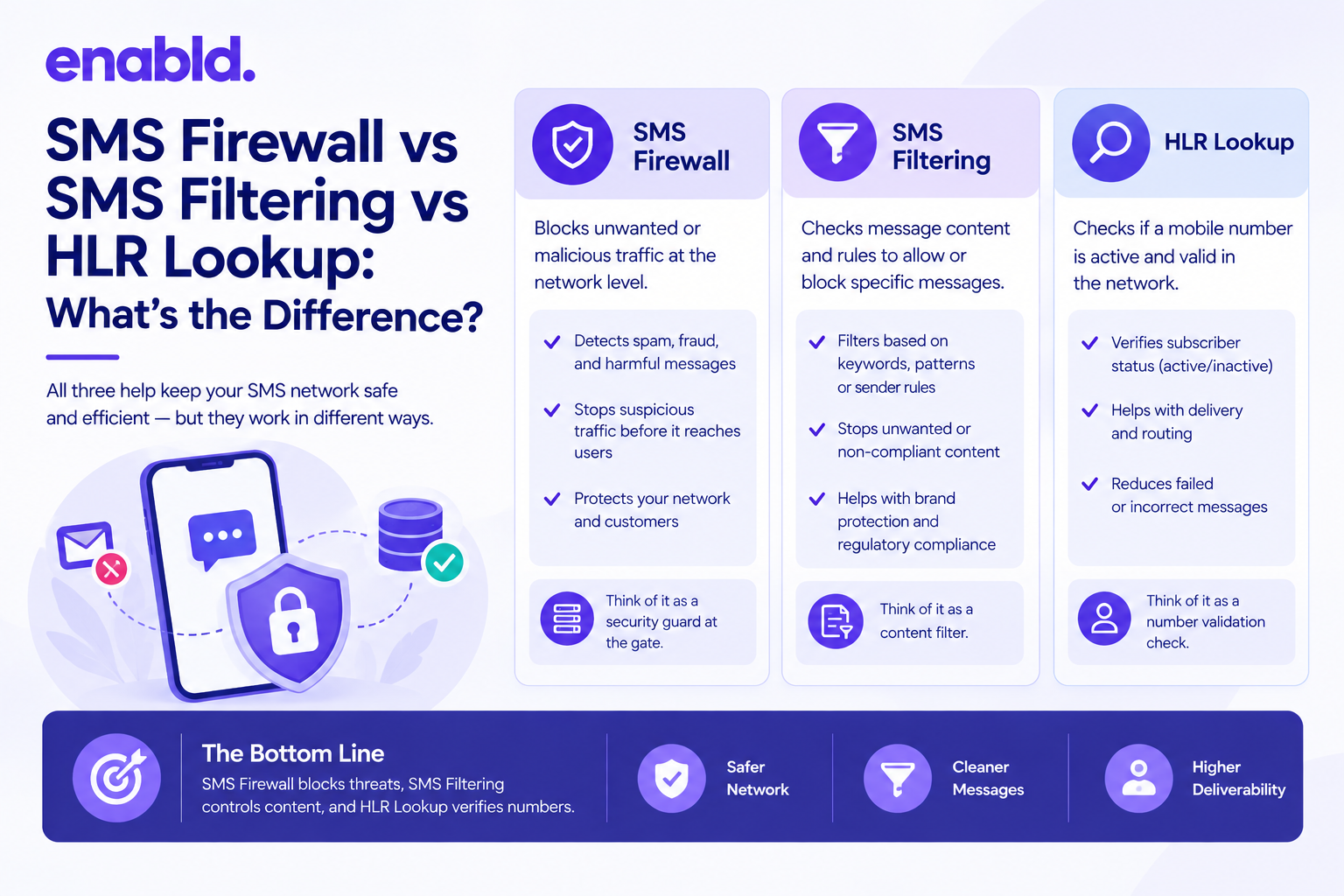
| Quick Answer: An SMS firewall is the overall system that inspects and blocks fraudulent or unauthorized traffic in real time. SMS filtering is one function inside that system, screening message content, sender patterns, and volume against defined rules. HLR lookup is a specific data query that checks a subscriber’s live network status, and it acts as one input a firewall uses for detection, not an enforcement system by itself. |
What Is an SMS Firewall?
An SMS firewall is the network security layer that inspects every message entering a telecom operator’s network and decides whether to allow, block, or redirect it. It is the umbrella system, combining multiple detection methods, content rules, volume analysis, sender verification, and subscriber data checks, into one enforcement point sitting at the edge of the network. When people say a message was blocked by “the firewall,” they are describing the outcome of several underlying checks working together, not a single mechanism.
What Is SMS Filtering?
SMS filtering refers to the specific rule sets a firewall applies to decide whether a message looks legitimate or suspicious. Filtering is a function that lives inside a firewall rather than a separate system that replaces one, even though some vendors market lightweight filtering tools on their own.
Content Based Filtering
This layer scans message text for spam indicators, banned keywords, phishing patterns, or content that violates an operator’s messaging policies, flagging or blocking messages that match known bad patterns.
Behavioral and Volume Based Filtering
This layer looks at sending patterns rather than content, flagging a single source suddenly pushing an unusual volume of messages, or traffic that matches known grey route behavior described in our guide on what an SMS firewall actually blocks.
What Is HLR Lookup?
HLR lookup is a real time query sent to the Home Location Register, the network database that holds a subscriber’s current status, including whether their number is active, which network they are registered on, and their roaming and porting history. On its own, an HLR lookup does not block or allow anything. It simply returns data.
What Data an HLR Lookup Returns
A typical HLR lookup response confirms whether a number is currently active, identifies the subscriber’s home and current serving network, and flags roaming status or recent porting activity, details that are difficult to fake and useful for spotting irregular numbers.
How HLR Lookup Feeds Into Fraud Detection
A firewall uses HLR lookup results as one input among several. A number with an inconsistent porting history or unusual roaming pattern gets weighted differently than one with a clean, stable record, but the firewall, not the lookup itself, makes the final decision on how to treat that message.
SMS Firewall vs SMS Filtering vs HLR Lookup: Key Differences
| Aspect | SMS Firewall | SMS Filtering | HLR Lookup |
| What it is | The overall enforcement system | A rule set applied within the firewall | A real time subscriber data query |
| Function | Decides to allow, block, or redirect traffic | Screens content, volume, and sender patterns | Confirms subscriber and network status |
| Operates alone? | Yes, as the enforcement layer | No, runs as part of a firewall | No, feeds data into detection, does not enforce |
| Primary use | Blocking fraud and grey route traffic | Flagging spam and abnormal sending behavior | Validating number legitimacy and status |
| Where it sits | Network edge, inspecting all traffic | Inside the firewall’s rule engine | Queried on demand as part of firewall logic |
How These Three Work Together in a Real Deployment
In practice, none of these three operate in isolation, and a mature deployment treats them as layers rather than competing options.
Firewall as the Orchestration Layer
The firewall is the system that receives every incoming message, runs it through the relevant checks, and makes the final call. It is the layer an operator actually configures policy in, and everything else feeds decisions back to it.
Filtering as a Detection Rule Set
Filtering rules are what the firewall actually evaluates each message against. Without filtering logic, a firewall has no criteria to act on, which is why the two are so often described together even though they are not the same thing.
HLR Lookup as a Data Source
HLR lookup supplies one specific type of evidence, subscriber and network status, that filtering rules can weigh alongside content and volume signals. It answers a narrow question well, but it was never designed to be a standalone fraud detection system.
Common Misconceptions Worth Clearing Up
SMS Filtering Alone Is Enough
Filtering catches known patterns, but fraud tactics shift constantly, and content or volume rules alone will eventually miss traffic that mimics legitimate behavior. Filtering needs to sit inside a broader firewall with additional signals, including HLR based validation, to stay effective over time.
HLR Lookup Is a Firewall
Because HLR lookup is often sold as part of a combined “SMS firewall and HLR lookup” product, it is easy to assume the lookup itself is doing the blocking. It is not. The lookup returns data, and the firewall’s rules decide what happens with that data.
What Telcos Should Actually Evaluate When Buying
When comparing vendors, it helps to ask specifically which of these three capabilities a platform provides natively versus which ones are bolted on or missing entirely.
- Does the platform combine content filtering, volume analysis, and HLR based validation in one system, or are these separate purchases?
- How current is the HLR data, and how quickly does a lookup return during real time message processing?
- Can filtering rules be adjusted by the operator’s own team, or does every change require a vendor request?
- Does the firewall integrate with existing SMS gateway infrastructure, or does it require a separate inspection point?
How Enabld Combines All Three
Enabld’s SMS firewall and HLR lookup platform is built around exactly this layering, real time content and volume filtering combined with live HLR based subscriber validation, running as a single system rather than separate tools an operator has to stitch together. That firewall sits on top of the same routing intelligence used across Enabld’s CPaaS platform, so fraud detection benefits from the same traffic visibility the gateway already has rather than working from a narrower, isolated view.
Final Thoughts
SMS firewall, SMS filtering, and HLR lookup describe three different layers of the same problem, not three competing solutions. The firewall enforces, filtering defines the rules it enforces against, and HLR lookup supplies one of the data sources those rules depend on. Understanding that layering makes vendor conversations far clearer, and makes it much easier to spot when a vendor is describing one piece of the stack as though it were the whole thing. If you are evaluating fraud protection for your own network, talk to the Enabld team about how firewall, filtering, and HLR validation work together on one platform.
Frequently Asked Questions
What is the difference between an SMS firewall and SMS filtering?
An SMS firewall is the full enforcement system that decides whether to allow or block traffic, while SMS filtering is one set of rules within that firewall, screening messages by content, volume, and sender behavior.
Is HLR lookup the same as an SMS firewall?
No. HLR lookup is a real time data query that confirms a subscriber’s network status, while an SMS firewall is the broader system that uses that data, along with other signals, to actually block or allow messages.
Can SMS filtering work without a firewall?
Filtering rules need an enforcement system to act on their results, so in practice filtering operates as a component of a firewall rather than as a fully standalone solution.
Why do vendors sell SMS firewall and HLR lookup as one product?
HLR lookup is one of the most valuable data sources a firewall can use for fraud detection, so bundling the two lets operators get real time validation and enforcement from a single integration rather than two separate systems.
Does HLR lookup slow down message delivery?
A well built HLR lookup integration returns results quickly enough to run as part of real time message processing, adding negligible delay compared to the overall delivery time of an SMS.
What happens if a message fails HLR validation?
The firewall, not the HLR lookup itself, decides what happens next. Depending on configured rules, a failed or inconclusive HLR result might lead to the message being blocked, flagged for review, or weighted alongside other fraud signals.
Is SMS filtering enough to stop grey route fraud on its own?
Not reliably. Grey route fraud often mimics legitimate traffic patterns closely enough that content and volume filtering alone can miss it, which is why HLR based subscriber validation is typically layered on top.
Should a telco buy SMS firewall, filtering, and HLR lookup from separate vendors?
It is generally more effective to use a platform that combines all three natively, since separate systems from different vendors often lack the shared visibility needed to correlate signals accurately in real time.