The Communication Platform as a Service (CPaaS) market is growing fast as enterprises realize the advantages of unified communications and messaging and look to telecom carriers to step up and meet their requirements. There are about a dozen or so telecom carriers across the world, serving huge markets with billions of subscribers, and then there are hundreds of virtual operators who piggy-back on tier-1 operators. They too offer CPaaS to their enterprise clients just like telecom carriers do. According to Gartner, 90% of enterprises will be using CPaaS by 2028. This is not surprising given the inherent benefits of the platform. Here, it must be understood that CPaaS is a generic term, and, if you dig deeper, there are vast differences across features. MVNOs may offer platforms with fewer features to serve smaller businesses, but telecom operators targeting top-level enterprises must look at CPaaS through a different lens since such a platform must be robust, scalable, absolutely secure, customizable, and feature-rich. If you are a telecom operator, this guide should give you a starting point for selecting a telecom-grade CPaaS.
Table of Contents
- What falls under CPaaS?
- Evaluation Points
- Do not Rush It
- Conclusion
What falls under CPaaS?
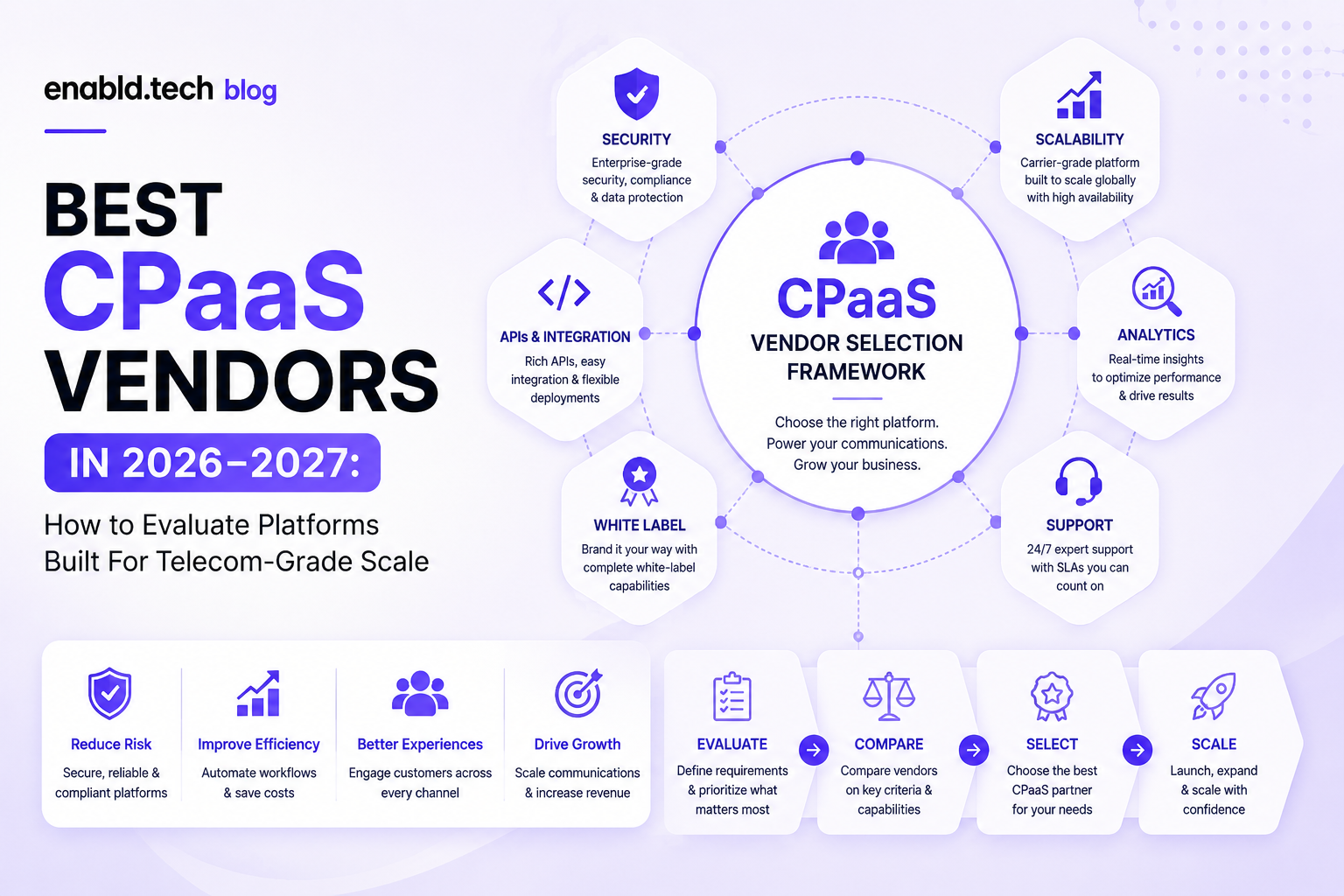
A Communication Platform could be something as simple as a cloud-based service offering voice and text messaging. It can also be more complex to cover omnichannel services, voice, email, messaging apps, video, rich communication and SMS. Layered on top are conversational capability, authentication, automation, security, APIs, AI-integration, chatbots, analytics, and automation. This is just a bird’s eyeview and most providers offer these features. As a telecom operator planning to offer digital communication services to your enterprise clients, you need to do a granular analysis of the platform and features prior to selecting a CpaaS partner. Here, it must be stated that most telecom operators would do well to consider white-label CpaaS as the best option because you get a head start with a market-proven and time-tested platform built for carriers, such as Enabld’s CpaaS platform. There are other factors that have a direct bearing on evaluating a CpaaS provider.
Evaluation Points
| Item | Factors to consider |
| Direct inbound dialing | Outbound calls may be routed through various paths to manage disruptions, but inbound call quality is even more important. How does the CpaaS provider technically manage direct inbound calls? Top-notch platforms factor in uptime, real-time monitoring, and geo-redundant data centers, while avoiding gray routes. |
| Integration | CpaaS comprises many modules like voice, video, rich communications, MMS, SMS, OTT messaging, and email, to mention a few. How well does the CpaaS provider integrate these modules through a unified dashboard? Does the module have abilities to scale effortlessly to handle sudden transient spikes in messaging? Is there interoperability and seamless switching between any or all of these channels? Do you get AI integration with ML capabilities? Do you get scheduling options? |
| Administrative | Telecom carriers need administrative facilities to manage the hundreds of enterprise clients who use their CpaaS. Telecom carriers, in turn, rely on CpaaS providers to provide software that has a vastly superior, AI-enabled administrative and accounting module that plugs into an existing CRM and allows easy control as well as analytics. Does the CpaaS under evaluation offer these facilities? |
| Modularity | CpaaS providers offer plenty of features in their software. The important thing for such white-label packages that telecom carriers use to serve enterprise clients is whether there is modularity. Not all of their clients want all features. It makes sense to offer and bill for only those services an enterprise needs and uses. |
| White label | White label CpaaS is the best way forward. CpaaS cannot be developed and deployed in a day or a month. Even after deployment, given the wide-ranging use-case scenarios, bugs pop up that need ironing out to make the package as fool-proof as possible. It takes years to fine-tune and refine a product. If you, as a carrier, can get such a white-label product, then you are off to a running start. Do not ever make the mistake of wanting to develop your own CpaaS. |
| Infrastructure | Does the white-label CpaaS provider have the required cloud infrastructure to serve telecom carriers who are looking at volume traffic and millions of transactions? |
| API integration | APIs are important for CpaaS to be integrated into a carrier’s existing software and hardware setup. It is just as important when the carrier, in turn, deploys these same CPaaS services to enterprise clients where APIs must hook into the existing software setup seamlessly. Check for SIP API capabilities, REST endpoints, webhook customization, and number provisioning, as also Call Detail Records, and CNAM management. |
| Support | Telecom carriers may not have the technical expertise to implement CpaaS and then provide support to users to ensure services are up and running. Does your CpaaS provider offer full support 24×7? |
Do not rush it
If you, as a telecom carrier, intend to offer CPaaS value-added digital services to your local or global clients, you cannot afford anything by way of technical snags that would affect your reputation and cause customer churn. Take it easy. Evaluate and re-evaluate. Hold remote discussions or in-person discussions as many times as it takes to give you a clear perspective and then decide.
Conclusion
Implementing CPaaS and offering digital value-added communication services to your enterprise is a giant step forward towards growth in terms of clientele and revenues. A careful evaluation of a CPaaS package is essential. If you have hesitation or do not know how to evaluate, or parameters to consider, you may even call in Enabld’s tech experts to assist you with CPaaS evaluation, and, hopefully, you should have clarity when you decide to go ahead.