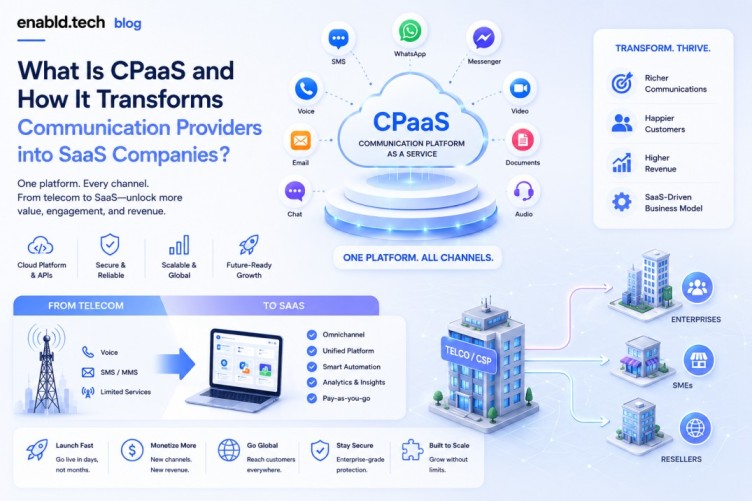
Telecom carriers offer vanilla communication like voice, MMS, and SMS. CPaaS, or Communication Platform as a Service, transforms a plain dish into a full-fledged menu covering rich communication services like WhatsApp and similar messaging platforms like Viber, WeChat, and Telegram, as well as video, documents, large audio files, and high-resolution photos with end-to-end encryption. What is more, all these diverse channels are unified on a common platform that allows easy cross-channel communication and tracking. Telecom carriers can sign up for CPaaS and then, in turn, offer any or all these services in a modular, pay-as-you-go fashion to their enterprise clients, small businesses, and resellers, effectively transforming into a software as a service business overnight with a consequent leap in revenues. That brings us to the question: What is CPaaS, and how does it enable the transformation of telcos to SaaS providers? Where does Enabld, the leading carrier-grade CPaaS provider fit into this scenario, and how can it help telecom carriers transform into a high-revenue earning SaaS enterprise?
What is CPaaS?
To start at the beginning, let us dwell a bit on CPaaS. CPaaS, or Communication Platform as a Service, is defined as a cloud-based platform for communication software that allows users to harmonize and integrate multiple channels of communications through a unified dashboard. You get SMS, WebRTC, long-form SMS, MMS, voice, chat, messaging app, video, document, and audio file communications built into the package in a modular way so that communication service providers like telecom carriers can offer these services to their clients on a selective basis according to needs and charge accordingly on a pay-as-you-go model. A CPaaS provider provides the cloud platform and the software that sits on top of the carrier’s existing hardware and software infrastructure. The carrier then offers these services to its enterprise clients via API integration into the user’s software setup for one-click communication through any channel. When they offer this service integration, carriers are effectively offering what can be termed “Software as a Service,” or SaaS. Enabld’s class-leading CPaaS is the vital platform powering this transitioning.
The change from telecom carrier to SaaS provider
A telecom carrier’s traditional business of voice and SMS relies on its core hardware infrastructure by way of towers, switches, and transmission equipment. CPaaS layers a communication software stack on top of this existing carrier’s software and hardware infrastructure along with a host of SDKs and APIs. The carrier then enrolls enterprise clients, small businesses, or resellers and allows them the use of any of these services through their existing software setup. This is achieved with the use of various APIs. The platform also allows carriers to set up accounts for each enterprise client for any or all of these modular communication facilities, track usage, grant permissions and access, set rates, set currency, and bill based on the pay-as-you-go model. They may also offer enhanced services like analytics and AI chatbots or even agentic bots to enterprise clients. In effect, what they are offering is software as a service. Take WhatsApp, Skype, or Facebook Messenger—all these are software-based messaging services. By taking all these into their fold through the CPaaS platform, these telcos are, in effect, offering software-based communication integration into their client’s setup.
Why would clients want to access software-based Whatsapp (or any other OTT messaging), or carry out SMS operations through the telco’s platform?
If users wish to send or receive a WhatsApp message, they must use the app on their smartphones or the web interface. This has the drawback of not being able to track or link topic-related messages exchanged through WhatsApp, email, or SMS. This inevitably leads to communication delays and errors resulting in customer dissatisfaction. Telcos integrate WhatsApp into an enterprise’s existing software, transforming usage patterns and methods, besides enhancing security, tracking, monitoring, and data maintenance.
The same applies to SMS. Software-based SMS integration into an enterprise’s setup permits transmission of scheduled bulk messages to selected groups of recipients. Besides that, enterprises can also use SMS for 2FA, to send OTPs, for payment and order confirmation, for updates, and for interactive communication. Communications take place in real time with security, monitoring, tracking, and recording to a central database. This monitoring, tracking, syncing, and recording would not be possible when SMS is done through a smartphone or a standalone SMS app.
These are just two use cases of communication channels switched to software based on CPaaS. Carriers can bill clients on a usage basis as is done in the SaaS segment.
This table gives you at-a-glance look at the differences between CPaaS and SaaS
| Features | CPaaS | SaaS |
| Cloud software layered on carrier hardware | Yes, CPaaS providers provide the crucial software layer on top of the carrier’s hardware, integrating the two in order to offer value added rich communication | Communication features integrated into user setup through APIs and SDK, permitting omnichannel communication through software |
| User category | Telcos and service providers | End users like enterprises, SMEs, resellers |
| Implementation | Via APIs | Via APIs into enterprise’s existing software setup |
| Usage Pattern | Bulk, on national and global levels, serving enterprises through software-hardware mix infrastructure | Localised individual use by an enterprise and its branches, based purely on software |
| Traffic | High traffic capabilities, interoperability, protocol handshakes, and more, handled by hardware and software | Channels through to the CPaaS platform on the carrier’s side |
Telco’s deployment of CPaaS meets the criteria of SaaS
- Communication Software as a Service is offered on a pay-as-you-go model, with users offered the choice of modules, capacity, and other parameters that the carrier can define and assign to the user’s account.
- All operations are software-based, with no need for specialized hardware such as those in use at the carrier’s end.
- Software incorporates facilities for maintaining individual accounts, tracking, data compilation, analytics, reports, insights, billing, setting languages, billing currency, billing cycles, and flexible add or remove modules on request.
Conclusion
While CPaaS is a mix of software, cloud platform, and communication hardware interface, which is the arrangement between the CPaaS provider and the carrier, the SaaS model applies to the arrangement between the carrier and their clients who use any or all of the communication channels the CPaaS platform facilitates in the background. The carrier uses APIs to plug in their software platform and its facilities to the user’s software setup, which is a purely software-based activity. User activity is also software-based and billed on usage on various channels like SMS, voice, and WhatsApp, all of which are available through the user’s software-based dashboard. There is quite a bit of work to be done to set up Enabld’s out-of-the-box white-label CPaaS software, but the company’s engineers provide full support to mesh the platform with the telco’s existing infrastructure and set up its now SaaS ecosystem. All it takes is a week or even less for telcos to start SaaS and watch revenues flow in.