Every SMS integration project eventually runs into the same fork in the road, connect over SMPP or connect over an HTTP API. The two protocols move the same message types, but they are built on fundamentally different session models, and choosing the wrong one for a given traffic profile shows up later as throughput problems, unnecessary complexity, or a gateway that cannot scale the way the business needs it to.
This guide breaks down SMPP vs HTTP SMS API at the architecture level, covers how SMPP vs REST API differs specifically, and gives telecom operators and aggregators a clear framework for deciding which protocol fits their traffic.
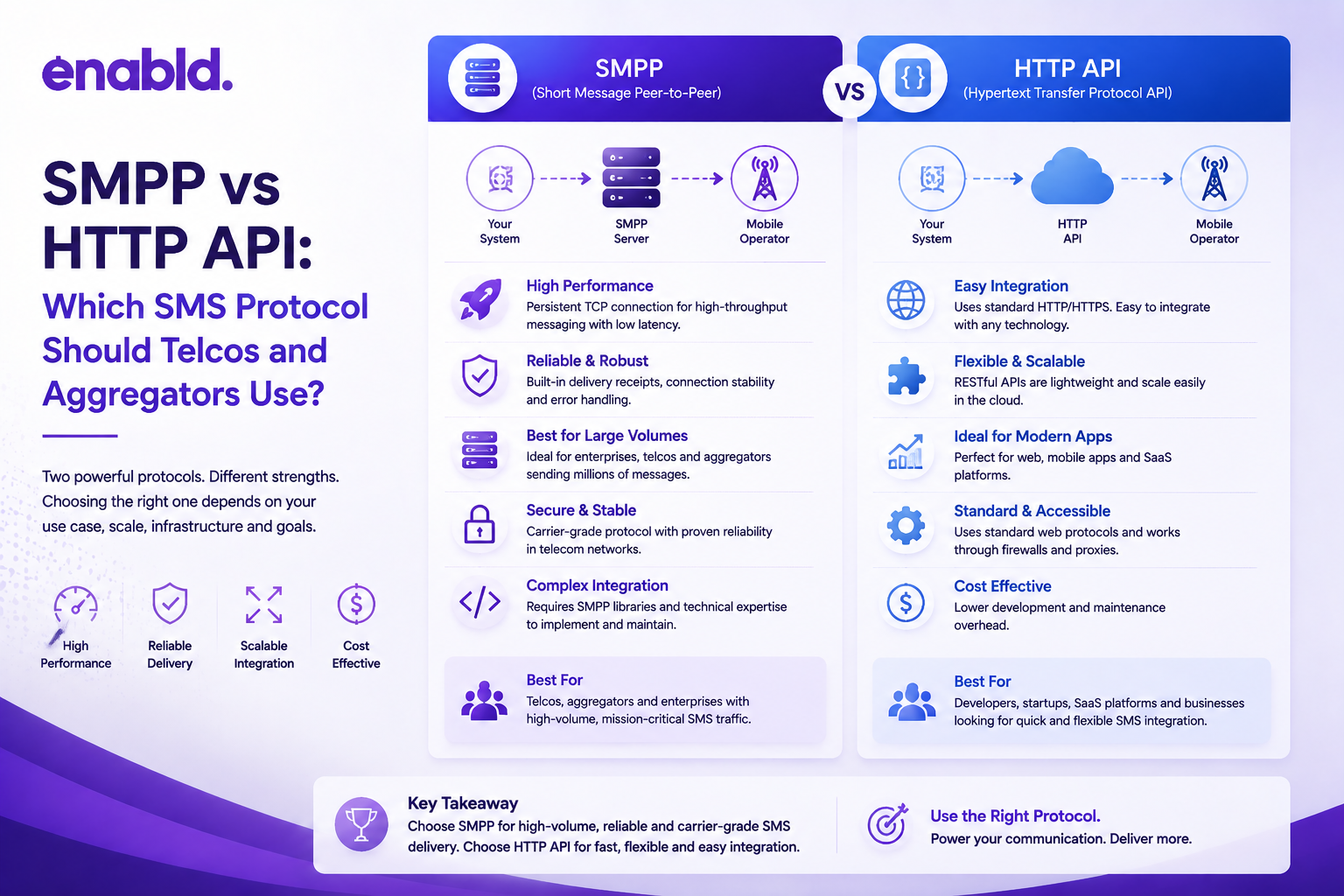
Quick Answer: SMPP is a persistent, session based binary protocol built specifically for high throughput SMS traffic between telecom systems. An HTTP SMS API is a stateless, request and response protocol built for simpler integration and lower to moderate volume. SMPP suits carriers, aggregators, and high volume A2P traffic, while HTTP APIs suit enterprises and applications that prioritize ease of integration over raw throughput.
What Is SMPP?
SMPP, Short Message Peer to Peer, is a binary protocol designed specifically for exchanging SMS traffic between an SMSC and an external system, referred to as an ESME, External Short Messaging Entity. The current widely deployed version is SMPP 3.4, though 5.0 exists with additional capabilities.
The defining feature of SMPP is the bind. A client establishes a persistent TCP connection to the SMSC or gateway and authenticates once, then keeps that connection open to send and receive messages continuously. Commands like submit_sm push a message out, and deliver_sm brings delivery reports and inbound messages back, all over the same long lived session. Because the connection stays open, SMPP avoids the overhead of repeatedly establishing new connections, which is exactly why it became the standard protocol for carrier to carrier and high volume A2P messaging.
What Is an HTTP SMS API?
An HTTP SMS API, often built as a RESTful interface, works on the same request and response model as most modern web APIs. A client sends an HTTP request, typically a POST with the message payload, to a specific endpoint, and the server returns a response confirming receipt. There is no persistent session to manage. Each request stands alone, authenticated independently, usually with an API key or token in the request header.
This statelessness is what makes HTTP SMS APIs so approachable for developers. Any programming language with basic HTTP support can integrate without needing an SMPP client library or an understanding of binary protocol commands, which is a large part of why HTTP APIs dominate lower volume and enterprise integrations.
SMPP vs HTTP API: Architecture Comparison
| Aspect | SMPP | HTTP SMS API |
|---|---|---|
| Connection model | Persistent bind, long lived TCP session | Stateless, one request per message |
| Protocol type | Binary, telecom specific | Text based, typically REST over HTTPS |
| Throughput | Very high, built for carrier scale traffic | Moderate, limited by request overhead |
| Integration complexity | Requires an SMPP client library and protocol knowledge | Straightforward for any developer familiar with HTTP |
| Delivery reports | Delivered asynchronously over the same bind via deliver_sm | Delivered via webhook callback to a separate endpoint |
| Typical users | Carriers, aggregators, high volume A2P senders | Enterprises, application developers, lower volume senders |
SMPP vs REST API: A Closer Look
Since most modern HTTP SMS APIs are built as REST APIs specifically, it is worth addressing SMPP vs REST API as its own comparison. REST layers a set of architectural conventions on top of HTTP, using standard verbs like POST and GET against defined resource endpoints, along with predictable response formats like JSON. That makes a REST based SMS API easy to test, easy to document, and easy to integrate into modern application stacks without any specialized tooling.
SMPP was never designed with that kind of accessibility in mind. It was built for telecom systems talking to other telecom systems, where both sides already understand the protocol and raw throughput matters more than developer convenience. The tradeoff is straightforward, REST API integration is faster to build and easier to maintain, while SMPP delivers the sustained throughput that carrier scale traffic actually requires.
When Should You Use SMPP?
SMPP is the right choice when message volume is high and consistent, and when the systems on both ends are already built for telecom grade protocols. Aggregators moving millions of messages a day, mobile operators exchanging A2P and P2P traffic, and CPaaS providers running wholesale routes all rely on SMPP because a single persistent bind can sustain far higher throughput than repeatedly opening and closing HTTP connections ever could. It is also the protocol of choice when delivery timing and session level control genuinely matter, since everything happens over one continuously managed connection.
When Should You Use an HTTP SMS API?
An HTTP SMS API makes more sense when ease of integration matters more than raw throughput, which describes most enterprise use cases. A SaaS company sending OTPs, a retailer sending order confirmations, or a healthcare provider sending appointment reminders typically does not need carrier scale volume, and the simplicity of a REST call fits naturally into how their engineering team already builds and maintains software. For teams without dedicated telecom expertise, an HTTP API also removes the need to manage bind states, reconnect logic, and other session level concerns that come with SMPP.
SMPP Gateway vs HTTP Gateway: What Changes at the Infrastructure Level
The protocol choice does not just affect the client integration, it shapes how the gateway itself needs to be built. An SMPP gateway has to manage large numbers of concurrent persistent connections, monitor bind health, handle reconnection logic, and sustain high message throughput per session without dropping traffic. An HTTP gateway, by contrast, has to handle a high volume of discrete, short lived requests efficiently, which usually means it leans more heavily on load balancing and request queuing rather than session management.
A carrier-grade platform generally needs to support both well rather than treating one as an afterthought. Enabld’s SMS gateway platform is built to handle SMPP, HTTP, SS7, and SIP simultaneously, which matters in practice, since operators and aggregators often need to accept traffic in whichever protocol a given partner already uses rather than forcing everyone onto a single standard.
Can You Use Both SMPP and HTTP in the Same Deployment?
In practice, most telecom grade platforms run both protocols at once rather than picking a single one. A gateway might accept HTTP traffic from an enterprise customer on one side while exchanging traffic with wholesale partners over SMPP on the other, converting between the two as needed, including recombining or splitting long messages that behave differently across protocols. This kind of protocol bridging is common enough that it shows up directly in real deployments, including in Enabld’s own work connecting partners across SS7, SMPP, and HTTP within a single messaging infrastructure, as covered in our case studies.
How to Decide Between SMPP and an HTTP SMS API
A useful way to frame the decision is to start with three questions. What is the expected message volume, since consistently high volume favors SMPP while moderate or bursty volume works fine over HTTP. Who is building the integration, since a lean application team without telecom experience will move faster with a REST API, while a telecom or aggregator team already comfortable with binary protocols will get more value from SMPP. And finally, does the traffic need to travel through the same signaling layers described in our guide on how an SMS gateway works, where SMPP’s tight integration with SS7 based routing tends to matter more.
Final Thoughts
Neither SMPP nor an HTTP SMS API is universally better, they solve different problems. SMPP remains the standard for high throughput, carrier grade SMS traffic where persistent connections and sustained volume matter most. HTTP APIs, particularly REST based ones, remain the fastest path to integration for enterprises and application teams that do not need carrier scale throughput. Most serious messaging infrastructure ends up supporting both rather than forcing a single choice. If you are deciding which protocol fits your traffic, or need a gateway that can bridge both, talk to the Enabld team about your specific volume and integration requirements.
Frequently Asked Questions
What is the main difference between SMPP and HTTP for SMS?
SMPP uses a persistent, session based connection built for high throughput SMS traffic, while an HTTP SMS API uses stateless, individual requests better suited to simpler, lower volume integrations.
Is SMPP faster than an HTTP SMS API?
For sustained high volume traffic, yes. SMPP’s persistent bind avoids the overhead of repeatedly opening new connections, which allows significantly higher throughput than typical HTTP requests.
Is a REST API the same thing as an HTTP SMS API?
Most modern HTTP SMS APIs are built following REST conventions, so the terms are often used interchangeably, though REST specifically refers to a set of architectural rules layered on top of HTTP.
Why do carriers and aggregators prefer SMPP over HTTP?
Carriers and aggregators typically handle very high, consistent message volumes, and SMPP’s persistent session model sustains that throughput far more efficiently than repeated HTTP requests would.
Is SMPP harder to integrate than an HTTP SMS API?
Yes, generally. SMPP requires an SMPP client library and an understanding of binary protocol commands, while an HTTP SMS API can be integrated using standard web development tools.
Can a single SMS gateway support both SMPP and HTTP?
Yes. Carrier-grade gateways commonly support SMPP, HTTP, SS7, and SIP simultaneously, allowing operators to accept traffic in whichever protocol a given partner already uses.
Which protocol is better for sending OTPs?
Either can work, but enterprises sending OTPs at moderate volume typically choose an HTTP SMS API for its simplicity, while high volume OTP senders may use SMPP for throughput.
Do delivery reports work differently between SMPP and HTTP?
Yes. SMPP delivers reports asynchronously over the same open bind using deliver_sm, while HTTP APIs typically send delivery status through a separate webhook callback.