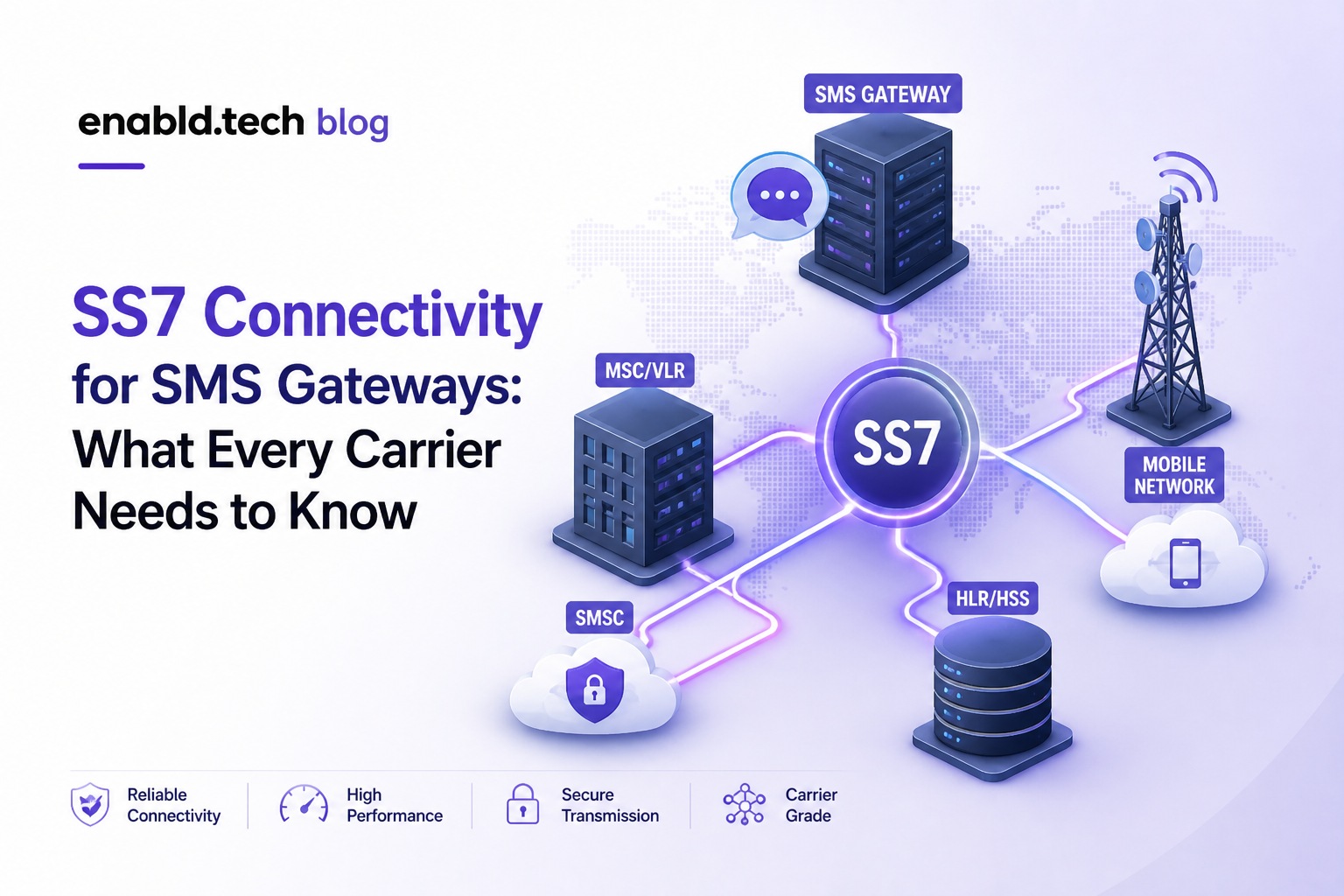
In a world where A2P SMS traffic continues to grow and enterprises demand real‑time, reliable messaging, SS7 connectivity has become an important differentiator for any modern SMS gateway platform. SS7 is the signaling backbone that lets carriers and wholesalers move from “best‑effort” delivery to telecom‑grade SMS routing, visibility, and control.
This article breaks down what SS7 connectivity really means for your SMS gateway and messaging infrastructure, why it matters for wholesale SMS gateway providers, and what every carrier should look for in an SS7 SMS gateway and SS7 service provider.
Table of Contents
- Why SS7 Still Matters in a Modern SMS Gateway
- Performance: How SS7 Boosts SMS Throughput
- SS7 vs Traditional Aggregator Routes
- How SS7 Fits into Your SMS Routing Platform
- Benefits of SS7 Connectivity for Carriers and Wholesalers
- Hosted SS7 vs Dedicated SS7 Platform
- What to Look for in an SS7 Service Provider?
- SS7 in Hybrid and IP‑Based Networks
- Building an Enterprise‑Ready SMS Solution on SS7
- Final Thoughts and Next Steps
Why SS7 Still Matters in a Modern SMS Gateway
SS7 (Signaling System 7) was initially designed for handling call setup and related tasks, but today it is also used for essential SMS services such as routing, roaming, and delivery reports between networks. For carriers and SMS providers, direct SS7 connectivity means communicating with the mobile core instead of relying on multiple intermediary hubs.
By using an enterprise grade SMS gateway, which supports SS7, you will be able to:
- Route messages directly into operator networks instead of over‑the‑top routes.
- Reduce the number of “hops” each SMS takes, which lowers latency and failure points.
- Gain deeper visibility into HLR lookups, routing, and delivery outcomes.
To put it simply, SS7 isn’t just a legacy technology; it’s a core technology that will distinguish a basic SMS solution for enterprises from a true carrier‑grade SMS routing platform.
Performance: How SS7 Boosts SMS Throughput
Throughput is one of the most significant motivations behind carriers opting for an SS7 SMS gateway solution because having control over the signaling pathway allows for a greater volume of messaging throughputs at higher levels of reliability.
According to Ozeki’s SS7 performance benchmarks, a single SS7 link can process between 12–18 SMS messages per second, and four SS7 links together can carry around 60–70 messages per second. On an E1 connection, you can theoretically host up to 30 SS7 links, but in practice you may get about 16 links, which translates into a “real speed limit” of approximately 240–300 SMS per second for SS7 over E1.
Similarly, Melrose Labs reports that its SS7 SMSC platform can be scaled up to 500 SMS per second, assuming sufficient SIGTRAN link capacity in the core network. These numbers illustrate how SS7‑based infrastructure can support wholesale volumes and large enterprise campaigns without relying on fragile, over‑the‑top routes.
SS7 vs Traditional Aggregator Routes
To understand the impact on your SMS Gateway & Messaging Infrastructure, it helps to compare SS7 connectivity with traditional aggregator‑based delivery.
| Aspect | Traditional Aggregator Route | SS7-Enabled SMS Gateway Platform |
| Network hops | Multiple third-party hubs before reaching MNO | Directly connected into carrier networks via SS7/SIGTRAN |
| Latency | Higher and less predictable | Lower latency with faster, more efficient routing |
| Delivery control | Limited control over final route | Full control of routing and prioritization at SMSC/SS7 level |
| Visibility | Basic delivery receipts only | Deep visibility via HLR, MAP operations, CDRs, and routing logic |
| Scalability | Dependent on partner capacity | Designed to scale via multiple SS7/SIGTRAN links and SMSC architecture |
| Use cases | Low-to-mid volume, price-driven | Wholesale volumes, mission-critical enterprise messaging |
Because the SS7 providers have direct access to the SS7 channels, they are able to fully manage the process of SMS routing across the wireless networks all the way until the message gets delivered on the target device. This level of control is what enterprises expect when they invest in a telecom‑grade SMS delivery gateway rather than a generic bulk SMS tool.
How SS7 Fits into Your SMS Routing Platform
An SMS Gateway platform that uses SS7 usually combines several building blocks to manage wholesale and enterprise messaging end‑to‑end.
Key elements include:
- SS7 SMSC / SS7 SMS gateway: Handles GSM MAP operations like Send Routing Info for SM (SRI for SM) and Forward Short Message (FSM) to interface directly with the mobile core.
- SIGTRAN connectivity (M3UA, M2PA, SCTP): Provides IP‑based transport for SS7 signaling, giving high‑throughput, low‑latency links between your gateway and the SS7 network.
- Intelligent routing engine: Finds the most efficient route for each SMS, minimizing unnecessary stops and delays.
- Reporting and CDRs: Generates call detail records with information such as IMSI and MSC per SMS along with analysis of the traffic on different networks based on deliverability.
For SMS wholesalers and CPaaS providers, these elements form part of a wholesale SMS gateway that also includes route management, pricing, billing, and bilateral agreements, all from one central platform.
Benefits of SS7 Connectivity for Carriers and Wholesalers
When you extend your SMS routing platform with SS7 connectivity, the benefits show up in both technical quality and business outcomes.
- Higher delivery quality and reliability
Direct SS7 connectivity gives a faster, more reliable route for sending your messages because they go straight into carrier networks instead of passing through multiple third‑party hubs. As a result, messages experience lower latency and fewer unnecessary delays.
- Better cost control and margins
With SS7 solutions, SMS providers can connect directly to mobile networks, which reduces dependency on aggregators and improves control over routing and termination costs. This is especially valuable for wholesale SMS gateway businesses where margins are usually tight and volumes are very high.
- Global reach with telecom‑grade infrastructure
An SS7 platform serves as the foundation for your messaging infrastructure, enabling high‑quality routing, protocol conversion, and monitoring across networks worldwide. This makes it easier to support cross‑border SMS aggregation and multi‑brand operations without having to deal with any scalability constraints.
- Enterprise‑grade features and SLAs
For enterprises that rely on OTPs, alerts, and transaction-based messages, a telecom‑grade SMS delivery gateway with SS7 connectivity supports higher throughput, better delivery assurance, and more advanced monitoring than standard bulk SMS tools.
Hosted SS7 vs Dedicated SS7 Platform
Carriers and messaging providers generally choose between a hosted SS7 solution and a dedicated SS7 platform based on the size of the organization and its business approach.
- Hosted SS7 (SaaS): A hosted SS7 solution lets businesses send SMS traffic over SS7 without building and maintaining their own SS7 infrastructure. This is attractive for providers who want to launch quickly or test new markets.
- Dedicated SS7 platform: A dedicated SS7 platform gives full control over infrastructure at a more affordable price than traditional legacy deployments. This is suitable for providers who would like to have total ownership of the SS7 connections, maintain healthy profit, and differentiate on quality.
Some SMS Gateway & Messaging Infrastructure vendors combine both, offering hosted SS7 for fast go‑to‑market and dedicated deployments.
What to Look for in an SS7 Service Provider?
Choosing an appropriate SS7 service provider is crucial for ensuring the resilience of your wholesale SMS gateway as well as developing an enterprise-ready SMS solution. When evaluating potential partners, pay attention to:
- Direct operator connectivity: Make sure that they have direct access to carrier networks and support global routing via SS7 and SCCP.
- Scalable SIGTRAN links: They must be able to increase M3UA and M2PA link capacities via SCTP as your message volumes grow.
- Intelligent routing capabilities: Confirm they offer flexible, rules‑based routing and protection against abuses such as SRI for SM message misuse and spoofing.
- Monitoring, reporting, and compliance: Check for end‑to‑end monitoring, detailed reporting, and support for regulatory compliance across regions.
- Support for both wholesale and enterprise traffic: Ideally, the platform should handle high‑volume wholesale SMS as well as enterprise campaigns from a single architecture.
When these features come together, your SS7 SMS gateway becomes more than just a technical component; it becomes a strategic asset for your messaging business.
SS7 in Hybrid and IP‑Based Networks
Modern networks are increasingly IP‑based, which is why SS7 often runs over SIGTRAN in hybrid environments. Through this technology, mobile network operators can leverage legacy SS7 with next‑generation IP networks, without compromising on performance.
Using SIGTRAN to optimize SMS delivery brings benefits such as:
- Scalability to handle high SMS traffic volumes efficiently.
- Seamless hybrid network integration between legacy SS7 and newer IP‑based systems.
- Improved reliability and performance through reduced latency and packet loss using SCTP.
This hybrid approach is particularly useful for carriers and SMS providers that want to modernize their SMS routing platform while still leveraging existing SS7 assets.
Building an Enterprise‑Ready SMS Solution on SS7
When developing an SMS solution for enterprises over a wholesale SMS gateway, the following advantages can be provided by connecting to the SS7 network:
- Consistent delivery for OTPs and alerts, even at peak traffic times.
- Better visibility into the activity of enterprise customers with advanced reporting and delivery analytics.
- Custom routing profiles for each customer according to their needs with regards to quality of services, region or compliance.
Platforms that combine a wholesale SMS gateway and a telecom‑grade SMS delivery gateway with SS7 integration are designed specifically for communication service providers who want full control over infrastructure, routing, and profitability. They help you onboard enterprises, resellers, and partners under your own brand while maintaining service quality and regulatory compliance.
Final Thoughts and Next Steps
For telecom carriers, SMS wholesalers, and CPaaS providers, SS7 connectivity is not an option anymore if your aim is to offer telecom-grade messaging at scale. Having SS7 integration transforms your basic SMS gateway solution into a robust SMS routing system capable of:
- Handling high‑volume wholesale SMS traffic with predictable performance.
- Ensuring reliable enterprise messaging with the reliability and control expected from carrier‑grade infrastructure.
- Generating higher profits through direct operator connectivity and intelligent routing.
If you are considering how to upgrade your SMS Gateway & Messaging Infrastructure, now is the time to look into an SS7-enabled wholesale SMS gateway and SMS delivery gateway based on carrier-grade technology.
Look for the SS7 service provider offering various SS7 solutions, from hosted SS7 services to SS7 SMS gateways, so that you would be able to launch quickly, scale safely, and deliver high-quality messaging services to your enterprise and wholesale clients. One such provider is Enabld, it offers a robust SMS gateway platform with SS7 connectivity, intelligent routing, and scalable infrastructure designed specifically for telecom operators, aggregators, MVNOs, and CPaaS providers seeking direct operator peering and wholesale-grade performance.
Upgrade with Enabld’s SS7 solutions, from hosted services to full SMS gateways. Contact Enabld’s team of experts today to deploy telecom-grade SS7 connectivity and dominate wholesale messaging.