In today’s fast-paced business environment, enterprises need communication solutions that are instant, reliable, and scalable. Two-way SMS API platforms have emerged as the foundation of real-time enterprise communication, enabling organizations to send and receive messages at scale while maintaining seamless customer engagement. According to recent data, SMS boasts a 98% open rate compared to email’s 20%, making it the most effective channel for reaching customers.
But why is a two-way SMS API platform essential in the current business environment? Find out how cloud numbers platforms, provision of virtual phone numbers, and an SMS API have changed the way businesses communicate.
Understanding Two-Way SMS: Why It Matters for Enterprises
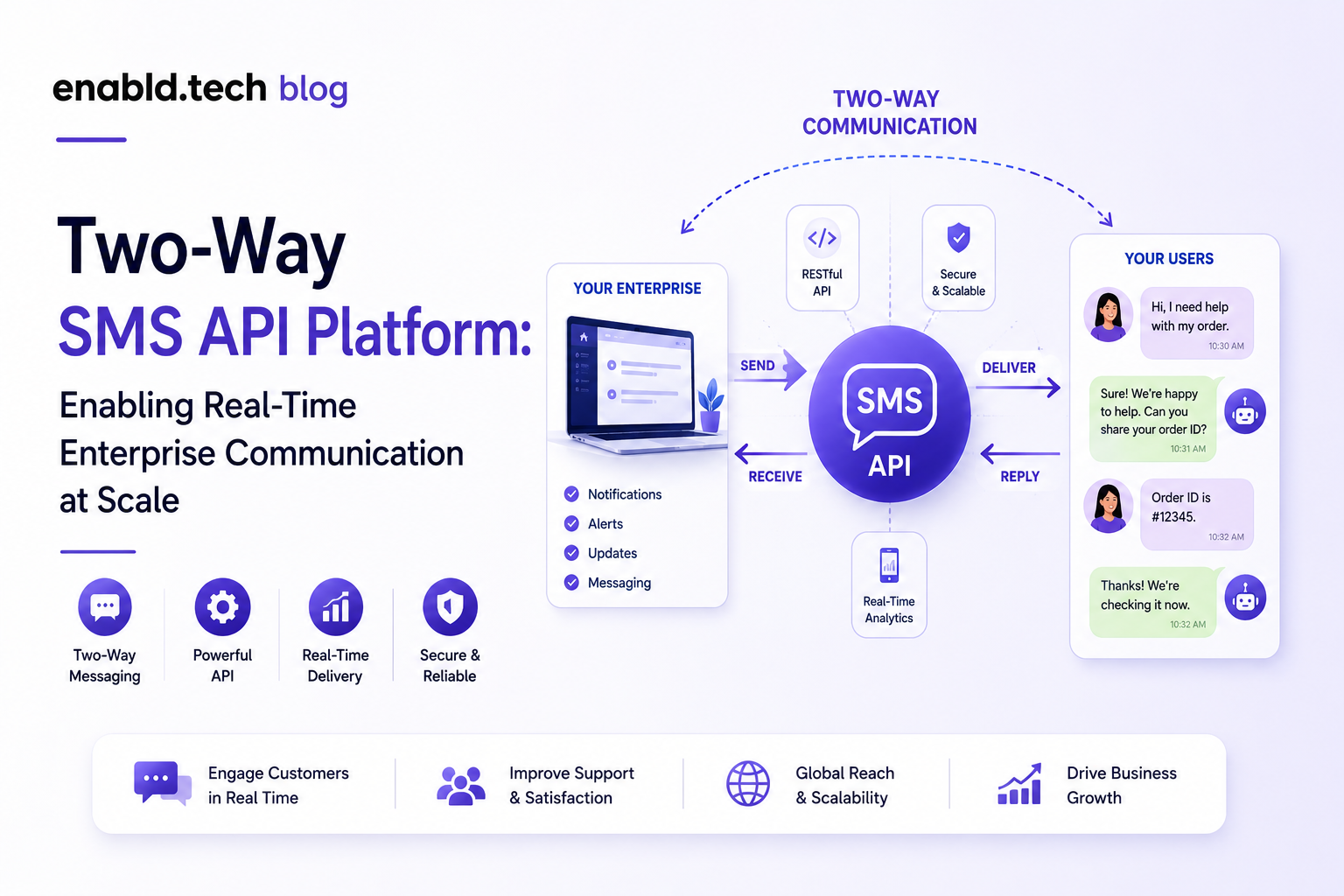
Two-way SMS allows businesses to not only send messages to their customers but also receive responses from them instantly. This type of communication helps create meaningful conversations rather than one-way broadcasts. The difference is significant:
- One-way SMS: Business sends promotional messages or alerts
- Two-way SMS: Customers can reply, ask questions, confirm appointments, or provide feedback
According to a report, business texting is on the rise, with 90% of texts read within 3 minutes of receipt. This immediacy makes two-way SMS ideal for customer support, appointment reminders, order updates, and verification processes.
The Power of Cloud Numbers Platform for Modern Business
A cloud numbers platform is the backbone of efficient SMS communication. While traditional phone systems rely on physical connectivity, a cloud-based number management system offers more flexibility, cost-efficiency, and global reach.
Cloud numbers platforms provide enterprises with:
- Instant number provisioning across multiple countries
- Centralized management through intuitive dashboards
- Automatic scaling based on message volume
- Reduced infrastructure costs compared to physical phone lines
- Integration capabilities with existing CRM and helpdesk systems
The cloud-based approach means businesses can expand their communication capabilities without investing in hardware. Instead, they leverage existing internet infrastructure to manage thousands of phone numbers from a single interface.
Virtual Phone Number Provisioning: Flexibility at Your Fingertips
Virtual phone number provisioning allows businesses to obtain phone numbers without using SIM cards or making any deals with carriers. This feature is crucial for companies that work in several different regions.
The virtual phone number provisioning process is quite simple and fast:
- Select your destination: Choose countries or regions where you need numbers
- Choose number types: Local, toll-free, or mobile numbers based on the purpose of usage
- Instant activation: Numbers become operational within minutes
- Configure routing: Set up how incoming messages are handled
- Integrate with API: Connect to your existing systems through SMS API integration
Virtual numbers can help companies separate their operations from their employees’ personal life and maintain anonymity and privacy. Additionally, virtual numbers allow creating a local presence in the regions without opening an office there.
2-Way SMS Numbers: Facilitating Effective Communication with Customers
2-way SMS numbers are the foundation of effective two-way communication between customers and businesses. These numbers not only send out the messages but can receive messages as well.
Enterprises leverage 2-way SMS numbers across various departments:
- Customer Support: Tech support inquiries and troubleshooting lead to faster resolution times.
- Sales: Lead qualification and follow-ups increase conversion rates significantly.
- Healthcare: Appointment confirmations and reminders reduce no-shows by 38%.
- Logistics: Delivery updates and customer confirmations improve customer satisfaction.
- Banking: Transaction alerts and fraud verification enhance security.
The ability to receive customer responses transforms SMS from a notification channel into a full-scale communication platform. Customers can confirm appointments, update preferences, report issues, or ask questions, all through text messages they already check multiple times daily.
SMS API Integration: Connecting Systems Seamlessly
SMS API integration is key that allows for effective two-way communication through automation. Through APIs, businesses can integrate their software applications with SMS messaging platforms and send and receive messages programmatically.
Modern enterprises depend on SMS API integration for:
- Automation: Trigger messages based on customer actions or system events
- Personalization: Pull customer data from CRM to create targeted messages
- Analytics: Track delivery rates, response times, and engagement metrics
- Scalability: Handle thousands of messages simultaneously without manual intervention
- Reliability: Built-in retry mechanisms and delivery confirmation
The integration process typically involves:
- Obtaining API credentials from your SMS provider
- Installing SDKs or making HTTP requests to SMS endpoints
- Configuring webhooks to receive incoming messages
- Testing with sample messages
- Deploying to production with monitoring
SIP Trunk Management Portal: Unified Communication Control
The implementation of a SIP trunk management portal unites voice and messaging services into a single operational strategy. It provides better control of communications for businesses that rely on telephony and SMS services.
Managing SIP trunks alongside SMS capabilities offers several advantages:
- Centralized billing: Single invoice for voice and messaging services
- Unified analytics: Complete view of all communication channels
- Simplified provisioning: Add numbers for both voice and SMS from one dashboard
- Consistent security: Unified encryption and fraud prevention policies
- Streamlined support: One vendor for all communication needs
The SIP trunk management portal becomes the central hub that allows IT professionals to keep track of call quality, message delivery rates, number usage, and other factors. This holistic view enables proactive management and faster issue resolution.
SMS-Enabled Virtual Numbers for Enterprises: The Complete Solution
SMS-enabled virtual numbers for enterprises combine all the benefits discussed above into a single, powerful solution. These numbers work for both voice and text, providing maximum flexibility for business operations.
SMS-enabled virtual numbers offer enterprises:
- Dual functionality: Handle voice calls and text messages on the same number
- Geographic flexibility: Choose numbers from any supported country
- Regulatory compliance: Built-in support for local telecom regulations
- Carrier-grade reliability: 99.99% uptime guarantees from major providers
- Faceless authentication: Perfect for OTP and verification workflows
Enterprises increasingly prefer SMS-enabled virtual numbers because they eliminate the need to maintain separate systems for voice and messaging. This consolidation reduces complexity, costs, and operational overhead.
Real-World Impact: Statistics That Matter
The business case for two-way SMS API platforms is backed by compelling statistics:
- SMS has a 98% open rate, significantly higher than email’s 20%
- 90% of text messages are read within 3 minutes of receipt
- SMS marketing generates 45% higher response rates compared to email
- Businesses using two-way SMS see 35% increase in customer engagement
- Appointment reminders via SMS reduce no-shows by 38%
- The Enterprise A2P SMS Market is projected to reach USD 12.0 billion by 2035
These numbers demonstrate why forward-thinking enterprises are investing heavily in two-way SMS capabilities.
Implementation Best Practices for Enterprise Success
Successfully deploying a two-way SMS API platform requires strategic planning. Here are key best practices:
Before Implementation
- Define clear use cases and success metrics
- Ensure compliance with local telecom regulations (TRAI in India, TCPA in the US)
- Select a provider with enterprise-grade SLAs
- Plan for scalability from the beginning
During Deployment
- Start with pilot programs before full-scale rollout
- Implement robust error handling and fallback mechanisms
- Set up comprehensive logging and monitoring
- Train support teams on new workflows
After Launch
- Continuously monitor delivery rates and response times
- Gather customer feedback and optimize message templates
- Update compliance protocols as regulations evolve
- Regularly audit number usage and remove inactive numbers
Security and Compliance Considerations
When implementing SMS-enabled virtual numbers for enterprises, security cannot be compromised. Key considerations include:
- Data encryption: Ensure messages are encrypted during transmission and while stored
- Two-factor authentication: Use MFA (multi-factor authentication) to secure API access
- Rate limiting: Prevent abuse through message throttling
- Audit trails: Maintain logs of all message activity
- GDPR/CCPA compliance: Respect customer privacy preferences
- Carrier certification: Partner with carrier-certified providers
The enterprise A2P SMS market growth reflects increasing trust in SMS security when implemented correctly.
Choosing the Right Two-Way SMS API Platform
Not all SMS platforms are created equal. When evaluating providers, consider these critical factors:
| Feature | Why It Matters |
|---|---|
| Global coverage | Reach customers in all target markets |
| API reliability | 99.99% uptime ensures consistent delivery |
| Two-way support | Essential for customer conversations |
| Developer experience | Well-documented APIs reduce integration time |
| Customer support | 24/7 enterprise support for critical issues |
| Pricing transparency | No hidden fees or surprise charges |
| Compliance tools | Built-in support for regulatory requirements |
The cloud numbers platform you choose should align with your business goals, technical requirements, and budget constraints.
The Future of Enterprise SMS Communication
Two-way SMS API platforms are evolving rapidly. Emerging trends include:
- RCS (Rich Communication Services): Enhanced messaging with images, buttons, and Carousels
- AI-powered chatbots: Automated responses using natural language processing
- 5G integration: Faster delivery and larger message payloads
- Omnichannel integration: Seamless switching between SMS, WhatsApp, email, and voice
- Predictive analytics: AI-driven insights into customer preferences
Enterprises that adopt two-way SMS today position themselves to leverage these advancements tomorrow.
Ready to Transform Your Enterprise Communication?
Two-way SMS API platforms are no longer an option, but a necessity for companies that wish to communicate efficiently. With the help of cloud numbers platform functionalities, virtual phone number provisioning, 2-way SMS numbers, seamless SMS API integration, SIP trunk management portal access, and SMS-enabled virtual numbers for enterprises, you will be able to engage in real-time communication.
Take Action Today
Don’t let outdated communication systems hold your business back. Whether you’re looking to improve customer support, increase sales conversions, reduce no-shows, or streamline internal communications, a two-way SMS API platform delivers measurable ROI.
Ready to get started? Contact Enabld team today for a personalized demo of our enterprise SMS platform. We’ll help you select the right numbers, configure your API integration, and design workflows that maximize engagement.
Schedule your free consultation now and discover how two-way SMS can transform your enterprise communication strategy.