Every enterprise messaging strategy eventually runs into the same question, should this message go out over WhatsApp, RCS, or plain SMS? Marketing teams want the rich media and branding that WhatsApp and RCS offer. Product and security teams often still default to SMS because it simply works everywhere, on every phone, without asking the recipient to opt into anything first. Picking one channel for everything usually leaves value on the table, and picking the wrong channel for a specific use case, an OTP that shows up as a low priority marketing message, for instance, can hurt conversion and trust.
This guide compares WhatsApp Business API vs RCS vs SMS directly, across reach, cost, rich media, and reliability, so enterprise teams can match each use case to the channel that actually fits it.
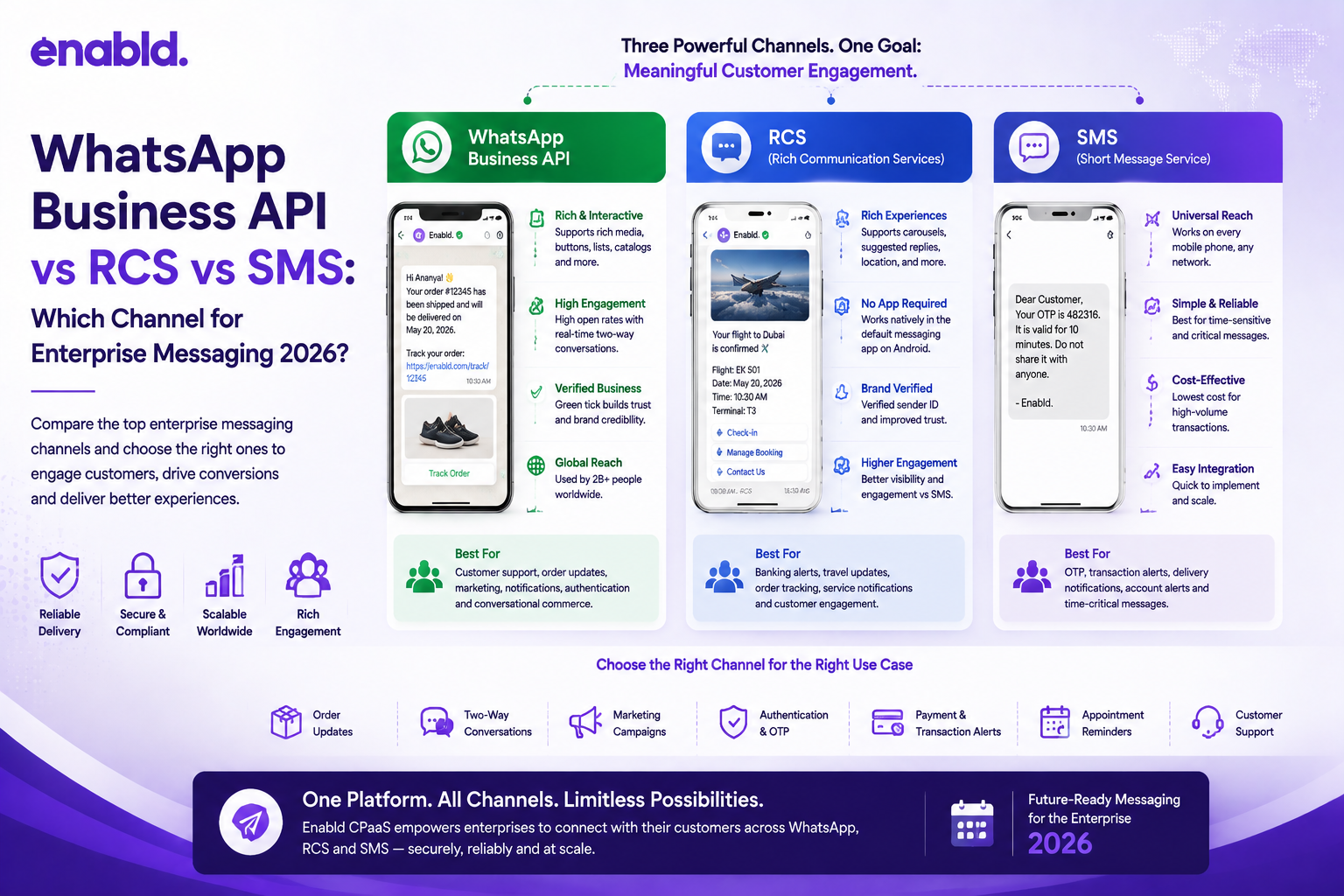
SMS, RCS, and WhatsApp Business API at a Glance
| Aspect | SMS | RCS | WhatsApp Business API |
|---|---|---|---|
| Device requirement | Any mobile phone | RCS capable device and carrier support | WhatsApp installed on the recipient’s phone |
| Opt-in required | No, though best practice varies by region | No | Yes, explicit opt-in generally required |
| Rich media | No, plain text only | Yes, images, carousels, buttons | Yes, images, video, documents, buttons, catalogs |
| Read receipts | No | Yes | Yes |
| Verified sender branding | Limited, sender ID only | Yes, verified business profile | Yes, verified business profile |
| Global reach | Universal | Growing, not yet universal | Strong in specific regions, not universal |
| Typical pricing model | Per message | Per message, often similar to SMS | Per conversation, template based |
| Best suited for | OTPs, alerts, fallback delivery | Rich marketing and engagement where supported | Rich engagement, support, commerce in high adoption regions |
What Is SMS for Enterprise Messaging?
SMS remains the baseline every enterprise messaging strategy is built around. It reaches any mobile phone, smartphone or basic device, without the recipient needing an app installed or an internet connection at the moment of delivery. That universal reach is exactly why SMS is still the default channel for one time passwords, critical alerts, and any message where guaranteed delivery matters more than rich presentation. Its limitation is equally clear, plain text only, no native read receipts, and minimal branding beyond a sender ID or short code.
What Is RCS for Enterprise Messaging?
Rich Communication Services is effectively SMS’s successor, built directly into a phone’s default messaging app rather than requiring a separate download. It supports rich media, carousels, suggested reply buttons, typing indicators, and read receipts, along with a verified sender name and logo so a business message looks legitimate rather than arriving from an unknown number. The catch is reach. RCS support depends on both the recipient’s device and their carrier having RCS enabled, and while adoption has grown significantly as more carriers and device makers support it, coverage still is not as universal as plain SMS.
What Is WhatsApp Business API for Enterprise Messaging?
WhatsApp Business API gives enterprises the same rich messaging experience consumers already use daily, images, documents, interactive buttons, catalogs, and two way conversations, but it requires the recipient to have WhatsApp installed and to have opted in to receive business messages. Pricing is structured around conversations rather than individual messages, and businesses generally need to use pre-approved message templates for messages sent outside an active customer service window. Where WhatsApp truly stands apart is regional adoption, in markets like India, Brazil, and parts of Europe, the Middle East, and Africa, WhatsApp is often the primary messaging app people use every day, which makes it a highly effective enterprise channel specifically in those regions.
Is WhatsApp Business Better Than RCS or SMS?
This is the question most enterprise teams are actually asking, and the honest answer is that it depends entirely on region and use case rather than one channel being categorically better. In markets with very high WhatsApp penetration, a WhatsApp message will often outperform SMS on engagement, since customers are already checking the app constantly and rich formatting drives higher response rates. In markets where WhatsApp adoption is lower, or for time sensitive, security critical messages like OTPs, SMS remains the more reliable choice precisely because it does not depend on app installation or opt-in status. RCS occupies a useful middle position, rich enough for engaging campaigns, delivered through a channel the recipient already has by default, but its reach is still catching up to SMS in many markets.
Reach and Device Compatibility Compared
Reach is where the three channels diverge the most sharply. SMS reaches essentially every mobile phone in use today, including basic feature phones, with no dependency on internet connectivity at the time of delivery. RCS requires a compatible device and carrier support, which has expanded considerably but is still not guaranteed for every recipient. WhatsApp Business API requires the recipient to have the app installed, which is close to universal in some markets and far less common in others. For any campaign that needs to reach an entire customer base without exception, SMS is still the only channel that can make that guarantee today.
Cost Comparison: SMS vs RCS vs WhatsApp
Cost structures differ enough that channel choice affects budget planning directly. SMS is typically billed per message, with well established, predictable pricing built around A2P messaging agreements. RCS pricing is often comparable to SMS on a per message basis, though this varies by carrier and region. WhatsApp Business API uses a conversation based pricing model, where a single approved conversation window can include multiple messages, which can be more cost efficient for interactive, back and forth exchanges but less predictable for simple one way notifications sent at high volume.
Rich Media and Branding Compared
If the priority is visual impact and interactive engagement, RCS and WhatsApp both outperform plain SMS by a wide margin. Both support images, buttons, and verified branding that make a business message immediately recognizable rather than looking like an anonymous text. WhatsApp adds catalogs and deeper conversational commerce features on top of that. SMS, by contrast, offers no native rich media at all, though MMS can add basic image support in some markets at the cost of higher pricing and lower reliability than plain SMS.
Choosing the Right Channel by Use Case
For OTPs, fraud alerts, and any message where guaranteed delivery is non negotiable, SMS should remain the default, with RCS or WhatsApp used as a secondary channel at most. For marketing campaigns, product launches, and visually driven promotions, RCS or WhatsApp will typically outperform SMS wherever they have strong reach, since the rich formatting drives noticeably higher engagement. For customer support and two way conversational use cases, WhatsApp Business API tends to be the strongest fit given its built in support for ongoing conversation threads and quick replies, particularly in regions where the app already has strong adoption.
Why a Fallback Strategy Matters
Because no single channel covers every recipient, most mature enterprise messaging strategies do not pick one channel exclusively. A message might attempt delivery over RCS or WhatsApp first for the richer experience, then automatically fall back to SMS if the recipient is not reachable on that channel. This kind of orchestration removes the need for engineering teams to build channel specific logic for every campaign, and it is exactly the kind of routing intelligence that separates a true omnichannel platform from a set of disconnected point integrations.
How Enabld Supports Multi-Channel Enterprise Messaging
Enabld’s CPaaS platform gives enterprises and the telecom operators serving them a single API layer for SMS, WhatsApp, RCS, and voice, with automatic fallback so a campaign is not left dependent on a single channel’s reach. For operators building this out under their own brand, that same orchestration sits on top of the same carrier-grade SMS gateway platform already handling routing and delivery for plain SMS traffic, so adding richer channels does not mean starting over with a separate integration. If you want the fuller picture of how telcos package this as a branded offering, our guide on launching omnichannel messaging under your own brand covers that in more depth.
Final Thoughts
WhatsApp Business API, RCS, and SMS each solve a different problem rather than competing head to head across every use case. SMS remains the reliable, universal fallback no enterprise messaging strategy should drop entirely. RCS and WhatsApp add rich engagement where reach allows, with WhatsApp particularly strong in regions where adoption is already high. The strongest strategy for most enterprises in 2026 is not choosing one channel, it is orchestrating all three so every message reaches the customer through whichever channel is actually available and most effective for that use case. If you are building a multi-channel messaging strategy and need infrastructure that handles the routing and fallback logic for you, talk to the Enabld team about your specific channel mix.
Frequently Asked Questions
Is WhatsApp Business better than RCS or SMS for enterprise messaging?
It depends on region and use case. WhatsApp performs best in markets with high adoption, RCS offers similar rich features natively in supported devices, and SMS remains the most reliable channel for universal reach and time sensitive alerts.
Does RCS work on all phones?
No. RCS requires both a compatible device and carrier support, so while adoption has grown significantly, it is not yet as universal as SMS.
Why do OTPs still get sent over SMS instead of WhatsApp or RCS?
SMS does not depend on app installation, opt-in status, or internet connectivity at the moment of delivery, making it the most reliable channel for time sensitive, security critical messages.
Is WhatsApp Business API expensive compared to SMS?
Pricing models differ rather than one being universally cheaper. WhatsApp uses conversation based pricing, which can be efficient for interactive exchanges but less predictable for high volume, one way notifications.
Can a business use SMS, RCS, and WhatsApp together?
Yes, and most mature enterprise messaging strategies do exactly this, using rich channels first where available and falling back to SMS automatically when a recipient is not reachable there.
Which channel is best for marketing campaigns?
RCS and WhatsApp generally outperform SMS for marketing due to rich media and interactive formatting, provided the target audience has strong adoption of those channels in their region.
Does WhatsApp Business API require customer opt-in?
Yes. Enterprises generally need explicit opt-in before messaging customers on WhatsApp, and messages sent outside an active conversation window typically require pre-approved templates.
Is SMS becoming obsolete because of RCS and WhatsApp?
No. SMS remains the only channel with truly universal reach across devices and carriers, which keeps it essential for fallback delivery even as richer channels grow in adoption.