If you have ever received a text from an airline with a logo, a “verified” badge, and a button to check in, you have already seen RCS business messaging in action. For most people the technology is invisible: it simply shows up in the default messaging app and looks like a much better version of a text message. For enterprises, though, the question is more practical. What is RCS messaging, how does it differ from SMS, and does it actually replace SMS for business use?
This guide explains what RCS messaging is, how RCS business messaging works, how RCS compares with SMS, and what enterprises should know before adding it to their messaging stack.
What Is RCS Messaging?
Rich Communication Services in Plain Terms
RCS stands for Rich Communication Services. It is a messaging standard developed by the GSMA as the successor to SMS and MMS. Instead of plain text limited to 160 characters, RCS supports high-resolution images and video, group chats, read receipts, typing indicators, and messaging over Wi-Fi or mobile data. Because it is built into the phone’s default messaging app, nobody has to download anything or create an account.
RCS in Google Messages and on iPhone
On Android, RCS runs through Google Messages, the default messaging app on most phones, where it often appears as “Chat features.” For years that left iPhone users out of the experience entirely. That changed when Apple added RCS support to Messages with iOS 18, which meant an iPhone and an Android phone could finally exchange rich messages instead of falling back to SMS. This single change is the main reason enterprises now treat RCS as a mainstream channel rather than an Android-only experiment.
How RCS Differs From OTT Apps
RCS often gets compared with WhatsApp or Telegram, but the two are built differently. OTT apps run on a company’s own servers and require the recipient to install the app. RCS runs through the carrier network and the phone’s native messaging app, which means it reaches subscribers by phone number without an install step.
What Is RCS Business Messaging?
The Business Side of the Standard
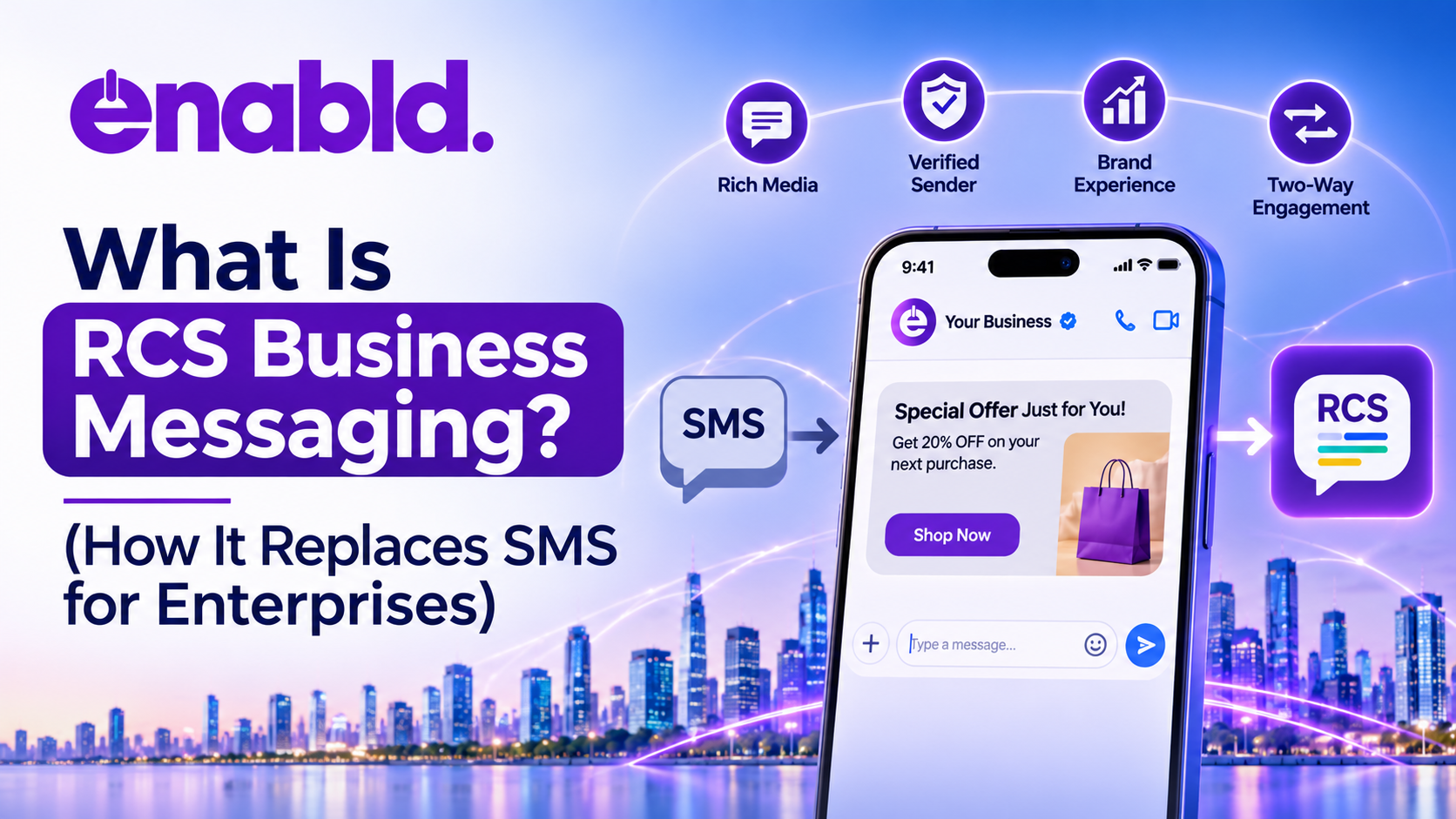
RCS business messaging, sometimes called RCS for Business, is the application-to-person side of RCS. Instead of one person texting another, a verified brand sends messages to customers through the same rich format. The experience can include the brand’s logo and name, a verified sender badge, image carousels, suggested replies, and action buttons such as “Track order,” “Book now,” or “Call us.”
Why Verification Matters
Only verified businesses can send branded RCS messages, and that verification is a large part of the appeal. A customer looking at an unfamiliar SMS from a random number has to guess whether it is legitimate. A customer looking at an RCS message with a verified brand profile has a much clearer trust signal. For use cases like banking alerts, OTPs, and delivery updates, where phishing is a constant risk, that matters more than any visual upgrade.
What Enterprises Can Actually Do With It
RCS for enterprise is not limited to promotions. Common uses include appointment booking and reminders, order and delivery tracking, two-way customer support, payment and billing notifications, and interactive product catalogs. The common thread is that the customer can act directly inside the conversation instead of clicking a link and leaving the thread.
RCS vs SMS: What Is Actually Different?
The Core Comparison
| Factor | SMS | RCS Business Messaging |
|---|---|---|
| Message format | Plain text, 160 characters per segment | Rich text, images, video, carousels, buttons |
| Sender identity | Phone number or alphanumeric ID | Verified brand name, logo, and badge |
| Interactivity | Links only | Suggested replies, action buttons, in-thread actions |
| Delivery and read data | Limited delivery reports | Delivery and read receipts, typing indicators |
| Reach | Universal, works on any phone | Growing, depends on device, carrier, and region |
| App install needed | No | No |
| Encryption for business messages | None in the message itself | Encrypted in transit, not end to end |
Where SMS Still Wins
SMS has one advantage that RCS cannot yet match: it works on every phone on every network. RCS needs a compatible device, a supported carrier, and, for many users, data connectivity. That is why RCS is better described as an upgrade layered on top of SMS than a clean replacement for it.
Where RCS Wins
RCS wins wherever engagement and trust matter. Rich media, interactive buttons, and verified branding give customers more reasons to open, read, and respond to a message. Enterprises that have moved high-value flows like onboarding, order tracking, and re-engagement onto RCS typically do so because those flows benefit from a richer, more actionable format than plain text allows.
Is RCS Secure? What Enterprises Should Know About Encryption
Personal Chats Now Support End-to-End Encryption
Android-to-Android RCS in Google Messages has been end-to-end encrypted for years. In May 2026, Apple and Google began rolling out cross-platform end-to-end encrypted RCS in beta, covering iPhone users on iOS 26.5 with supported carriers and Android users on the latest version of Google Messages. A lock icon appears in both apps when a conversation is encrypted. The encryption is built on the GSMA’s Universal Profile 3.0 and the Messaging Layer Security protocol.
Business Messaging Works Differently
This is the part enterprises need to read carefully. As of mid-2026, end-to-end encryption applies to person-to-person conversations, not to high-volume business messaging. Business messages are encrypted in transit, but they are not end-to-end encrypted. For business messaging, trust comes primarily from verified brand identity rather than message encryption. Teams with strict compliance requirements, such as healthcare or payments, should review each channel’s encryption model with their compliance team before moving sensitive content onto RCS.
How RCS Fits Into an Enterprise Messaging Strategy
Treat RCS as the Rich Layer, SMS as the Safety Net
Because RCS coverage is not yet universal, the practical approach is to send each message through the richest channel the recipient can actually receive and fall back to SMS when they cannot. A modern CPaaS platform handles this routing automatically, so the business writes one campaign and the platform decides whether each recipient gets RCS, SMS, or another channel.
SMS Infrastructure Still Anchors Delivery
That fallback is only as reliable as the SMS layer underneath it. A dependable SMS gateway platform catches every message RCS cannot deliver, which is why enterprises should plan RCS and SMS together rather than treating them as competing budgets.
Clean Traffic Protects Both Channels
RCS and SMS both depend on carrier-level trust. Spam and grey-route abuse damage deliverability for legitimate senders on either channel, which is why operators protect their networks with an SMS firewall that filters bad traffic before it reaches subscribers.
Choosing Between RCS, WhatsApp, and SMS
RCS is one of several channels enterprises now juggle. If you are weighing it against OTT options, our comparison of WhatsApp Business API vs RCS vs SMS walks through the trade-offs in detail, and our guide to Telegram vs WhatsApp for business messaging explains why SMS fallback matters for any OTT-first strategy. For a deeper look at how operators bring RCS to market, see our guide on how telcos enable RCS business messaging in 2026.
Frequently Asked Questions
What is RCS messaging?
RCS, or Rich Communication Services, is a messaging standard that replaces SMS and MMS with a richer experience: high-resolution media, read receipts, typing indicators, group chats, and messaging over Wi-Fi or mobile data, all inside the phone’s default messaging app.
What is RCS business messaging?
RCS business messaging is the application-to-person use of RCS, where a verified brand sends rich, interactive messages to customers, including logos, carousels, suggested replies, and action buttons, directly in the native messaging app.
What is the difference between RCS and SMS?
SMS is plain text that works on every phone. RCS supports rich media, interactivity, verified sender branding, and read receipts, but depends on device, carrier, and region support. Most enterprises use RCS as the primary experience with SMS as automatic fallback.
Does RCS work on iPhone and in Google Messages?
Yes. RCS runs through Google Messages on Android, and Apple added RCS support to the Messages app with iOS 18, allowing rich messaging between iPhone and Android users where carriers support it.
Is RCS business messaging end-to-end encrypted?
Not yet. Person-to-person RCS now supports end-to-end encryption between iPhone and Android in beta, but business messages are encrypted in transit rather than end to end. Verified brand identity is the main trust mechanism for business messaging.
Will RCS replace SMS for enterprises?
Not entirely in the near term. RCS offers a better experience, but SMS remains the only channel that reaches every phone. Most enterprises are adding RCS on top of SMS rather than removing SMS altogether.
What do enterprises need to send RCS messages?
Businesses typically need a verified RCS sender profile and access through a messaging provider connected to carrier and Google infrastructure, such as a CPaaS platform, which also handles fallback to SMS when a recipient cannot receive RCS.