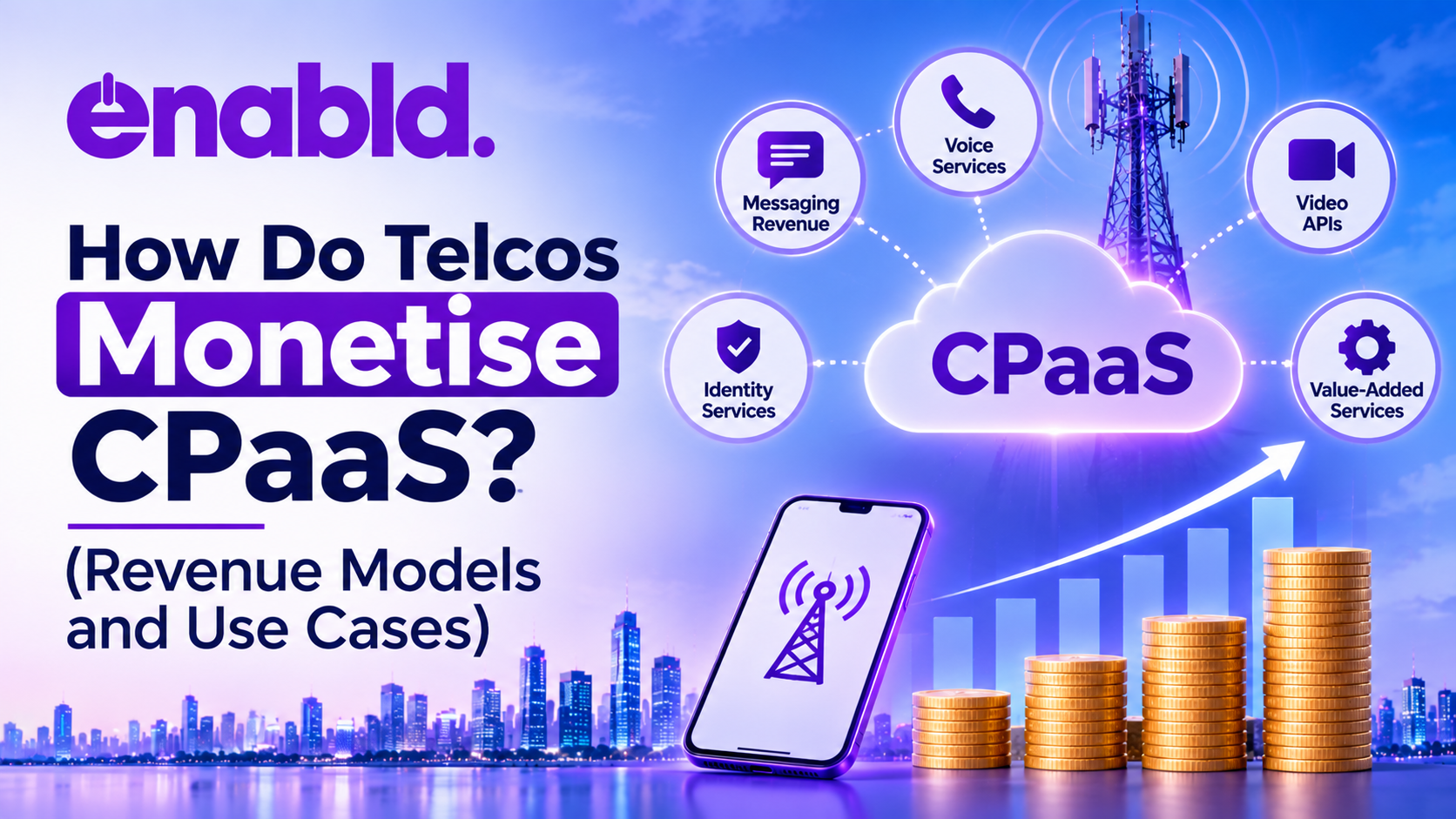
Telcos have always carried the traffic that enterprise communication runs on, yet for years most of the value from that traffic went to someone else. Aggregators, OTT platforms, and cloud communication providers built businesses on top of operator networks while operators collected wholesale termination fees. Telco CPaaS monetisation is the shift away from that position: instead of only selling connectivity, operators package their messaging, voice, and identity capabilities as programmable services and sell them directly to enterprises and developers.
This guide explains how to monetise CPaaS as an operator, which CPaaS revenue streams matter most, how a telco CPaaS business model is typically structured, and what drives CPaaS margin in practice.
Why Telcos Are Looking at CPaaS Monetisation Now
Declining Core Revenue, Growing Programmable Demand
Voice and consumer SMS revenue keep flattening, while enterprise demand for programmable communication keeps growing. The global CPaaS market is projected to grow from roughly $19.1 billion in 2024 to over $86 billion by 2030, and a meaningful share of that value depends on infrastructure operators already own. For an operator, CPaaS is a way to earn a larger share of enterprise communication spend rather than watching it route around the network.
Value Is Moving Up the Stack
Analysts have noted that CPaaS value is migrating from basic connectivity toward orchestration and identity. Sending a message is increasingly a commodity. What enterprises pay a premium for is knowing the right channel to use, verifying who is on the other end, and protecting the journey from fraud. That is good news for operators, because identity and network-level trust are two things they hold natively.
Monetisation Is the Hard Part
Exposing APIs is not the same as earning from them. Industry bodies like the GSMA have highlighted monetisation as the make-or-break challenge for network APIs, since many operator API programmes have launched without a clear commercial model behind them. The rest of this article focuses on the models that make the revenue real.
Core CPaaS Revenue Streams for Telcos
1. A2P Messaging (SMS, RCS, and OTT Channels)
Application-to-person messaging remains the largest and most proven revenue stream. Banks, retailers, airlines, and logistics companies send OTPs, alerts, and notifications at scale, and operators earn on every message terminated or originated through their platform. A well-run SMS gateway platform is the foundation, and the same stack extends to RCS and OTT channels, which carry higher per-message value than plain SMS.
2. Voice APIs and Programmable Voice
Programmable voice covers click-to-call, IVR, call masking, and voice OTP. Operators monetise it per minute, per call, or through bundled plans. It is less glamorous than messaging but sticky, because enterprise customers embed it deeply in customer support and logistics workflows.
3. Identity and Verification Services
Number verification, SIM swap detection, and silent authentication all rely on subscriber data that only the operator controls. This is where operators have a structural advantage over any third-party CPaaS vendor. A mobile identity solution lets telcos charge per verification call or per authenticated user, typically at a higher value than a standard message.
4. Fraud Protection and Traffic Quality Services
Operators can monetise the trust they provide as well as the traffic they carry. Filtering grey-route and spam traffic with an SMS firewall protects subscribers and recovers revenue lost to bypass, and enterprise-facing versions of these tools, such as number validation and sender verification, can be sold as paid services.
5. Network APIs
Beyond messaging and voice, operators can expose network capabilities such as location, quality on demand, and device status as APIs. This stream is earlier in its commercial maturity than messaging, and it tends to be priced per API call or through revenue-sharing arrangements with developer platforms and aggregators.
Telco CPaaS Business Models
Build and Operate Your Own Platform
Some operators run their own CPaaS under their own brand, selling directly to enterprises. This gives the highest control over pricing, customer relationships, and margin, but it requires investment in the platform, developer experience, sales, and support.
White-Label or Managed CPaaS
A common middle path is deploying a white-label CPaaS platform under the operator’s brand, with a technology partner running the underlying stack. The operator owns the customer relationship and brand while avoiding the cost of building everything from scratch. This is often the fastest route to market for operators without a large internal software team.
Partner and Aggregator Model
Operators can also expose capabilities through global aggregators and CPaaS vendors, which resell access to enterprise customers. This lowers the sales burden but comes with lower margin, since the partner keeps a share of the revenue.
CPaaS Revenue Sharing: How It Typically Works
Where Revenue Sharing Appears
CPaaS revenue sharing shows up whenever more than one party touches a transaction: an operator and an aggregator, an operator and a developer platform, or an operator and a technology partner running a managed service. The split is usually a percentage of per-message or per-API-call revenue, or a fixed platform fee plus a smaller usage share.
What Determines the Split
The share an operator keeps generally depends on how much of the value chain it owns. An operator that supplies network access only will usually keep less than one that also owns the customer relationship, the platform, and the support. Contract length, committed volumes, and exclusivity also move the numbers.
A Practical Rule
Revenue sharing works best when each party’s contribution is clear and measurable. Operators should be wary of arrangements where the partner controls the customer relationship and the pricing, since that is how an operator ends up back in a wholesale role.
What Drives CPaaS Margin for Telcos
Mix Matters More Than Volume
Plain SMS termination is high volume but low margin. Margin improves as the mix shifts toward higher-value services such as verification, RCS, and fraud protection. A telco chasing message counts alone can grow revenue while margin stays flat.
Pricing Structure
How the service is priced affects margin as much as what is sold. Offering transparent pay-as-you-go pricing to smaller customers and committed-volume tiers to large accounts protects both growth and predictability. We cover this trade-off in our guide to CPaaS pricing models for telcos.
Traffic Quality and Fraud Leakage
Grey routes and artificially inflated traffic erode margin by diverting legitimate revenue and degrading network quality. Operators that control their traffic quality keep more of the revenue they should have earned in the first place.
Platform Cost and Automation
A platform that requires heavy manual onboarding and support will consume margin. Self-service onboarding, automated routing, and real-time reporting reduce the cost of serving each additional enterprise customer.
Common Telco CPaaS Use Cases
| Use Case | Service Sold | Typical Customer | Revenue Model |
|---|---|---|---|
| OTP and authentication | A2P SMS, silent authentication, number verification | Banks, fintech, e-commerce | Per message or per verification |
| Transaction alerts | A2P SMS, RCS | Banks, payment providers | Per message |
| Customer engagement | RCS, OTT messaging, SMS fallback | Retail, travel, telecom | Per message plus platform fee |
| Delivery and logistics | Voice, SMS, number masking | Delivery, ride-hailing, marketplaces | Per minute or per message |
| Fraud prevention | SIM swap detection, number validation, SMS firewall | Banks, regulators, enterprises | Per query or subscription |
| Healthcare and appointments | SMS, voice reminders | Clinics, insurers | Subscription or volume-based |
Where Telcos Should Start
Start With What Already Works
Most operators should begin with A2P messaging and identity services, since the demand is proven and the network assets already exist. Layer in RCS, voice APIs, and network APIs once the core platform and sales motion are stable.
Own the Customer Relationship
Whatever model an operator picks, the ability to price, sell, and support enterprise customers directly is what keeps margin in-house. A white-label approach can speed up launch without giving up that relationship.
Make Reliability the Selling Point
Enterprises can buy messaging from many vendors, but fewer can offer verified identity, clean traffic, and direct network delivery. Positioning around trust and quality, rather than price alone, is what lets operators earn more than commodity termination rates.
Frequently Asked Questions
How do telcos monetise CPaaS?
Telcos monetise CPaaS by packaging messaging, voice, identity, and network capabilities as programmable services sold to enterprises and developers. The main revenue streams are A2P messaging, programmable voice, identity and verification, fraud protection, and network APIs.
What are the main CPaaS revenue streams for telcos?
The largest stream is A2P messaging over SMS, RCS, and OTT channels. Voice APIs, identity and verification services, fraud and traffic quality services, and network APIs make up the rest, with identity services typically commanding higher value per transaction.
What is a telco CPaaS business model?
A telco CPaaS business model describes how an operator delivers and sells CPaaS: building its own platform, running a white-label platform with a technology partner, or exposing capabilities through aggregators and partners. Each differs in control, investment, and margin.
How does CPaaS revenue sharing work?
Revenue sharing splits the income from a CPaaS transaction between the parties involved, such as an operator and an aggregator or technology partner. The split is usually a percentage of usage revenue, sometimes combined with a fixed platform fee, and depends on how much of the value chain each party owns.
What affects CPaaS margin for telcos?
Margin depends on service mix, pricing structure, traffic quality, and platform cost. Higher-value services like verification and RCS improve margin, while grey-route leakage and manual operations erode it.
What is the best way for a telco to start monetising CPaaS?
Most operators start with A2P messaging and identity services, where demand is proven, and often launch through a white-label CPaaS platform to reach market faster while keeping the enterprise customer relationship.