Ask five vendors to explain CPaaS vs UCaaS and you will likely get five slightly different answers, mostly because each one is describing the piece of the market they sell into. That confusion costs enterprise buyers real time during procurement, since choosing the wrong model usually means re-platforming within a year or two once the limitations show up.
This guide lays out the actual architecture behind each model, not just the marketing language, so you can see exactly how CPaaS, UCaaS, and CCaaS are built, who each one is designed for, and where they genuinely overlap.
Quick Answer: CPaaS gives developers APIs to build custom communication features into their own applications. UCaaS is a fully built, hosted platform for internal team communication like calling, chat, and video. CCaaS is a fully built, hosted platform for customer facing contact center operations like call queues and agent routing. The core difference between CPaaS and UCaaS is that CPaaS is a build-your-own toolkit, while UCaaS is a ready to use application.
What Is CPaaS?
Communications Platform as a Service gives development teams a set of APIs for SMS, voice, video, chat, and email that they embed directly into their own software. Nothing about the end user interface is fixed. A company using CPaaS builds its own customer experience and only borrows the underlying communication infrastructure. If you want the full breakdown, our guide on what CPaaS is covers the definition and use cases in more depth.
What Is UCaaS?
Unified Communications as a Service bundles voice calling, video meetings, team messaging, and file sharing into a single hosted application that employees log into directly. Unlike CPaaS, there is no custom development involved. A business signs up, provisions users, and gets a working internal communication system out of the box. UCaaS is aimed squarely at IT and operations teams who need to equip employees quickly, not at developers building something new.
What Is CCaaS?
Contact Center as a Service is the customer facing counterpart to UCaaS. It provides a hosted stack built specifically for support and sales teams, including automatic call distribution, interactive voice response, queue management, and workforce optimization tools. Where UCaaS connects employees to each other, CCaaS connects agents to customers, and the two solve fundamentally different operational problems even though they often sit inside the same organization.
How Each Model Is Actually Built: An Architecture Comparison
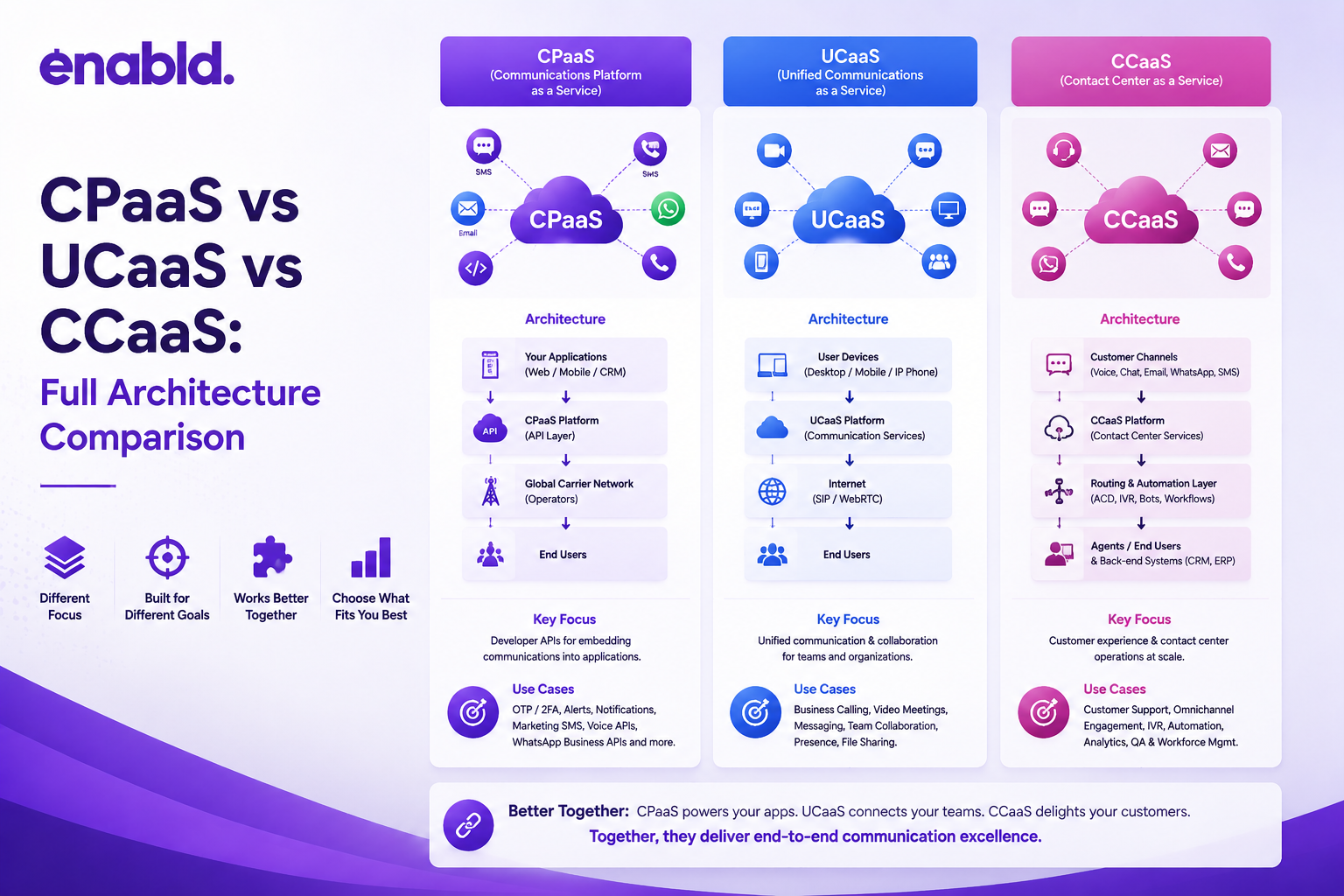
The real difference between these three models is architectural, not just functional.
A CPaaS architecture is a set of exposed APIs sitting on top of underlying telecom infrastructure, SMSCs, SS7 or SIP signaling, routing engines, that a developer calls programmatically. There is no fixed user interface because the application layer belongs entirely to whoever is building on top of the platform. This is the model behind Enabld’s CPaaS platform, where operators and enterprises consume communication capability as building blocks rather than a finished product.
A UCaaS architecture, by contrast, is a closed, fully built application stack. The provider owns the client software, whether that is a desktop app, mobile app, or browser client, and the backend that connects calls, meetings, and messages together. The buyer configures settings and manages users, but does not touch the underlying code.
A CCaaS architecture looks similar to UCaaS in that it is also a closed, hosted application, but the components are different. Instead of calendar integrations and team chat, a CCaaS stack centers on an automatic call distributor for routing inbound contacts, an IVR system for self service and call steering, and workforce management tools for scheduling and performance tracking across an agent floor.
CPaaS vs UCaaS vs CCaaS at a Glance
| Aspect | CPaaS | UCaaS | CCaaS |
|---|---|---|---|
| Primary purpose | Build custom communication features | Internal team communication | Customer facing contact center operations |
| Delivered as | APIs and SDKs | Ready to use hosted application | Ready to use hosted application |
| Who configures it | Developers | IT or operations admins | Contact center managers |
| Typical buyer | Product and engineering teams | IT leadership | Customer experience leadership |
| Core components | SMS, voice, video, and messaging APIs | Calling, video, chat, collaboration | ACD, IVR, queue management, workforce tools |
| Customization | Fully custom, build-your-own | Configuration within a fixed app | Configuration within a fixed app |
CPaaS vs UCaaS: The Core Difference
The CPaaS vs UCaaS comparison really comes down to one question, do you want to build something, or do you want something ready to use. UCaaS makes sense when a company simply needs employees to call, message, and video conference with each other without any custom development. CPaaS makes sense when a company wants to embed specific communication features, an SMS confirmation, an in-app voice call, a WhatsApp notification, directly into a product they are already building, where an off the shelf UCaaS app would not fit naturally into that workflow at all.
Some vendors now offer both under one roof, but it is worth noting that a UCaaS platform with an API layer bolted on is still fundamentally a UCaaS product with a bit of programmability, not the same thing as a CPaaS architecture designed for building from the ground up.
CPaaS vs CCaaS: Where They Actually Overlap
CPaaS vs CCaaS is a slightly different comparison because the overlap is more common in practice. Many CCaaS platforms are themselves built using CPaaS style APIs under the hood, since a contact center still needs to send SMS confirmations, route voice calls, and trigger notifications, capabilities a CPaaS layer naturally provides. The difference is that CCaaS wraps those capabilities inside a full application built specifically for agent workflows, while CPaaS leaves the workflow entirely up to whoever is building on top of it. A company that needs a complete contact center out of the box should look at CCaaS. A company building custom customer engagement logic that does not fit a standard contact center mold is usually better served going directly to CPaaS.
Can CPaaS, UCaaS, and CCaaS Work Together?
Yes, and increasingly they do. It is common for a UCaaS or CCaaS platform to be built on top of CPaaS infrastructure behind the scenes, with the CPaaS layer handling SMS delivery, voice routing, and number provisioning while the UCaaS or CCaaS layer handles the finished application experience. For telecom operators and CSPs specifically, this layering is often the actual business opportunity. Rather than choosing one model, an operator can use a CPaaS enablement platform as the foundation and build UCaaS or CCaaS style offerings on top of it under their own brand, which is a very different strategy than buying a finished UCaaS or CCaaS product from someone else.
Which One Should You Choose?
For an enterprise IT team equipping employees with calling, chat, and video, UCaaS is almost always the right starting point since building that from scratch with CPaaS would be unnecessary and slow. For a customer experience team managing high volume support queues, CCaaS is purpose built for exactly that job. For a product or engineering team that needs communication features embedded into an existing app, or a telecom operator that wants to build and monetize its own branded communication services, CPaaS is the right foundation, particularly paired with infrastructure like enterprise messaging and carrier-grade SMS delivery.
Final Thoughts
CPaaS, UCaaS, and CCaaS solve genuinely different problems, and the architecture behind each one reflects that. UCaaS and CCaaS give you a finished application, while CPaaS gives you the raw building blocks to create something of your own. Understanding that distinction, rather than treating the three as interchangeable cloud communication buzzwords, is what actually leads to the right procurement decision. If you are evaluating CPaaS as the foundation for a broader communications strategy, talk to the Enabld team about how a white label CPaaS platform can support what you are building.
Frequently Asked Questions
What is the difference between CPaaS and UCaaS?
CPaaS provides APIs for developers to build custom communication features into their own apps, while UCaaS is a ready to use hosted application for internal team calling, chat, and video.
What is the difference between CPaaS and CCaaS?
CPaaS gives you building blocks to create custom communication workflows, while CCaaS is a complete, ready to use platform purpose built for contact center operations like call routing and agent workflows.
Should a business choose CPaaS or UCaaS?
It depends on the goal. Choose UCaaS for ready to use internal team communication, and choose CPaaS if you need to embed custom communication features directly into your own product or application.
Can CPaaS, UCaaS, and CCaaS be used together?
Yes. Many UCaaS and CCaaS platforms are actually built on top of CPaaS infrastructure behind the scenes, combining a finished application layer with programmable communication capability underneath.
Is CPaaS more expensive than UCaaS or CCaaS?
Pricing models differ rather than one being universally more expensive. CPaaS is typically usage based, while UCaaS and CCaaS are often priced per seat or per agent.
Do telecom operators use CPaaS, UCaaS, or CCaaS?
Telecom operators most commonly use CPaaS enablement platforms as a foundation, since it lets them build and brand their own messaging, voice, and omnichannel services rather than reselling someone else’s finished product.
Which model is best for customer support teams?
CCaaS is purpose built for customer support and contact center teams, offering call routing, queue management, and workforce tools that CPaaS and UCaaS do not provide out of the box.
Is CPaaS only relevant for developers?
CPaaS is primarily consumed by developers and technical teams, but the business decision to adopt it usually comes from product, engineering, or telecom leadership looking to build differentiated communication experiences.