It is estimated that about 600 telecom operators around the world currently use CPaaS platforms. It is also a trend for telcos to acquire existing CPaaS providers. The CPaaS business is expected to exceed US$47 billion by 2030. Growth rates are encouraging, with Rich Communication Services expected to grow at 14.98%, messaging APIs at 14.67%, and healthcare revenues growing at 15.22% (COMMUNICATION PLATFORM-AS-A-SERVICE (CPAAS) MARKET SIZE & SHARE ANALYSIS – GROWTH TRENDS AND FORECAST 2026 – 2031) Read between the lines and you will see just how important CPaaS is for telecom operators as a vital avenue for revenue and client growth and why white-label CPaaS is the best, if not the only, way forward for telecom. Let us take a look at the nitty-gritty of CPaaS and why telecom operators and carriers are opting for white-label CPaaS from well-established providers instead of developing one on their own.
Table of Contents
- What is CPaaS?
- What is white-label CPaaS for telecom?
- How does white-label CPaaS for telecom carriers work?
- Why telcos opt for white-label CPaaS model?
- Conclusion
What is CPaaS?
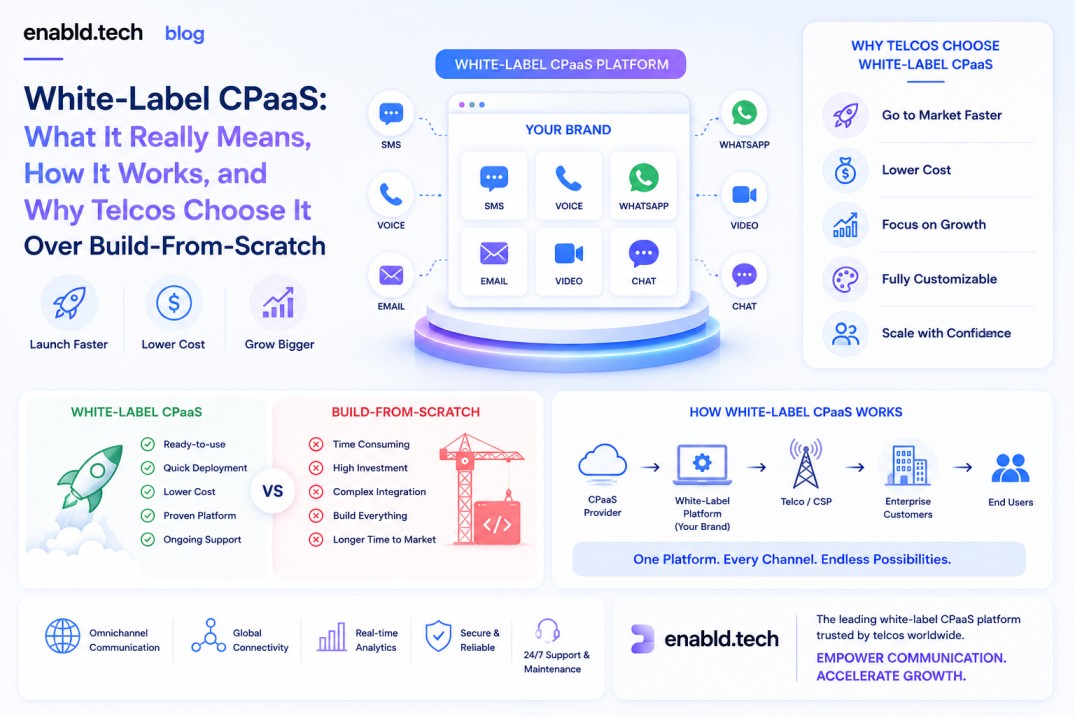
In the simplest terms one can define Communication Platform as a Service (CPaaS) as a cloud-based setup that permits voice calls, video chats, WhatsApp, and SMS, as well as other OTT messaging apps like Telegram, Signal, and Facebook Messenger, to be integrated into a business user’s software setup through APIs without the high costs of backend infrastructure and maintenance cost. For telecom operators, CPaaS considerably extends the service scope as well as monetization opportunities by offering all these services to their enterprise and small/medium business clients in any geographic location, with full control and total security.
What is white-label CPaaS for telecom?
Wikipedia defines “white-label” as being applicable to a service or a product created by one company and then sold by another company under its brand, conveying the impression to the market and buyer that they are the manufacturers. The automobile industry offers a good example of white-labeling. Aston Martin, for example, uses the Mercedes-AMG engine in its cars. In the context of telecommunications, a white-label CPaaS means a telecom carrier opts to deploy a full-fledged CPaaS developed by a third-party developer but under its own brand. Just like an automobile engine cannot be designed, developed, refined, and perfected in a short time due to the innumerable parameters and components, CPaaS also incorporates into its stack various communication channels, protocols, security, controls, and billing, all of which must interlock and work in perfect sync to deliver flawless performance regardless of scale, number of users, or geographic regional differences in technologies.
CPaaS developers offer the entire package with a modular backend structure that permits or denies access to functionalities according to requirements, while the front end can be modified to reflect brand theme, colors, logo, and design idiom. A telecom operator can also modify rates, billing structures, payments, and customer management features while the core functionalities remain intact. A custom dashboard permits telcos to manage APIs, SDKs, code, and their clients, as well as manage billing, customer databases, and analytics.
How does white-label CPaaS for telecom carriers work?
A CPaaS provider/developer like, for instance, Enabld, owns the software and offers a cloud infrastructure, which they offer to telecom operators who already own hardware like core switches, towers, and base stations. The CPaaS software overlays this hardware infrastructure, and the provider takes care of API integration, routing logic, and developer tools, which are plugged into the telecom carrier’s network, transforming it from a voice and text-only service to rich communications including voice, text, video, OTT messenger, direct inward dialing, least cost routing, and WhatsApp Business integration. The dashboard comes along with the CPaaS, allowing carriers to manage all these services that they, in turn, offer to enterprise clients, smaller businesses, and resellers. Importantly, communication channels shift from operating in silos to a unified, omnichannel mode. White-label CPaaS permits the provider to modify the front-end, rebranding it with the carrier’s logo and color theme. Carriers can also set their own rates, currencies, design packages, and billing cycles in order to suit their enterprise clients. The CPaaS development provides a set of APIs that the carrier can use to plug into the enterprise’s software setup, and such clients, whether large or small, enjoy carrier-grade performance. It is a pay-as-you-go model for both the carrier-CPaaS provider and carrier-client segments.
Why telcos opt for the white-label CPaaS model?
The automobile engine analogy again comes to mind in developing one’s own CPaaS versus opting for a white-label CPaaS. A typical engine has dozens of components, each designed and manufactured to precise tolerances from selected materials to result in a given performance and durability parameter. Likewise, CPaaS comprises programming logic that interfaces various protocols, accords priority, takes care of failures, provides fallbacks, and guarantees quality communication performance regardless of carrier, technology in use (3G, 4G, or 5G), messaging app plug-in APIs, load balancing, protocol use, gateway integration, routing, scaling, and hundreds of various other considerations factoring in various use case scenarios. It takes developers months and years to come up with a carrier-grade CPaaS, and even after that the platform undergoes rigorous testing, reiterative refinements based on actual customer feedback, and upgrades to keep pace with changing technologies and security issues. The result is total, market-proven reliability, which is a must for communications. Carriers cannot afford to have their reputations tarnished due to poor performance, security, reliability, and ability to manage sudden spikes in loads. Everything must work right from the first day. White-label CPaaS from providers like Enabld does just that, and it proves to be economical. Time to market is also a crucial consideration. A ready-to-deploy, tested, and certified CPaaS package that can be up and running in a day is much better than a wait of several months or years for in-house CPaaS development. Top-tier CPaaS developers also offer a full stack of tools like HELM, Azure Devops, and others in order to refine and revolutionize service delivery.
Summarised:
| Feature | Description | Benefit for telco |
| Carrier grade capability | Handles any volume of traffic across any channel, scales effortlessly, protocol integration, seamless APIs | Get started from day one without worries about technical glitches |
| Branding | Telco’s own brand appears across the spectrum of web interface, billing, etc. | Strong brand identity, customer loyalty and retention |
| Flexible, modular approach | Modular integration of omnichannel | Telcos can offer their clients only specific channels as may be required, reducing costs in the process |
| Multiple languages, multiple currencies, rate, least cost routing, and more | Rich feature sets permits flexibility in billing rates, usage limits and currency to suit clients in various countries | Immeasurably enhances scope of business revenues and onboarding new customers. |
Conclusion
Telecom is a business operating in a competitive environment, and white-label CPaaS opens up new pathways for monetization of existing setup at low upfront costs. What telecom cannot afford is any negative impact on quality of service that would result in customer churn when they launch value added service. A market-proven, time-tested white-label CPaaS has all the advantages and no drawbacks for getting off to a flying start.