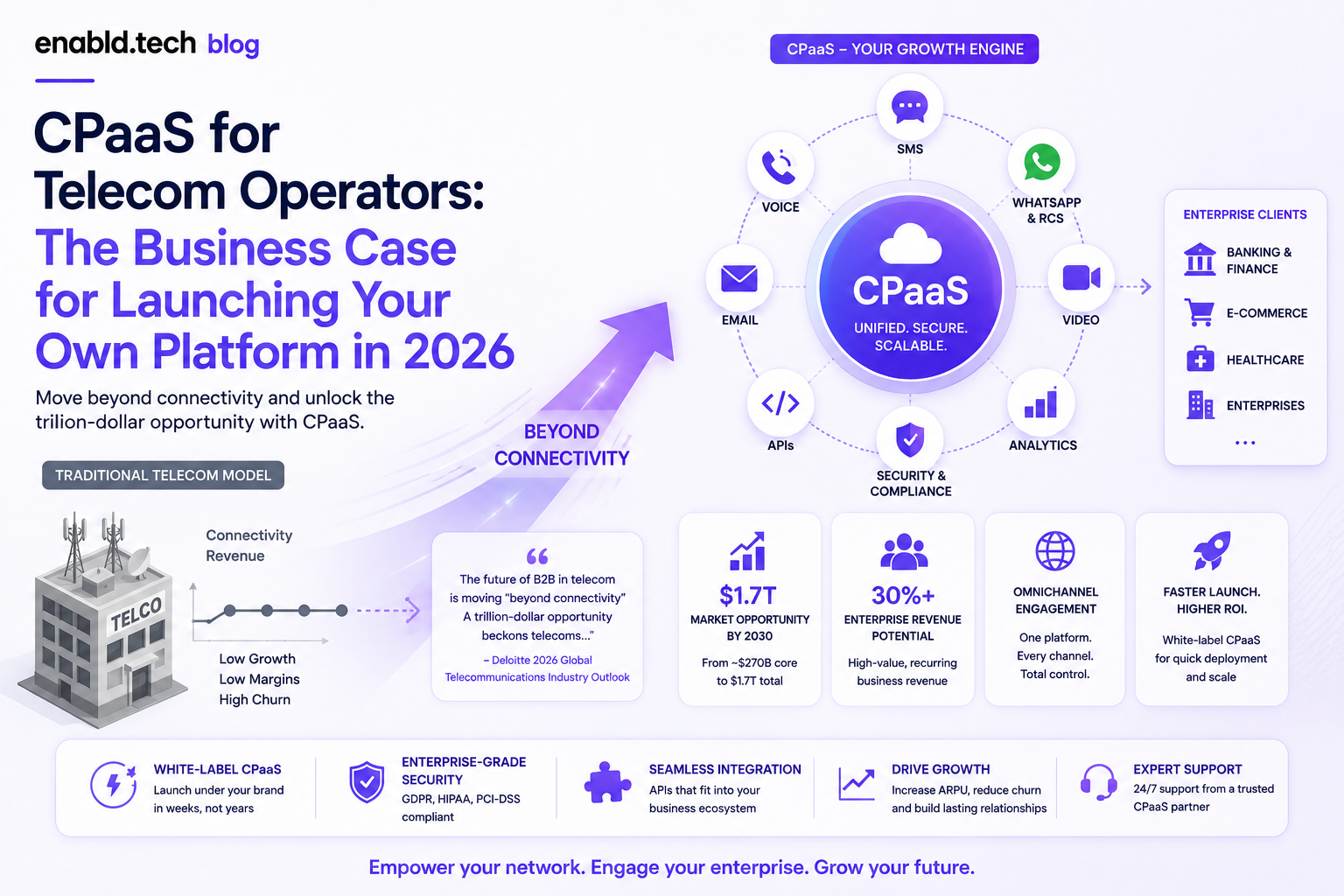
“The future of B2B in telecom is moving “beyond connectivity”
A trillion-dollar opportunity beckons telecoms…”
This is a quote from Deloitte’s 2026 Global Telecommunications Industry Outlook (https://www.deloitte.com/us/en/insights/industry/technology/technology-media-telecom-outlooks/telecommunications-industry-outlook.html). The report also goes on to state that 70% of the revenue derives from ordinary customers and 30% from business enterprises, out of which 70% revenues is from connectivity services. While the core telecom market will be worth about US$270 billion, “value added” tech services could boost the figure to a staggering US$1.7 trillion all the way to 2030, with projections estimating that core telecom will account for only $0.30 trillion, while technology services beyond core will account for $2.91 trillion by 2030. The key entry point to such revenue enhancement through tech services is to offer Communication Platform as a Service (CPaaS). There is a strong business case for telecom operators to partner with a well-established, trusted, and reliable CPaaS partner like Enabld to launch an entire suite of modern digital communication services.
Table of Contents
A Brief Look at CPaaS
CPaas or Flanker Model or tailor packages for higher revenues?
CPaaS vs Flanker model
CPaaS serves high paying business clients
White label CPaaS short-circuits questions
Conclusion
A Brief Look at CPaaS
In a nutshell, CPaaS covers the gamut of communications across various digital channels, including voice, video, SMS, voice OTP, chatbot, WhatsApp (and similar messaging platforms), and even social media. With CPaaS in place, these channels do not operate in silos but are smoothly harmonized with full oversight, data insights, and analytics, as well as full control. Top-tier CPaaS includes compliance with HIPAA, PCI-DSS, and GDPR across all messaging channels, which is yet another reason for businesses to use a unified omni-channel communication platform and for telcos to offer such a service through API integration into the business client’s existing software setup.
CPaas or Flanker Model, or tailor packages for higher revenues?
One of the easiest ways for telecom operators to increase revenues is to do away with low-value voice and data packages and increase rates while simultaneously increasing tariffs. One reason trotted out for going this route is that telecom operators must invest in emerging 5G and 6G technologies and need funds. Such measures do result in revenue increases but have implications. Another strategy adopted in various countries is to set up flanker brands to differentiate service packages like single-line pricing and fewer add-ons, and target specific customers. The downside is that flanker brands usually target individual customers and are perceived as low-price, low-feature subsets of an existing telecom brand. This model also carries the risk of fragmenting the brand and diluting its value as well as image perception. A white label CPaaS is the better business alternative for telecom operators, especially when you opt for a tried and market-proven package with full support from Enabld.
CPaaS vs Flanker model
| Feature | CPaaS | Flanker |
| Scale | Scale to serve bulk demands without slowdown or logjam | Scaling issues, especially for business bulk users |
| Channels | Omnichannel harmonized through a single interface | No harmonization of various digital communication channels |
| Security | GDPR, HIPAA and PCI-DSS compliant platform | No such security features |
| Brand value | Operates under the same telecom brand, which leads to enhanced brand perception | Brand segmentation, impacts and dilutes brand value |
| Deployment | Immediate through a proven, certified, White-label CPaaS platform | Takes time, effort, and money to build a flanker brand |
| Revenues | Higher, in bulk, high growth from business clients | Low margins, market churn, higher cost of servicing |
CPaaS serves high-paying business clients
The usual method of implementation is for telecom operators to select a white label CPaas provider like Enabld, who in turn carries out modifications to the front and backend to tailor the package to suit each operator’s specifics in terms of pricing, service models, and other areas while core functionalities remain intact. Such a CPaaS provider also offers APIs that integrate into their business client’s existing software set up in a seamless manner. By opting for this route and serving high-paying large enterprises, telecom operators are assured of year-on-year revenue growth and higher revenues. This growing revenue stream could also help them to subsidize their individual customer market and thus get the best of both worlds: loyal, high-paying business clients and loyal individual customers. More importantly, delaying implementation of integrated digital omni-channel communication services could lead to business clients shifting loyalties elsewhere. The flip side of the coin is that the quicker you adapt and evolve, the better you get at retention as well as attracting new, enterprise-grade business clients to your fold.
White label CPaaS short-circuits questions
Telcos naturally must consider every factor before they launch something as sophisticated as a digital communication platform that serves business enterprises. Banks, for instance, handle thousands of customers every minute with SMS messages, emails, and 2FA authentication. ecommerce segment, likewise, must not only respond but be proactive in customer reach and engagement. The healthcare segment also needs omni-channel communication with records in the CRM and HIPAA-secure compliance cover for patient records. Telecom company management is rightly chary of development of a CPaaS platform from the ground-up, which can be a long-drawn-out, expensive, and painful process. On the other hand, a white-label CPaaS short-circuits all such operational and management issues and lets telecom operators launch guaranteed and reliable services within a week or less, with full back-end support from the white-label CPaaS provider for integration into their existing framework, as well as providing and implementing APIs for business clients’ setup. And the best thing is that this is a service; it is not up-front capital heavy: you pay as you go, out of earnings derived from client revenues.
Conclusion
One thing is clear: digital communication offers mouth-watering revenue increases, and it is something telecom operators cannot delay launching. It is also the best model compared with flanker or tariff-increase models. Because it is cloud-based and offered as a service, telecom operators do not need to invest in any infrastructure and work on the pay-as-you-go model. Returns are higher and progressively increase over the years, even as you retain an edge over the competition. When you have the best CPaaS provider, like Enabld partnering withyour growth, your success is assured.