For mobile network operators and communication service providers evaluating messaging infrastructure, the question is rarely whether they need an SMS gateway. It is whether the gateway they choose can actually handle carrier scale traffic, integrate cleanly with SS7 and SMPP, and stay reliable when volumes spike. Understanding how does SMS gateway work at the architecture level is the first step to answering that question properly, before any procurement conversation even starts.
This guide breaks down the SMS gateway architecture layer by layer, explains how an SS7 SMS gateway and an SMPP gateway each play a different role, and walks through exactly what happens between the moment a message is submitted and the moment it lands on a handset.
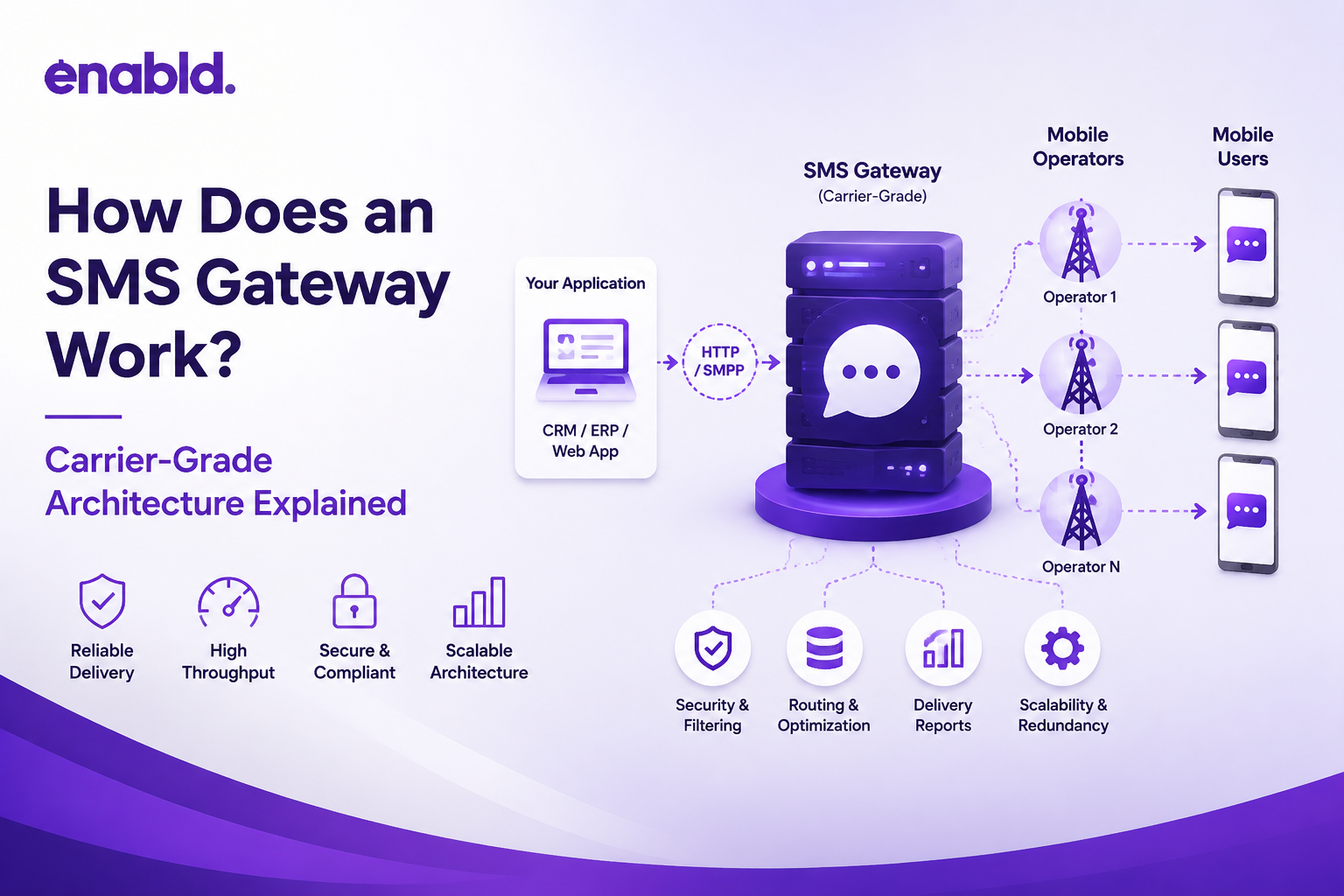
Quick Answer: An SMS gateway works by receiving a message from an application or network element, checking routing rules, translating the message into the correct signaling protocol, typically SS7 or SMPP, and forwarding it through the appropriate path to reach the destination mobile network, then returning a delivery report back to the sender.
What Is an SMS Gateway, Technically Speaking?
An SMS gateway is the piece of infrastructure that sits between two different messaging worlds and translates between them. On one side you have IP based systems, applications, enterprise platforms, CPaaS APIs, that speak protocols like SMPP or HTTP. On the other side you have the mobile network itself, which historically relies on SS7 signaling to move messages between operators, SMSCs, and handsets.
A basic gateway just forwards traffic. A carrier-grade SMS gateway does far more. It manages routing across dozens or hundreds of interconnects, applies rules based on cost and quality, handles authentication and throttling, generates delivery reports, and stays operational even when individual routes or partners fail. This is the layer that Enabld’s SMS gateway platform is built around, designed specifically for operators who need that level of control rather than a black box.
Core Components of SMS Gateway Architecture
A carrier-grade SMS gateway architecture is made up of several distinct components working together, not a single piece of software.
The SMSC (Short Message Service Center)
The SMSC is the store and forward engine at the heart of the network. When a message cannot be delivered immediately, the SMSC holds it and retries based on configured rules until delivery succeeds or the message expires. Every SMS gateway architecture is built around reliable interaction with one or more SMSCs.
The Signaling Layer
This is where SS7 or, increasingly, Diameter and SIGTRAN based signaling comes in. The signaling layer is responsible for locating the subscriber, checking their status on the network, and routing the message toward the correct mobile switching center.
The Application Interface
This is the SMPP gateway or HTTP API layer where enterprises, aggregators, and CPaaS platforms connect to submit and receive messages. It is the part of the stack that developers actually interact with day to day.
The Routing Engine
The routing engine decides which path a message takes based on destination, cost, quality thresholds, and contractual agreements with interconnect partners. This component is what turns a simple gateway into a true SMS routing gateway capable of managing multiple upstream and downstream connections at once.
How SS7 Powers the SMS Gateway
An SS7 SMS gateway relies on a signaling stack that was built decades ago for telephony but still carries the majority of the world’s SMS traffic. A few layers matter here.
MTP, the Message Transfer Part, handles the physical and network level transport of signaling messages between network elements. SCCP, the Signaling Connection Control Part, adds addressing on top of that, including the Global Title, which is essentially the address used to route a signaling message to the correct network node. TCAP, the Transaction Capabilities Application Part, manages the actual transaction, and MAP, the Mobile Application Part, carries the specific operations related to mobility and messaging, such as querying the HLR to find out where a subscriber currently is on the network.
When a message needs to be delivered, the gateway or SMSC sends a MAP query through this stack to the Home Location Register, or HLR, to retrieve routing information for that subscriber. Only once that lookup completes does the actual message get forwarded toward the correct mobile switching center. This is why SS7 SMS gateway performance depends so heavily on clean, well managed interconnects rather than just raw bandwidth.
SMPP Gateway Explained: How Applications Connect
While SS7 handles the telecom side, an SMPP gateway handles the application side. SMPP, the Short Message Peer to Peer protocol, is how enterprise platforms, aggregators, and CPaaS providers actually submit traffic into the network.
The flow typically works like this. An application establishes an SMPP bind, essentially a persistent connection, with the gateway, authenticating with a system ID and password. Once bound, it can send submit_sm requests, which is the SMPP command for handing off a message to the gateway. The gateway acknowledges receipt, processes routing, and later sends back a deliver_sm request carrying the delivery report once the message has actually reached the handset or failed to do so. This request and response pattern is what makes an SMPP gateway reliable enough for OTPs, alerts, and other time sensitive traffic, since the sending application always knows the final status of a message rather than guessing.
Step by Step: What Happens When You Send an SMS
Walking through a single message end to end makes the architecture much easier to visualize.
- An application or enterprise platform submits a message through the SMPP gateway or API layer.
- The gateway authenticates the sender and checks the message against routing rules, filters, and rate limits.
- The routing engine selects the best interconnect based on destination, cost, and quality data.
- If needed, a MAP query goes out through the SS7 stack to the HLR to locate the subscriber.
- The message is forwarded to the correct SMSC or mobile switching center for final delivery.
- A delivery report travels back through the same path, confirming success or failure to the original sender.
Under normal conditions this entire sequence completes in a few seconds, but the number of moving parts is exactly why carrier-grade reliability, not just raw speed, is the real differentiator between gateway providers.
SMS Routing Gateway: How Messages Choose Their Path
For operators managing multiple interconnect partners, an SMS routing gateway is what keeps the business profitable and reliable at the same time. Rather than sending every message down a single fixed path, the routing engine evaluates each message against a set of rules, cost per route, delivery quality history, sender ID requirements, and destination network, then picks the best available path in real time.
This is also where intelligent failover matters. If a preferred route degrades or a partner connection drops, traffic needs to shift automatically to a backup path without dropping messages. That kind of resilience is a core part of how Enabld structures its CPaaS platform, which is built around exactly this kind of always on routing logic rather than static configuration.
SS7 vs SMPP: Where Each One Fits
| Aspect | SS7 SMS Gateway | SMPP Gateway |
|---|---|---|
| Primary role | Network side signaling and subscriber lookup | Application side message submission |
| Who connects | Mobile operators and their network elements | Enterprises, aggregators, and CPaaS platforms |
| Key protocol layers | MTP, SCCP, TCAP, MAP | SMPP binds, submit_sm, deliver_sm |
| Typical use case | Routing between operators, HLR queries | A2P messaging, OTPs, alerts, marketing |
| Where it sits | Deep in the telecom core network | At the edge, facing developers and platforms |
Why Enterprise SMS Gateway Architecture Needs to Be Carrier-Grade
An enterprise SMS gateway that only works at low volume is not much use to a telecom operator or a CSP handling millions of messages a day. Carrier-grade architecture needs to account for high throughput without message loss, redundant SMSC and signaling connections so no single point of failure takes down delivery, real time monitoring so network teams can see exactly where traffic is at any moment, and compliance with GSMA recommendations around routing, sender ID handling, and anti spam filtering.
This is also where the difference between a generic messaging tool and a proper wholesale infrastructure becomes clear. As covered in our breakdown of what to look for in a bulk SMS gateway provider, throughput numbers on a spec sheet mean very little without the routing intelligence and failover behavior to back them up.
Where CPaaS Fits Into the Architecture
An SMS gateway is one layer of a much larger CPaaS stack. While the gateway handles message transport, a full CPaaS enablement platform adds voice, WhatsApp, RCS, and other channels on top of the same underlying routing and signaling infrastructure. For operators, this matters because it means the SMS gateway they build or license today can become the foundation for a much broader enterprise messaging platform later, rather than a dead end that needs replacing. If you want the fuller picture of that layer, our guide on what CPaaS is covers how it connects back to everything described here.
Final Thoughts
Understanding how an SMS gateway works at the architecture level, from SS7 signaling and HLR lookups to SMPP binds and routing engines, gives network teams a much clearer basis for evaluating vendors than marketing claims alone. If you are a mobile operator, CSP, MVNO, or aggregator evaluating messaging infrastructure, a carrier-grade SMS gateway should give you full visibility and control over routing, signaling, and delivery rather than treating it as a black box. Talk to the Enabld team to see how a carrier-grade SMS gateway architecture could fit into your network.
Frequently Asked Questions
How does an SMS gateway work in simple terms?
An SMS gateway receives a message, checks routing rules, translates it into the right signaling protocol, and forwards it toward the destination network, then returns a delivery report to the sender.
What is the difference between SS7 and SMPP in SMS gateway architecture?
SS7 handles network side signaling and subscriber lookups between operators, while SMPP is the protocol enterprises and platforms use to submit messages into the gateway.
What does an SMSC actually do?
The SMSC stores a message and retries delivery on a schedule until it succeeds or expires, acting as the store and forward engine at the core of SMS gateway architecture.
Why is SS7 still used for SMS if it is an older protocol?
SS7 remains the backbone for locating subscribers and routing messages across the majority of global mobile networks, and most operators have not fully migrated away from it for SMS.
What makes an SMS gateway carrier-grade rather than basic?
Carrier-grade gateways add redundant signaling connections, intelligent routing, real time monitoring, and failover handling, none of which a basic single path gateway typically supports.
How does an SMS routing gateway choose which path to use?
It evaluates each message against rules like cost per route, delivery quality history, sender ID requirements, and destination network, then selects the best available path in real time.
Is an SMPP gateway only used for bulk messaging?
No. SMPP is used for OTPs, transactional alerts, and two way messaging as well as bulk campaigns, since the protocol supports real time delivery confirmation through deliver_sm.
Can an SMS gateway support both SS7 and SMPP at the same time?
Yes. Most carrier-grade platforms run both, using SMPP to accept traffic from applications and SS7 to handle the network side signaling needed to actually deliver it.