Not everyone has a credit card, and not everyone who has one wants to type the number into a checkout page on a small screen. Direct carrier billing solves that by letting a customer charge a purchase to the phone account they already have. For telecom operators, it turns an existing billing relationship into a payment product.
This guide explains what direct carrier billing is, how a transaction works, who does what, and where messaging infrastructure fits into the flow.
Quick Answer: Direct carrier billing (DCB) is a mobile payment method that charges a purchase to a customer’s phone bill or prepaid balance instead of a card or bank account. The telco authenticates the subscriber, approves the charge, and collects payment, then passes the merchant’s share on after taking its own cut. Customers usually confirm with their phone number and a one time PIN sent by SMS.
What Is Direct Carrier Billing?
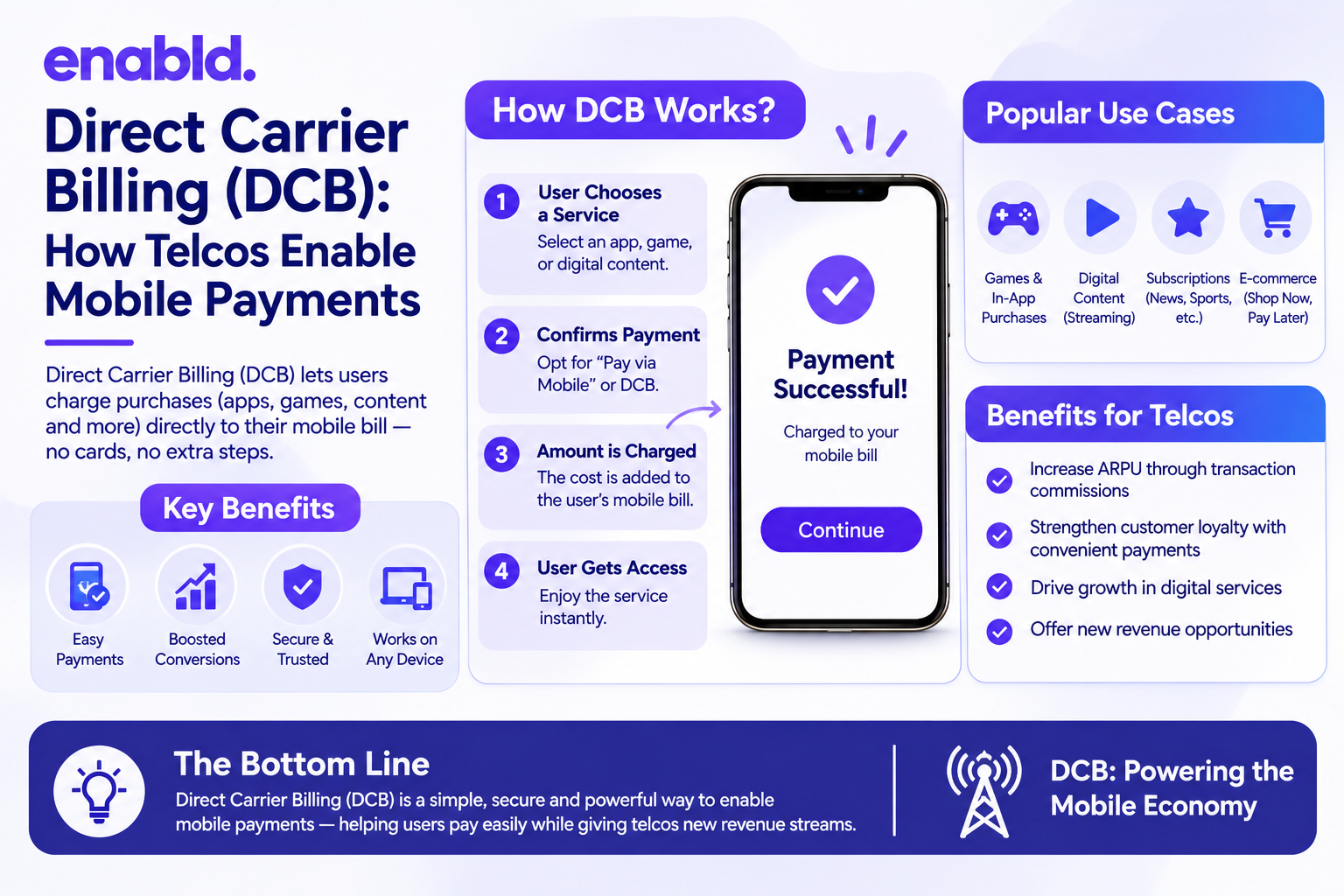
DCB, also called carrier billing, mobile billing, or operator billing, lets subscribers pay for digital goods and services through their mobile account. The charge appears on the next postpaid bill or comes out of the prepaid balance.
Where DCB Is Used
It is common for digital content and services such as app purchases, games, streaming subscriptions, music, ticketing, and other online services. Availability varies by operator and market, so merchants usually confirm which carriers support which purchase types.
Why It Appeals to Customers and Merchants
For customers, the appeal is simple: no card details, no new account, and a short checkout. For merchants, it opens a payment route to people who lack cards or avoid entering card data online, which can lift conversion in mobile first markets.
How Does Direct Carrier Billing Work?
A DCB payment follows a short sequence, and the telco sits in the middle of it.
A Typical PIN Based Flow
- The customer chooses carrier billing at checkout.
- The merchant or aggregator identifies the customer’s operator and asks for their mobile number.
- The operator sends a one time PIN by SMS.
- The customer enters the PIN to confirm.
- The operator approves the charge and records it against the bill or prepaid balance.
- Settlement follows later, with the merchant receiving its share.
Other Authentication Methods
Some flows identify the subscriber automatically over the mobile network, so the customer only confirms the purchase without typing a number. Which method is used depends on the operator, the market, and the type of purchase.
Why the SMS Step Matters
The confirmation message carries the authentication. If it arrives late or not at all, the customer abandons the purchase. That makes reliable delivery a core part of DCB performance, not an afterthought. Our guide on how an SMS gateway works explains what happens between sending a PIN and the handset receiving it.
Who Does What in a DCB Transaction
| Party | Role |
|---|---|
| Customer | Chooses carrier billing and confirms the purchase |
| Merchant | Sells the digital product and receives a revenue share |
| Aggregator or payment intermediary | Connects merchants to many operators through one integration |
| Telco | Authenticates the subscriber, approves the charge, bills the customer, and settles with the partner |
Why Aggregators Exist
A merchant would otherwise need a separate integration and contract with every operator. Aggregators reduce that to one connection, and they often handle reporting and settlement too. Operators that want to reach more merchants can work with aggregators or build direct merchant relationships.
Why Telcos Offer Direct Carrier Billing
For an operator, DCB turns the subscriber relationship into a revenue line without needing a banking license or card network. The telco already knows who the customer is, already bills them, and already has a way to reach them. Each transaction earns a share of the purchase value, and it can raise engagement with the operator’s own services.
We cover the wider picture of operator payment services, including mobile money, in our guide on mobile payment for telcos.
Direct Carrier Billing vs Mobile Money vs Card Payments
| Factor | Direct Carrier Billing | Mobile Money | Card Payments |
|---|---|---|---|
| Funded from | Phone bill or prepaid balance | Stored wallet balance | Bank account or credit line |
| Needs a bank account | No | No | Yes |
| Typical use | Digital goods and services | Transfers, bill pay, wider financial services | Broad online and in store purchases |
| Who runs it | Telco | Telco or financial partner | Card networks and banks |
| Checkout effort | Phone number and PIN | Wallet login or PIN | Card details and verification |
DCB is a checkout method tied to an existing account. Mobile money works more like a wallet or bank account of its own. The two can complement each other inside one operator.
Risks and Compliance Considerations
Carrier billing is convenient, which also makes it a target. Common concerns include:
- Unauthorized or tricked subscriptions, where customers are signed up without clear consent
- Automated sign up abuse using bots or fake numbers
- Complaints and refunds when charges are not understood
- Regulatory rules on consent, pricing disclosure, and consumer protection, which differ by country
Good practice includes clear price and terms before confirmation, explicit customer consent, spending limits, easy cancellation, and monitoring for unusual patterns. Operators should check the rules that apply in each market they serve.
Protecting the Messaging Layer
Because PINs travel by SMS, fraud in the messaging layer can feed fraud in payments. Number validation and traffic screening help here. Our explainer on what an SMS firewall does shows how operators block abusive traffic, and our comparison of SMS firewall vs HLR lookup covers how number checks fit in.
Where CPaaS Fits in Carrier Billing
DCB depends on communication at several points: PIN delivery, purchase receipts, renewal reminders, and customer support messages. A CPaaS platform gives an operator one place to run all of those, with routing, delivery reporting, and fraud controls built in. The underlying SMS gateway platform handles the high volume, time sensitive traffic that authentication creates.
Beyond the PIN
Operators can add receipts and renewal notices by SMS, rich confirmations over channels like WhatsApp or RCS where customers use them, and fallback to SMS when a rich channel cannot deliver. For operators building these services under their own brand, CPaaS enablement provides the stack without a multi year build.
What Telcos Should Plan Before Launching DCB
- Which merchant categories and spend limits to allow
- Whether to work through aggregators, direct merchants, or both
- How authentication will work for prepaid and postpaid customers
- How fraud monitoring, consent records, and refunds will be handled
- How PIN delivery will be kept fast and reliable
Final Thoughts
Direct carrier billing lets operators convert a billing relationship into a payments business, and it gives customers a simple way to pay without a card. Its success depends on trust, clear consent, and dependable messaging. If you are planning carrier billing or related mobile payment services and want to see how messaging, fraud protection, and CPaaS fit together, talk to the Enabld team about your requirements.
Frequently Asked Questions
What is direct carrier billing?
Direct carrier billing is a payment method that charges a purchase to a customer’s mobile phone bill or prepaid balance instead of a card or bank account. The telco authenticates the user and collects the payment.
How does DCB work?
The customer selects carrier billing at checkout, enters their phone number, and confirms with a one time PIN sent by SMS or through network based identification. The operator approves the charge and settles with the merchant later.
Who earns money from direct carrier billing?
The merchant earns revenue from the sale, and the telco keeps a share for handling authentication, billing, and collection. Aggregators may also take a fee for connecting merchants to operators.
Is direct carrier billing the same as mobile money?
No. Carrier billing charges an existing phone bill or prepaid balance at checkout. Mobile money is a separate stored value wallet that works more like a bank account and supports transfers and wider financial services.
Do customers need a bank account or credit card for DCB?
No. Customers only need an active mobile account with an operator that supports carrier billing, which is why it helps reach people without cards.
Why is SMS important in carrier billing?
SMS commonly delivers the one time PIN that authenticates the purchase. If the message is late or fails, the customer cannot complete payment, so reliable SMS delivery directly affects conversion.
What are the main risks of direct carrier billing?
The main risks are unauthorized or tricked subscriptions, automated sign up abuse, customer complaints, and regulatory requirements around consent and disclosure. Clear consent, limits, and fraud monitoring reduce them.
Can a telco offer DCB without building its own platform?
Yes. Operators can use aggregators and licensed platforms for the payment connection, and a CPaaS platform for the messaging layer, rather than building every component in house.