For years, every operator exposed its network in its own way, if it did at all. A developer who wanted to check whether a SIM had recently changed would need a separate integration, contract, and test cycle for each carrier. The GSMA Open Gateway is the industry’s attempt to replace that patchwork with one common way to ask the network questions.
This guide explains what the GSMA Open Gateway is, how it relates to CAMARA, who takes part, how operators earn from it, and where CPaaS platforms fit.
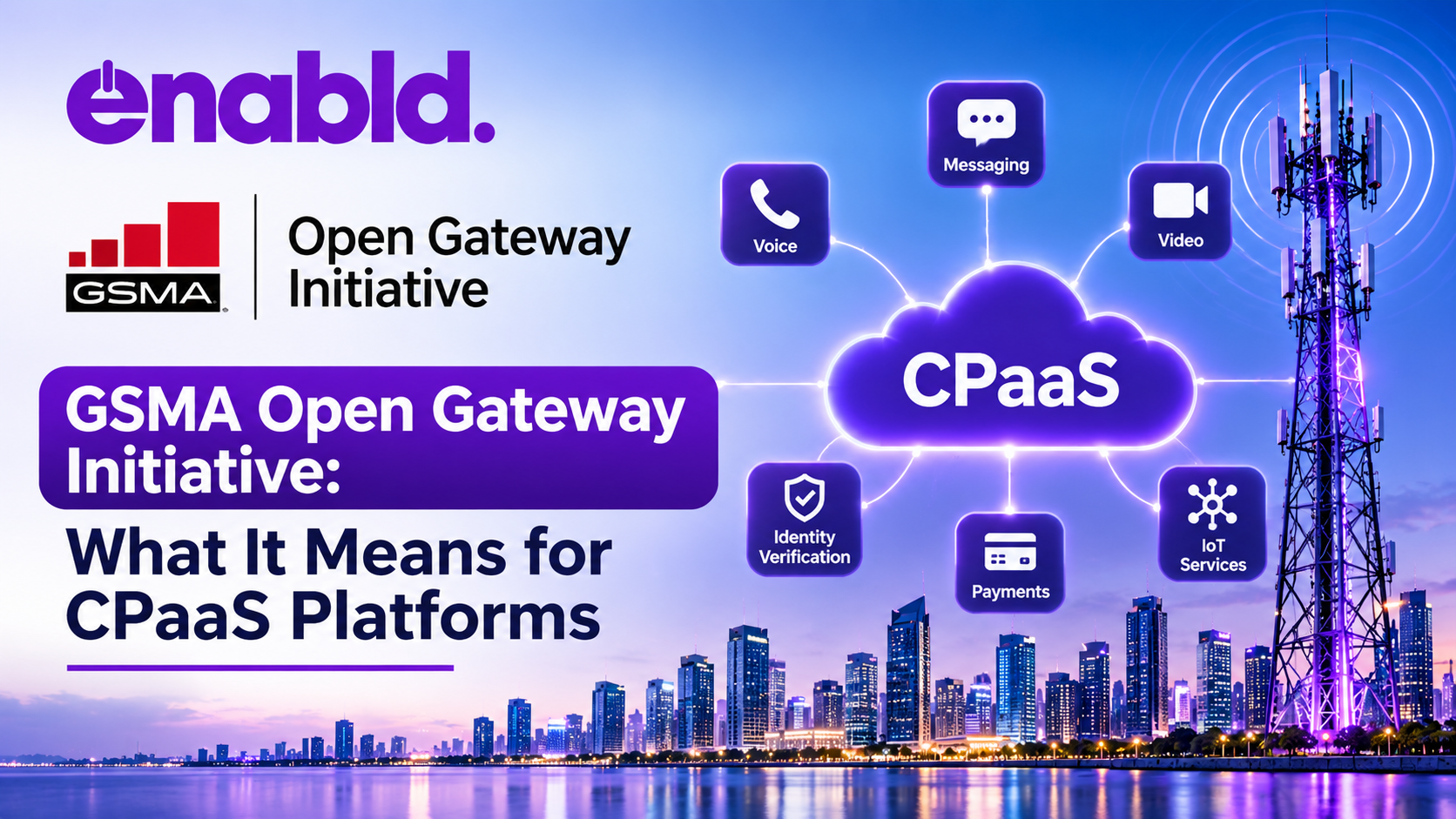
Quick Answer: The GSMA Open Gateway is a mobile industry framework of standardized network APIs that gives developers and enterprises common, interoperable access to operator network capabilities, such as number verification, SIM swap detection, and quality on demand. The APIs are defined and published in CAMARA, an open source project run with the Linux Foundation. Operators expose them, and aggregators and other channel partners help developers reach many networks through one integration.
What Is the GSMA Open Gateway?
The Open Gateway is an operator commitment and framework run by the GSMA, the industry body for mobile operators. Its goal is simple: make network capabilities available to software developers in a consistent, federated way, regardless of which operator or country is involved.
When It Started
Operators began work on the idea in 2022. The initiative was announced at MWC Barcelona 2023 with the backing of 21 operators, and the first live APIs went into deployment later that year.
Why It Exists
Operators have spent heavily on 5G and want new revenue beyond connectivity. Developers want predictable, easy access to network features. The Open Gateway borrows an idea from roaming, where agreed standards let networks work together, and applies it to APIs.
What Is CAMARA?
CAMARA is the open source project where the actual API definitions are written. It is run by the Linux Foundation with the GSMA, and it was announced at MWC 2022. The two are often mentioned together, but the roles differ.
| Element | Role |
|---|---|
| GSMA Open Gateway | The operator commitment, certification, and go to market framework |
| CAMARA | The open source project that defines and publishes the API specifications |
| Operators | Expose the APIs on their networks |
| Aggregators and channel partners | Connect developers to multiple operators through one integration |
| Developers and enterprises | Use the APIs inside their applications |
Which APIs Does Open Gateway Include?
The initiative launched with eight network APIs, and more have followed.
| API | What It Does |
|---|---|
| Number Verification | Confirms the phone number claimed by a user matches the SIM on the connection |
| SIM Swap | Detects recent changes to the SIM tied to a number |
| Device Status | Reports whether a device is reachable or roaming |
| Device Location and Location Verification | Checks where a device is, or whether it is within an expected area |
| Quality on Demand | Requests a defined level of network quality for a session |
| Simple Edge Discovery | Helps applications find the closest edge computing resources |
| One Time Password SMS | Supports sending and validating one time passwords |
| Carrier Billing Checkout | Supports charging purchases to a mobile account |
Two of the launch APIs, one time password SMS and carrier billing checkout, sit close to CPaaS and payments. Our guide on direct carrier billing explains how that payment model works.
Where Open Gateway Stands in 2026
According to GSMA’s Q1 2026 update, the initiative includes 81 operator groups and 61 channel partners, covering 292 networks and about 80 percent of mobile connections. It reports 140 API instances commercially launched across 85 networks in 50 markets. Anti fraud APIs, mainly SIM Swap and Number Verification, are the most widely launched.
Figures differ slightly across sources and change often, and availability still varies by operator and market. Businesses should check what a specific network offers before building on it.
How Network API Monetisation Works
The Open Gateway makes the technology standard. The commercial side is where operators and partners still compete and experiment.
How Operators Earn
Typical models include charging per API call, charging by usage tier, or bundling APIs into enterprise packages. Terms vary by operator and aggregator, and commercial models were one of the open questions when the initiative launched.
Why Aggregators Matter
A developer rarely wants to sign contracts with dozens of operators. Aggregators connect many operators to many developers, handling access, billing, and support. GSMA’s own analysts have described scaled distribution partners, including hyperscalers and aggregators, as central to success.
What Drives Demand
Fraud prevention leads the way. Verifying a number silently over the mobile connection, or checking for a recent SIM swap before approving a transaction, helps banks, fintechs, and marketplaces cut account takeover risk.
What Open Gateway Means for CPaaS Platforms
CPaaS and network APIs share the same buyers, the same developer experience, and the same need for metering and security. That makes the Open Gateway relevant to any operator running or planning a CPaaS business.
A Natural Fit With Existing Communication APIs
Operators already sell SMS and voice through APIs. Network APIs extend that catalogue. Our explainer on what a telecom API is covers how communication APIs work and why an API gateway layer matters for access control and billing.
Messaging and Network APIs Can Support Each Other
Number Verification can replace some one time passwords with a silent check, which could reduce certain OTP volumes. At the same time, it can raise trust and conversion for the flows that remain, and SMS stays the universal fallback when silent verification is not possible. Operators should plan both lines together. Our guide on 5G and CPaaS covers this and the wider 5G context.
Fraud Controls Still Matter
Opening network capabilities invites abuse, so protection must grow alongside access. An SMS firewall and number validation remain essential parts of a secure messaging stack.
What Telcos Need to Be Ready
A Developer Facing Platform
Portals, documentation, sandboxes, and keys are the front door. A CPaaS platform already includes much of this for messaging and voice.
Billing and Metering
Pay per call models need accurate usage tracking, rate handling, and invoicing. Operators with existing wholesale and enterprise billing have a head start.
Reliable Messaging Underneath
OTP, alerts, and fallback traffic still run through a carrier grade SMS gateway platform, and CPaaS enablement lets operators launch that layer under their own brand. For the commercial case, see our guide on CPaaS for telecom operators.
A Clear Role in the Ecosystem
Decide whether to expose APIs directly, work through aggregators, or both, and which markets and use cases to prioritize first.
Limits and Open Questions
- Coverage differs by operator and country, so a developer may not get every API everywhere
- Commercial terms are not uniform, and pricing can vary widely
- Some APIs, such as quality on demand, depend on advanced 5G capabilities that are not available on every network
- Privacy and consent requirements shape how location and identity APIs can be used
Final Thoughts
The GSMA Open Gateway turns network capabilities into products that developers can use with a common set of APIs, and CAMARA supplies the technical definitions behind them. For operators, it is a route to revenue beyond connectivity. For CPaaS businesses, it is a signal that the developer facing platform an operator builds for messaging may soon carry more than messaging. If you are mapping how messaging, voice, and network APIs fit together on your network, talk to the Enabld team about your roadmap.
Frequently Asked Questions
What is the GSMA Open Gateway?
The GSMA Open Gateway is a mobile industry framework of standardized network APIs that gives developers common access to operator network capabilities, such as number verification and SIM swap detection, across different operators and countries.
What is the difference between GSMA Open Gateway and CAMARA?
Open Gateway is the GSMA led operator framework and commitment. CAMARA is the open source project, run with the Linux Foundation, where the API specifications are defined and published.
Which APIs are part of the Open Gateway?
The initiative launched with eight APIs, including SIM Swap, Number Verification, Device Status, Device Location, Quality on Demand, Simple Edge Discovery, One Time Password SMS, and Carrier Billing Checkout, with more added since.
How do operators make money from network APIs?
Common models include per call charges, usage tiers, and enterprise bundles, often delivered through aggregators that connect many operators to many developers. Terms vary by operator and market.
What is the role of aggregators in Open Gateway?
Aggregators connect multiple operators to developers through one integration, handling access, billing, and support, so developers do not need separate contracts with every network.
Does Open Gateway replace SMS or CPaaS?
No. It adds network capabilities alongside messaging and voice. Number Verification may reduce some OTP use, but SMS remains the universal fallback, and CPaaS platforms continue to provide the messaging layer.
Is the Open Gateway only for 5G networks?
It was framed around 5G era capabilities, though many APIs, such as number verification and SIM swap, work on mobile data connections more broadly. Some, like quality on demand, depend on advanced network features.
Are Open Gateway APIs available in every country?
No. Availability depends on which operators have launched which APIs. GSMA reports commercial launches across dozens of markets, but businesses should confirm coverage for their target networks.