Search for CPaaS and nearly every result describes the same thing: a company that sells messaging and voice APIs to developers. That is a CPaaS provider. There is a second model that gets far less attention, and it is the one telecom operators care about most. A CPaaS enablement platform does not sell communication services to you. It gives you the platform to sell them yourself.
This guide explains what a CPaaS enablement platform is, how it differs from a CPaaS provider, and how to tell which one fits your business.
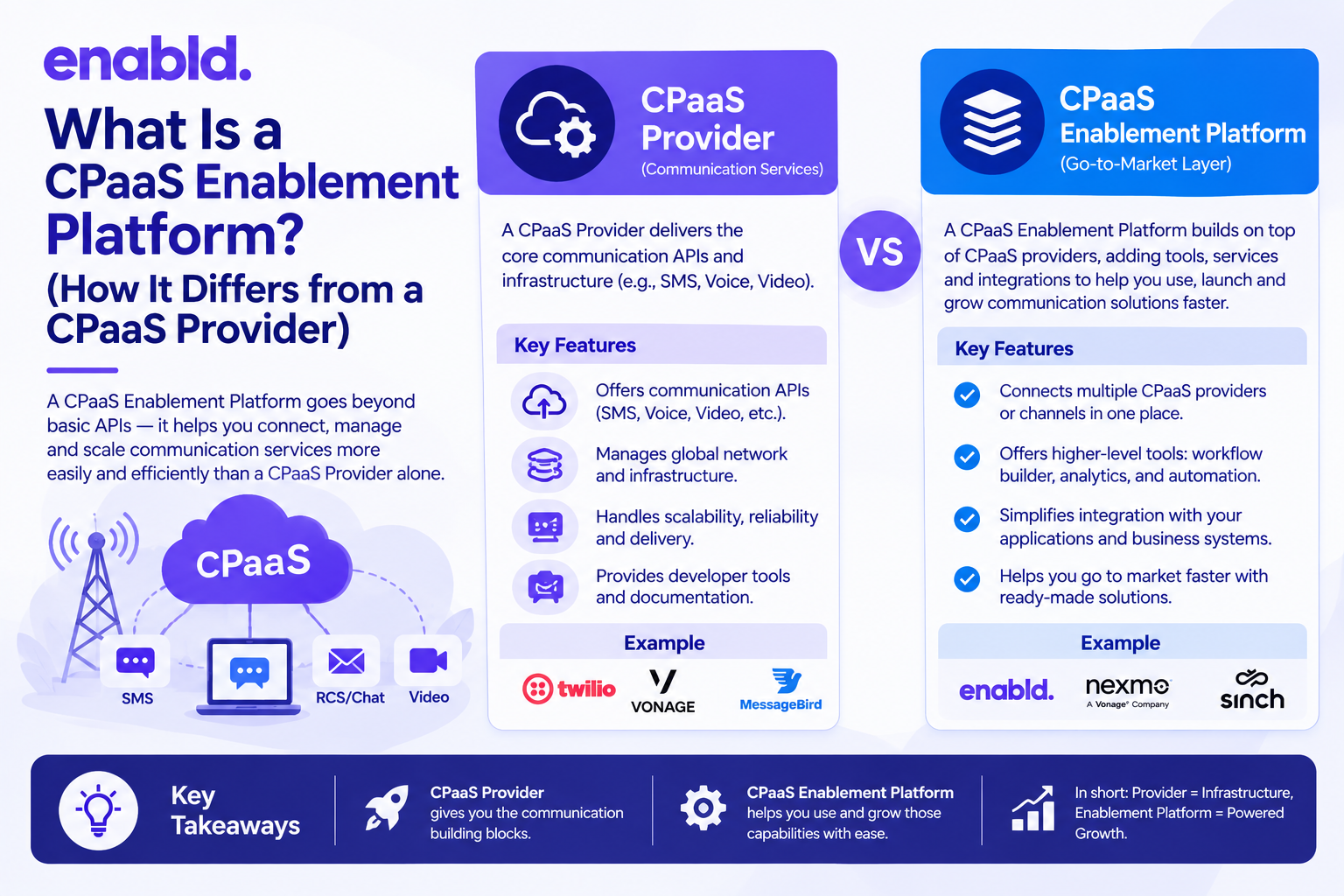
Quick Answer: A CPaaS provider sells communication APIs, such as SMS, voice, and WhatsApp, directly to businesses under its own brand. A CPaaS enablement platform supplies the technology that lets telecom operators and service providers launch their own branded CPaaS business. The provider is the one selling to the end customer. The enablement platform is the infrastructure behind someone else’s brand.
What Is a CPaaS Enablement Platform?
A CPaaS enablement platform is the full technology stack a telco or communication service provider needs to run a CPaaS business: messaging and voice infrastructure, routing, APIs, a customer portal, fraud protection, and billing. The operator licenses it, applies its own brand, and sells to its own customers.
If you need the foundation first, our guide on what CPaaS is covers the basic definition and examples.
What Is Typically Included
- Multichannel messaging and voice, including SMS, WhatsApp, RCS, and voice
- A carrier grade SMS gateway platform for routing and delivery
- Developer APIs and a customer facing portal
- Fraud protection and number validation
- Billing, reporting, and account management tools
- White label branding across the whole experience
Who It Is Built For
Mobile operators, MVNOs, VoIP providers, wholesale carriers, and other communication service providers. These companies already own network relationships and customers. They lack a ready product to sell CPaaS services, and building one takes years.
What Is a CPaaS Provider?
A CPaaS provider operates its own platform and sells it directly. A business signs up, gets API keys, and pays per message or per minute. The provider owns the brand, the pricing, and the customer relationship.
Who Buys From a CPaaS Provider
Enterprises, startups, and developers who want communication features inside their own apps. They are consumers of the platform, not resellers of it.
CPaaS Enablement Platform vs CPaaS Provider
| Factor | CPaaS Provider | CPaaS Enablement Platform |
|---|---|---|
| Who the customer is | Enterprises and developers | Telcos and service providers |
| Who owns the brand | The provider | The operator, white labeled |
| Who owns the end customer | The provider | The operator |
| What is sold | Messaging and voice services | The platform to run a CPaaS business |
| Revenue model | Usage fees from end customers | Licensing or revenue share, with the operator earning usage revenue |
| Infrastructure ownership | Provider runs and maintains it | Vendor maintains the stack, operator runs the business |
| Typical goal | Add communication to a product | Build a new revenue line |
Why the Difference Matters for Telcos
When an operator resells a third party provider’s service, the end customer often ends up with a relationship to that provider, not the operator. The operator earns a thin reseller margin and risks losing the account. An enablement platform reverses that. The operator keeps the customer, the brand, and the recurring messaging revenue. We cover this advantage in more detail in our guide on white label CPaaS for telcos.
Reselling vs Enabling: A Simple Example
Picture a regional mobile operator with thousands of business customers who need OTP and alert messaging.
- Reseller route: the operator signs up with a CPaaS provider and refers customers. The customers integrate with that provider, and the operator earns a small commission.
- Enablement route: the operator licenses an enablement platform, launches its own branded CPaaS, and sells directly. Customers integrate with the operator’s APIs and billing, and the operator keeps the revenue and the relationship.
How a CPaaS Enablement Platform Works
The vendor runs the carrier grade core: signaling, routing, interconnects, and fraud controls. The operator brands the portal and APIs, sets pricing, and adds its own sales and support. Customer traffic flows through the operator’s brand into the shared infrastructure.
Our breakdown of how the CPaaS enablement ecosystem works walks through the layers and where revenue is earned at each one.
Enablement Platform vs Building From Scratch
Some operators consider building their own CPaaS stack. That path means years of engineering, specialized telecom hires, and ongoing maintenance of signaling and routing. For most operators, licensing is faster and carries less risk, a trade off we compare in detail in our guide on white label CPaaS vs building from scratch.
How to Evaluate a CPaaS Enablement Platform
- Does it support the protocols and channels your customers need?
- Is the branding fully white label, including portal, domains, and billing?
- Is fraud protection built in, including grey route and sender ID controls?
- How quickly can you launch, and what support do you get during onboarding?
- Can you scale from enterprise messaging to wholesale traffic on the same platform?
Our vendor selection checklist goes through these criteria in full, and our guide to choosing the best CPaaS enabled service provider is a useful companion.
Where Enabld Fits
Enabld is built around the enablement model. Its CPaaS enablement offering gives telecom operators and service providers the stack to launch their own branded CPaaS platform, rather than reselling a third party product. That keeps customer ownership, brand, and recurring messaging revenue with the operator.
Final Thoughts
A CPaaS provider sells communication services. A CPaaS enablement platform helps you become the provider. For enterprises that just need messaging APIs, a provider is usually the right choice. For telcos, MVNOs, and carriers that want to own the customer relationship and build a new revenue line, enablement is the better fit. If you are weighing the two models, talk to the Enabld team about what launching under your own brand would involve.
Frequently Asked Questions
What is a CPaaS enablement platform?
A CPaaS enablement platform is the technology stack that lets a telecom operator or service provider launch and run its own branded CPaaS business, including messaging, voice, routing, APIs, fraud protection, and billing.
What is the difference between a CPaaS provider and a CPaaS enablement platform?
A CPaaS provider sells communication APIs directly to businesses under its own brand. An enablement platform supplies the infrastructure that lets an operator sell those services under the operator’s own brand.
Who uses a CPaaS enablement platform?
Mobile operators, MVNOs, VoIP providers, wholesale carriers, and other communication service providers that want to sell CPaaS to their own customers rather than resell another company’s product.
Is a CPaaS enablement platform the same as white label CPaaS?
They overlap closely. White label describes the branding model, where the operator’s brand replaces the vendor’s. Enablement describes the broader approach of supplying the full platform and support to run the business.
Why not just resell a CPaaS provider’s service?
Reselling usually leaves the end customer tied to the provider and earns a thin margin. An enablement platform lets the operator own the customer relationship and keep the recurring messaging revenue.
How long does it take to launch with a CPaaS enablement platform?
It depends on scope and onboarding needs, but licensing an existing platform is generally far faster than building one, which typically takes years of engineering.
Do I need a telecom engineering team to use one?
Not for the core infrastructure. The vendor maintains signaling, routing, and fraud controls, while the operator focuses on branding, pricing, sales, and customer support.
Can an enablement platform support both enterprise and wholesale messaging?
Many can. A platform with shared gateway and fraud layers can serve brands sending their own messages and operators trading wholesale traffic from the same foundation.